

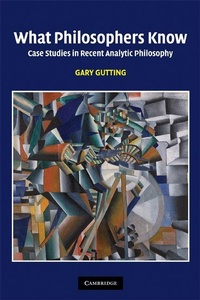
What Philosophers Know
Case Studies in Recent Analytic Philosophy
Published on 2. April 2009
Book
Paperback/Softback
264 pages
978-0-521-67222-1 (ISBN)
Description
Philosophy has never delivered on its promise to settle the great moral and religious questions of human existence, and even most philosophers conclude that it does not offer an established body of disciplinary knowledge. Gary Gutting challenges this view by examining detailed case studies of recent achievements by analytic philosophers such as Quine, Kripke, Gettier, Lewis, Chalmers, Plantinga, Kuhn, Rawls, and Rorty. He shows that these philosophers have indeed produced a substantial body of disciplinary knowledge, but he challenges many common views about what philosophers have achieved. Topics discussed include the role of argument in philosophy, naturalist and experimentalist challenges to the status of philosophical intuitions, the importance of pre-philosophical convictions, Rawls' method of reflective equilibrium, and Rorty's challenge to the idea of objective philosophical truth. The book offers a lucid survey of recent analytic work and presents a new understanding of philosophy as an important source of knowledge.
Reviews / Votes
'This series of case studies of problems and advances in philosophical thinking argues effectively that philosophy can make progress and that philosophers do have distinctive substantial knowledge. The treatment is excellent: sophisticated and of interest to experts while also clearly-written and engaging for readers generally.' David Sosa, University of Texas at AustinMore details
Language
English
Place of publication
Cambridge
United Kingdom
Target group
College/higher education
Product notice
Paperback (trade)
Illustrations
Worked examples or Exercises
Dimensions
Height: 229 mm
Width: 152 mm
Thickness: 16 mm
Weight
434 gr
ISBN-13
978-0-521-67222-1 (9780521672221)
Copyright in bibliographic data and cover images is held by Nielsen Book Services Limited or by the publishers or by their respective licensors: all rights reserved.
Schweitzer Classification
Other editions
Additional editions
E-Book
05/2009
1st Edition
Cambridge University Press
€26.49
Available for download
Book
04/2009
Cambridge University Press
€58.30
Shipment within 15-20 days
Person
Gary Gutting holds the Notre Dame Chair in Philosophy at the University of Notre Dame. His most recent publications include The Cambridge Companion to Foucault, 2nd Edition (2005), Foucault: A Very Short Introduction (2005) and French Philosophy in the Twentieth Century (2001).
Content
Introduction; Part I. How Does That Go? The Limits of Philosophical Argument: 1. Quine's 'Two Dogmas': argument or imagination?; 2. Argument and intuition in Kripke's Naming and Necessity; 3. The rise and fall of counterexamples: Gettier, Goldman, and Lewis; 4. Reflection: pictures, intuitions, and philosophical knowledge; Part II. Arguments and Convictions: 5. Turning the tables: Plantinga and the rise of the philosophy of religion; 6. Materialism and compatibilism: two dogmas of analytic philosophy?; 7. Was there a Kuhnian revolution? Convictions in the philosophy of science; 8. Conviction and argument in Rawls' A Theory of Justice; Part III. Philosophical Truth and Knowledge: 9. Rorty against the world: philosophy, truth, and objectivity; 10. Philosophical knowledge: summary and application; References.