

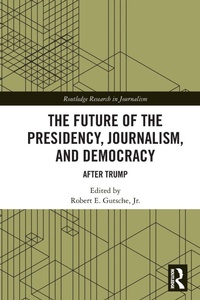
The Future of the Presidency, Journalism, and Democracy
After Trump
1st Edition
Published on 29. January 2024
Book
Paperback/Softback
364 pages
978-1-032-07166-4 (ISBN)
Description
This volume examines the effects of Donald Trump's presidency on journalistic practices, rhetoric, and discourses. Rooted in critical theory and cultural studies, it asks what life may be like without Trump, not only for journalism but also for American society more broadly.
The book places perspectives and tensions around the Trump presidency in one spot, focusing on the underlying ideological forces in tensions around media trust, Trumpism, and the role of journalism in it all. It explores how journalists dealt with racist rhetoric from the White House, relationships between the Office of the President and social media companies, citizens, and journalists themselves, while questioning whether journalism has learned the right lessons for the future. More importantly, chapters on liberal media "bias," the First 100 Days of the Biden Presidency, gender, and race, and how journalists should adopt measures to "reduce harm" hint as to where politics and journalism may go next.
Reshaping the scholarly and public discourse about where we are headed in terms of the presidency and publics, social media, and journalism, this book will be an important resource for scholars and graduate students of journalism, media studies, communication studies, political science, race and ethnic studies and sociology.
The book places perspectives and tensions around the Trump presidency in one spot, focusing on the underlying ideological forces in tensions around media trust, Trumpism, and the role of journalism in it all. It explores how journalists dealt with racist rhetoric from the White House, relationships between the Office of the President and social media companies, citizens, and journalists themselves, while questioning whether journalism has learned the right lessons for the future. More importantly, chapters on liberal media "bias," the First 100 Days of the Biden Presidency, gender, and race, and how journalists should adopt measures to "reduce harm" hint as to where politics and journalism may go next.
Reshaping the scholarly and public discourse about where we are headed in terms of the presidency and publics, social media, and journalism, this book will be an important resource for scholars and graduate students of journalism, media studies, communication studies, political science, race and ethnic studies and sociology.
More details
Series
Language
English
Place of publication
London
United Kingdom
Publishing group
Taylor & Francis Ltd
Target group
College/higher education
Postgraduate and Undergraduate Advanced
Illustrations
1 s/w Abbildung, 1 s/w Zeichnung, 2 s/w Tabellen
2 Tables, black and white; 1 Line drawings, black and white; 1 Illustrations, black and white
Dimensions
Height: 234 mm
Width: 156 mm
Thickness: 21 mm
Weight
582 gr
ISBN-13
978-1-032-07166-4 (9781032071664)
Copyright in bibliographic data and cover images is held by Nielsen Book Services Limited or by the publishers or by their respective licensors: all rights reserved.
Schweitzer Classification
Other editions
Additional editions
E-Book
04/2022
1st Edition
Routledge
€55.49
Available for download
E-Book
04/2022
1st Edition
Routledge
€55.49
Available for download
Book
04/2022
1st Edition
Routledge
€234.10
Shipment within 10-20 days
Person
Robert E. Gutsche, Jr. is Senior Lecturer in Critical Digital Media Practice in the Sociology Department at Lancaster University, U.K. His research focuses on issues of power, geography, political communication, and innovation in digital journalism. He is author, co-author, and editor of several books, including Media Control: News as an Institution of Power and Social Control and The Trump Presidency, Journalism, and Democracy. As Associate Editor and Engagement Editor of Journalism Practice, he produces and hosts "The J Word: A Podcast by Journalism Practice."
Content
Preface; Introduction: How Trump Tested the Press, They Failed, and We Wonder, "Now What?"; Part I Trumpism and Its Attack(s) on Journalism: Fear, Phobias, and Fighting "Bullshit"; 1. The Politics of Fear After Trump; 2. Conservative News Audiences: A Lack of Media Trust and How They Think Journalism Can Improve; 3. Media Distrust and Republican Identity in Trump's Wake; 4. American and Cuban: Cuban-origin Voters' Interpretations of Trump and the "Socialist" Media Frame in the 2020 U.S. Presidential Election; 5. Counter-net of Tomorrow? Right-wing Responses to Deplatforming Trump; Part II Journalism's (Failed) Responses to Trump: From Dis-information to Social Distance; 6. Shifting the Frame: Trump's "Big Lies," Misogyny, and Cultural War Escalation; 7. Donald Trump and the Rhetoric of Dis-information: COVID-19, China, and Coverage of his Comments; 8. The Trump Effect on Rural Communities and their Newspapers: In Retrospect and On Recovery; Part III Journalism & Politics in Opposition to Trumpism: From Bashing to Biden; 9. UnFoxing Market Failure: Complicating Media Matters for America's #UnFoxMyCableBox Campaign for Digital Activism; 10. Trump's News Practices and Discursive Patterns in his New Moment as "Former President"; 11. From Chaos and Cage Fighting to Quiet and Calm: How Trump and Biden Changed Journalism's Relationship with the Presidency; 12. Returning to Neoliberal Normalcy: Analysis of Legacy News Media's Coverage of the Biden Presidency's First Hundred Days; Part IV Journalism's Ideological & Practical Crisis: From Norms to "New, New, New" Journalism?; 13. Media and White Supremacy After 45: Is Anti-racist Journalism Possible?; 14. Not Two Sides of the Same Coin: Avoiding False Equivalencies Teaching Political Journalism After Trump; 15. It's Time Journalists Take "Minimize Harm" Seriously: Lessons from the Trump Era; 16. Trump, COVID-19, and Authoritarian Populism: The Future of U.S. Technopolitics