

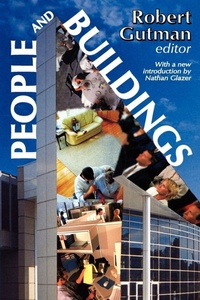
People and Buildings
1st Edition
Published on 30. April 2009
Book
Paperback/Softback
494 pages
978-1-4128-0993-1 (ISBN)
Description
There is at the present time a continuing interest in relating the behavioral sciences to design disciplines. Sociologists and social psychologists have been added to faculties of architecture schools, where they off er seminars and participate as programming specialists and design critics in studio courses. Behavioral scientists in many European countries have collaborated with architects and planners in design work undertaken by governmental ministries, and more recently have been participating in the work of private design fi rms. Similar developments are now common in the United States.
In this fascinating study of the "ecology of buildings," biologists, anthropologists, sociologists, psychologists, and architects analyze the effect of working and living spaces on human behavior. Focusing on such contemporary social problems as the influence of the physical environment on psychological stress, mental illness, family disorganization, urban violence, and delinquency, the contributors show that we must respect the constraints that the environment and the nature of man impose on human adaptability.
The selections in People and Buildings have been written primarily by scientists and designers working in the behavioral mode. The selections within each part have been arranged to provide an ordered argument or exploration of the general topic with which the part as a whole deals. To facilitate the reader's appreciation of the argument, each selection is preceded by a short prefatory statement. In view of the fact that a single article or preface can hardly be representative of the depth of the literature that has developed around an argument, Gutman has included an annotated bibliography, which is keyed to the selections through the use of subheadings. A new introduction by Nathan Glazer has been prepared for this edition.
In this fascinating study of the "ecology of buildings," biologists, anthropologists, sociologists, psychologists, and architects analyze the effect of working and living spaces on human behavior. Focusing on such contemporary social problems as the influence of the physical environment on psychological stress, mental illness, family disorganization, urban violence, and delinquency, the contributors show that we must respect the constraints that the environment and the nature of man impose on human adaptability.
The selections in People and Buildings have been written primarily by scientists and designers working in the behavioral mode. The selections within each part have been arranged to provide an ordered argument or exploration of the general topic with which the part as a whole deals. To facilitate the reader's appreciation of the argument, each selection is preceded by a short prefatory statement. In view of the fact that a single article or preface can hardly be representative of the depth of the literature that has developed around an argument, Gutman has included an annotated bibliography, which is keyed to the selections through the use of subheadings. A new introduction by Nathan Glazer has been prepared for this edition.
More details
Language
English
Place of publication
New York
United States
Publishing group
Taylor & Francis Inc
Target group
Professional and scholarly
Dimensions
Height: 229 mm
Width: 152 mm
Thickness: 26 mm
Weight
709 gr
ISBN-13
978-1-4128-0993-1 (9781412809931)
Copyright in bibliographic data and cover images is held by Nielsen Book Services Limited or by the publishers or by their respective licensors: all rights reserved.
Schweitzer Classification
Other editions
Additional editions
Robert Gutman
People and Buildings
Book
09/2017
1st Edition
Routledge
€209.40
Shipment within 10-20 days
Person
Robert Gutman, until his death in 2007, was a lecturer in social and environmental studies at Princeton University's School of Agriculture. He is the author of Architectural Practice: A Critical View, and The Design of American Housing: A Reappraisal of the Architect's Role among numerous scholarly articles. Nathan Glazer is professor of education, emeritus, at Harvard University. He is known for his writings on ethnicity and race, immigration, urban development, and social policy in the United States. His books include We are all Multiculturalists Now, Beyond The Melting Pot and The Lonely Crowd.
Content
One: Behavioral Constraints on Building Design; 1: The Aesthetics of Function; 2: Physiology and Anatomy of Urination; Design Considerations for Urination; 3: Cultural Variability in Physical Standards; 4: Invasions of Personal Space; 5: Territoriality: A Neglected Sociological Dimension; 6: The Physical Environment: A Problem for a Psychology of Stimulation; Two: Spatial Organization and Social Interaction; 7: The Psycho-Social Influence of Building Environment: Sociometric Findings in Large and Small Office Spaces; 8: Architecture and Group Membership; 9: Silent Assumptions in Social Communication; 10: The Social Psychology of Privacy; 11: Social Theory in Architectural Design; Three: Environmental Influences on Health and Well-Being; 12: The Housing Environment and Family Life; 13: Medical Consequences of Environmental Home Noises; 14: Effects of Esthetic Surroundings: I. Initial Short-Term Effects of Three Esthetic Conditions upon Perceiving "Energy" and "Well-Being" in Faces 1; Effects of Esthetic Surroundings: II. Prolonged and Repeated Experience in a "Beautiful" and an "Ugly" Room 7; 15: Grieving for a Lost Home; 16: Health Consequences of Population Density and Crowding; Four: The Social Meaning of Architecture; 17: Images of Urban Areas: Their Structure and Psychological Foundations; 18: Furniture Arrangement as a Symbol of Judicial Roles; 19: Fear and the House-as-Haven in the Lower Class; 20: Pecuniary Canons of Taste; 21: Place, Symbol, and Utilitarian Function in War Memorials; Five: The Application of Behavioral Science to Design; 22: The Questions Architects Ask 1; 23: The Room, A Student's Personal Environment; 24: Old People's Flatlets at Stevenage; 25: Typology and Design Method; 26: The City as a Mechanism for Sustaining Human Contact