

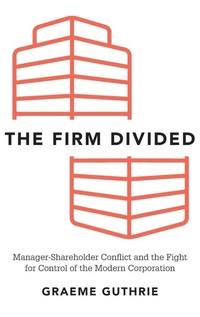
The Firm Divided
Manager-Shareholder Conflict and the Fight for Control of the Modern Corporation
Published on 27. April 2017
Book
Hardback
352 pages
978-0-19-064118-4 (ISBN)
Description
A battle is being fought within corporations. Shareholders want managers to make their shares as valuable as possible, managers want shareholders to leave them alone, and the board of directors is caught in the middle. The Firm Divided shows how strong boards persuade managers to do what's best for shareholders-and why weak boards don't.
Graeme Guthrie blends the stories of particular firms and individuals with the insights of scholarly research, enhancing understanding of how seemingly separate events are consequences of the separation of ownership and control, the ultimate cause of manager-shareholder conflict. Boards of directors can affect the outcome of this conflict by monitoring managers, providing incentives for managers to work in shareholders' best interests, delegating monitoring to outside parties, and influencing the effectiveness of the market for corporate control. How directors do this depends on how they weigh their fiduciary duty to shareholders against the close ties that bind them to senior executives.
The Firm Divided provides conceptual insight, underpinned by research into corporate governance, into board-manager interactions. It shows how tools that can benefit shareholders when used by strong boards can actually harm shareholders when used by weak boards. Guthrie provides a 360 degree view of firms, exploring the ways in which each player pursues their own goals, with examples from a range of firms in diverse industries.
Graeme Guthrie blends the stories of particular firms and individuals with the insights of scholarly research, enhancing understanding of how seemingly separate events are consequences of the separation of ownership and control, the ultimate cause of manager-shareholder conflict. Boards of directors can affect the outcome of this conflict by monitoring managers, providing incentives for managers to work in shareholders' best interests, delegating monitoring to outside parties, and influencing the effectiveness of the market for corporate control. How directors do this depends on how they weigh their fiduciary duty to shareholders against the close ties that bind them to senior executives.
The Firm Divided provides conceptual insight, underpinned by research into corporate governance, into board-manager interactions. It shows how tools that can benefit shareholders when used by strong boards can actually harm shareholders when used by weak boards. Guthrie provides a 360 degree view of firms, exploring the ways in which each player pursues their own goals, with examples from a range of firms in diverse industries.
Reviews / Votes
"This book is an engaging description of the ongoing war between managers and investors. It is a bit unusual in the governance field as it is most enjoyably written, but retains academic credibility. It is an enlightening read.'-- Charles M. Elson, Edgars S. Woolard, Jr. Chair in Corporate Governance and Director, John L. Weinberg Center for Corporate Governance, University of Delaware
"The Firm Divided is a comprehensive investigation of the tensions that arise in the modern shareholder-manager conflict that sheds light on monitoring, selling, motivating, and delegating - in ways that might improve corporate governance. Guthrie clearly understands the details of modern corporate governance and expresses the ideas and narratives in an easy, flowing manner."
-- Frank Partnoy, George E. Barrett Professor of Law and Finance, University of San Diego, and author of WAIT: The Art and Science of Delay
"Guthrie provides a comprehensive but highly accessible analysis of corporate governance at publicly traded firms. The blending of real-world cases with the underlying economic intuition provides unique insights into the peril and promise of modern governance systems. The book will appeal to anyone interested in an entree into the sphere of corporate governance, from the casual reader, to the corporate executive or board member, to graduate students."
-- Stuart Gillan, Associate Professor of Finance, University of Georgia
More details
Language
English
Place of publication
New York
United States
Target group
Professional and scholarly
Dimensions
Height: 240 mm
Width: 161 mm
Thickness: 23 mm
Weight
693 gr
ISBN-13
978-0-19-064118-4 (9780190641184)
Copyright in bibliographic data and cover images is held by Nielsen Book Services Limited or by the publishers or by their respective licensors: all rights reserved.
Schweitzer Classification
Other editions
Additional editions
Graeme Guthrie
The Firm Divided
Manager-Shareholder Conflict and the Fight for Control of the Modern Corporation
E-Book
03/2017
1st Edition
OUP eBook
€39.49
Available for download
Graeme Guthrie
The Firm Divided
Manager-Shareholder Conflict and the Fight for Control of the Modern Corporation
E-Book
03/2017
1st Edition
OUP eBook
€39.49
Available for download
Person
Graeme Guthrie is a professor in the School of Economics and Finance at Victoria University of Wellington, New Zealand. His research has appeared in the top journals on finance and economics, and as a consultant he has provided advice on a wide variety of issues in relation to agriculture, electricity, gas, real estate, and telecommunications, much of it using real options analysis. He is the author of Real Options in Theory and Practice (Oxford University Press).
Content
Contents
Preface v
I Monitor 1
1 A gadfly in the ointment
The consequences of separating ownership and control 3
2 Whose side are you on?
The role of the board of directors 23
3 Overseeing the unseeable
The conflict between managers and shareholders 47
II Motivate 69
4 Narrowing the gap
The incentives generated by managerial ownership 71
5 A primer on pay
Executive compensation and efficient contracting 97
6 Hiding high pay
Executive compensation and managerial power 135
7 Separating the wheat from the chaff
Incentives generated by executives' career concerns 169
IIIDelegate 205
8 With one hand tied behind their back
Delegating monitoring to external capital markets 207
9 No skin in the game
Delegating monitoring to financial analysts 239
10 Crashing the party
Delegating monitoring to large shareholders 275
IVSell 309
11 A new broom
The market for corporate control 311
12 Bypassing the board
Offensive tactics in hostile takeovers 341
13 Fighting back
Defensive tactics in hostile takeovers 377
V The rules of the game matter as well 413
14 Caught in the middle
Reforming the legal and regulatory environment 415
Epilog 431
Acknowledgments 433
Notes 435
Bibliography 509
Preface v
I Monitor 1
1 A gadfly in the ointment
The consequences of separating ownership and control 3
2 Whose side are you on?
The role of the board of directors 23
3 Overseeing the unseeable
The conflict between managers and shareholders 47
II Motivate 69
4 Narrowing the gap
The incentives generated by managerial ownership 71
5 A primer on pay
Executive compensation and efficient contracting 97
6 Hiding high pay
Executive compensation and managerial power 135
7 Separating the wheat from the chaff
Incentives generated by executives' career concerns 169
IIIDelegate 205
8 With one hand tied behind their back
Delegating monitoring to external capital markets 207
9 No skin in the game
Delegating monitoring to financial analysts 239
10 Crashing the party
Delegating monitoring to large shareholders 275
IVSell 309
11 A new broom
The market for corporate control 311
12 Bypassing the board
Offensive tactics in hostile takeovers 341
13 Fighting back
Defensive tactics in hostile takeovers 377
V The rules of the game matter as well 413
14 Caught in the middle
Reforming the legal and regulatory environment 415
Epilog 431
Acknowledgments 433
Notes 435
Bibliography 509