


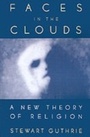
Faces in the Clouds
A New Theory of Religion
Published on 3. August 1995
Book
Paperback/Softback
336 pages
978-0-19-509891-4 (ISBN)
Description
Religion is one of the most universal and most studied human phenomena, yet there exists no widely shared definition of religion. This ambitious study attempts to provide and defend such a definition. Stewart Guthrie argues that religion is best understood as systematic anthropomorphism: the attribution of human characteristics to non-human things or events. Many writers have seen anthropomorphism as a superficial characteristic of religion. For Guthrie, however, it is central; religion consists in seeing the world as human-like.
Guthrie begins by demonstrating that we find plausible, in varying degrees, a continuum of human-like beings including gods, spirits, demons, gremlins, abominable snowmen, Hal the Computer, and Chiquita Banana. We find messages from such beings in phenomena such as weather, earthquakes, plagues, traffic accidents, and the flight of birds. Guthrie argues that this represents an adaptive strategy; we "bet" on the most important possible interpretation of our perceptions of our world - it is better to mistake a boulder for a bear than the other way around. Because of the extreme importance for us of other human beings and their actions, we project human characteristics onto what we see. Guthrie then shows how this explanation can be applied to virtually every belief and experience classified as religious. The result is a provocative and disturbing book that should be both influential and controversial.
Guthrie begins by demonstrating that we find plausible, in varying degrees, a continuum of human-like beings including gods, spirits, demons, gremlins, abominable snowmen, Hal the Computer, and Chiquita Banana. We find messages from such beings in phenomena such as weather, earthquakes, plagues, traffic accidents, and the flight of birds. Guthrie argues that this represents an adaptive strategy; we "bet" on the most important possible interpretation of our perceptions of our world - it is better to mistake a boulder for a bear than the other way around. Because of the extreme importance for us of other human beings and their actions, we project human characteristics onto what we see. Guthrie then shows how this explanation can be applied to virtually every belief and experience classified as religious. The result is a provocative and disturbing book that should be both influential and controversial.
Reviews / Votes
`"Guthrie's argument is interesting, clearly set out, and well taken....The book is lucid, engaging, and very well written."'Wayne Proudfoot, Columbia University `"A scholarly contribution to our understanding of the springs of the immagination."'
James W. Fernandez, University of Chicago `"Witty, elegant, magnificently written....A stunning achievement that will have an enormous impact on religious studies."'
Robert Orsi, Indiana University `Academic and seminary libraries will need this provocative and carefully argued explanation.'
Library Journal 'The subtitle may be deceptive. What is offered here is not so much a "new" account of religion, as something potentially more interesting, namely a sophisticated and clearly argued defence of a classical view, generally neglected in recent studies of religion. Guthrie must be commended for paying attention to recurrent features of religious representations, which are too often neglected or treated as self-evident by cultural anthropologists. Such careful attention to psychological findings and hypotheses is rare, and is the main reason why the book will be indispensable to all students of religion.'
Pascal Boyer, King's College, Cambridge, Method & Theory in the Study of Religion 'fascinating study of anthropomorphism'
Philip J. Stewart, Human Sciences Centre, Oxford, Social Anthropology, Volume 2, Part 2 - 1994 readers will be intrigued by the book's more general thesis that this anthropomorphism is no less pervasive outside the field of art and aesthetic appreciation of nature, and by Guthrie's attempt to explain why this is so ... The explanation is surely plausible, and Guthrie presents it in a lively and lucid fashion. * Ronald W. Hepburn, British Journal of Aesthetics, Vol. 37, No. 3, July '97 *
More details
Language
English
Place of publication
New York
United States
Target group
Professional and scholarly
Illustrations
frontispiece, 32 pp halftone plates, halftone and line drawings
Dimensions
Height: 229 mm
Width: 152 mm
Thickness: 20 mm
Weight
547 gr
ISBN-13
978-0-19-509891-4 (9780195098914)
Copyright in bibliographic data and cover images is held by Nielsen Book Services Limited or by the publishers or by their respective licensors: all rights reserved.
Schweitzer Classification
Other editions
Additional editions
E-Book
04/1995
1st Edition
OUP eBook
€40.99
Available for download
E-Book
04/1995
1st Edition
OUP eBook
€40.99
Available for download
Person
Stewart E. Guthrie is Professor of Anthropology at Fordham University and is the author of A Japanese New Religion.