

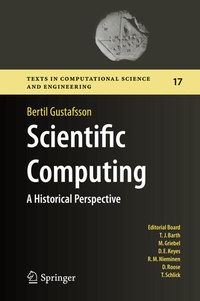
Scientific Computing
A Historical Perspective
Published on 12. October 2018
Book
Hardback
XIII, 262 pages
978-3-319-69846-5 (ISBN)
Description
This book explores the most significant computational methods and the history of their development. It begins with the earliest mathematical / numerical achievements made by the Babylonians and the Greeks, followed by the period beginning in the 16th century. For several centuries the main scientific challenge concerned the mechanics of planetary dynamics, and the book describes the basic numerical methods of that time.
In turn, at the end of the Second World War scientific computing took a giant step forward with the advent of electronic computers, which greatly accelerated the development of numerical methods. As a result, scientific computing became established as a third scientific method in addition to the two traditional branches: theory and experimentation.
The book traces numerical methods' journey back to their origins and to the people who invented them, while also briefly examining the development of electronic computers over the years. Featuring 163 references and more than 100 figures, many of them portraits or photos of key historical figures, the book provides a unique historical perspective on the general field of scientific computing - making it a valuable resource for all students and professionals interested in the history of numerical analysis and computing, and for a broader readership alike.
In turn, at the end of the Second World War scientific computing took a giant step forward with the advent of electronic computers, which greatly accelerated the development of numerical methods. As a result, scientific computing became established as a third scientific method in addition to the two traditional branches: theory and experimentation.
The book traces numerical methods' journey back to their origins and to the people who invented them, while also briefly examining the development of electronic computers over the years. Featuring 163 references and more than 100 figures, many of them portraits or photos of key historical figures, the book provides a unique historical perspective on the general field of scientific computing - making it a valuable resource for all students and professionals interested in the history of numerical analysis and computing, and for a broader readership alike.
Reviews / Votes
"The book evolves like a numerical course where the historical aspects are somewhat expanded at the expense of the numerical issues, but the main formulas and ideas are there. The numerics are however too thin to be useful as lecture notes for a course on numerical analysis. Therefore the book can only serve as additional literature to accompany a true course about the numerics." (Adhemar Bultheel, European Mathematical Society, euro-math-soc.eu, March 20, 2019)More details
Product info
Book
Series
Edition
1st ed. 2018
Language
English
Place of publication
Cham
Switzerland
Publishing group
Springer International Publishing
Target group
Professional and scholarly
Illustrations
53 s/w Abbildungen, 34 farbige Tabellen, 31 farbige Abbildungen
67 schwarz-weiße und 34 farbige Abbildungen, Bibliographie
Dimensions
Height: 241 mm
Width: 160 mm
Thickness: 21 mm
Weight
582 gr
ISBN-13
978-3-319-69846-5 (9783319698465)
DOI
10.1007/978-3-319-69847-2
Schweitzer Classification
Other editions
Additional editions
Book
02/2019
Springer
€50.28
Shipment within 7-9 days
E-Book
10/2018
Springer
€50.28
Available for download
Person
Bertil Gustafsson is Professor at Uppsala University and a member of the Royal Swedish Academy of Sciences. His main area of research is the numerical solution of partial differential equations.
Earlier books:
B. Gustafsson, H.-O. Kreiss, J. Oliger: Time-Dependent Problems and Difference Methods, Whiley (1995).
B. Gustafsson: High Order Difference Methods for Time Dependent PDE. Springer (2008).
B.Gustafsson: Fundamentals of Scientific Computing. Springer (2011).
B. Gustafsson, H.-O. Kreiss, J. Oliger: Time-Dependent Problems and Difference Methods, 2nd ed., Whiley (2013).
Content
1 Scientific Computing, an introduction.- 2 Computation far back in time.- 3 The centuries before computers.- 4 The beginning of the computer era.- 5 The establishment of scientific computing as a new discipline.- 6 Impact of numerical analysis and scientific computing.- References.