

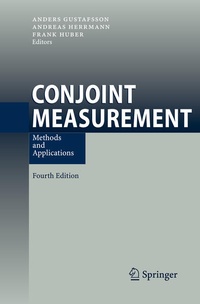
Conjoint Measurement
Methods and Applications
4th Edition
Published on 19. September 2007
Book
Hardback
VII, 373 pages
978-3-540-71403-3 (ISBN)
Description
The book covers all recent developments in Conjoint Analysis. Leading scientists present theory and applications of this technique. In short, the following models, techniques, and applications are discussed: normative models that maximize return, extension of choice-based conjoint simulations, latent class, hierarchical Bayes modelling, new choice simulators, normative models for representing competitive actions and reactions (based on game theory), applications in diverse areas, computation of monetary equivalents of part worth, share/return optimisation (including Pareto frontier analysis), coupling of conjoint analysis with the perceptual and preference mapping of choice simulator results.
Reviews / Votes
From the reviews:"The aim of this book is to reflect the substantial research and recent developments done in Conjoint Analysis. Leading scientists present theory, models and applications to marketing and business research. This book of 21 essays contains latest developments in conjoint modeling, a number of comparisons and cross validation studies." (Edward M. Psyadlo, Zentralblatt MATH, Vol. 1059 (10), 2005)More details
Edition
4th ed. 2007
Language
English
Place of publication
Berlin
Germany
Publishing group
Springer Berlin
Target group
Professional and scholarly
Research
Edition type
Revised edition
Illustrations
VIII, 373 p. 39 illus.
Dimensions
Height: 23.5 cm
Width: 15.5 cm
Weight
733 gr
ISBN-13
978-3-540-71403-3 (9783540714033)
DOI
10.1007/978-3-540-71404-0
Schweitzer Classification
Other editions
Additional editions
Book
10/2010
4th Edition
Springer
€96.29
Shipment within 7-9 days
E-Book
09/2007
4th Edition
Springer
€96.29
Available for download
Previous edition
Book
08/2003
3rd Edition
Springer
€85.59
Article exhausted; check for reprint
Content
Conjoint Analysis as an Instrument of Market Research Practice.- Measurement of Price Effects with Conjoint Analysis: Separating Informational and Allocative Effects of Price.- Market Simulation Using a Probabilistic Ideal Vector Model for Conjoint Data.- A Comparison of Conjoint Measurement with Self-Explicated Approaches.- Non-geometric Plackett-Burman Designs in Conjoint Analysis.- On the Influence of the Evaluation Methods in Conjoint Design - Some Empirical Results.- Evolutionary Conjoint.- The Value of Extent-of-Preference Information in Choice-Based Conjoint Analysis.- A Multi-trait Multi-method Validity Test of Partworth Estimates.- Conjoint Preference Elicitation Methods in the Broader Context of Random Utility Theory Preference Elicitation Methods.- Conjoint Choice Experiments: General Characteristics and Alternative Model Specifications.- Optimization-Based and Machine-Learning Methods for Conjoint Analysis: Estimation and Question Design.- The Combinatorial Structure of Polyhedral Choice Based Conjoint Analysis.- Using Conjoint Choice Experiments to Model Consumer Choices of Product Component Packages.- Latent Class Models for Conjoint Analysis.- A Generalized Normative Segmentation Methodology Employing Conjoint Analysis.- Dealing with Product Similarity in Conjoint Simulations.- Sales Forecasting with Conjoint Analysis by Addressing Its Key Assumptions with Sequential Game Theory and Macro-Flow Modeling.