

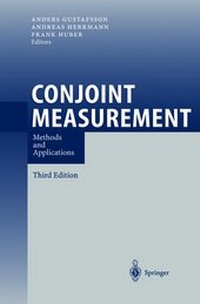
Conjoint Measurement
Methods and Applications
3rd Edition
Published on 8. August 2003
Book
Hardback
VII, 568 pages
978-3-540-40479-8 (ISBN)
Description
by Paul E. Green I am honored and pleased to respond to authors request to write a Fore word for this excellent collection of essays on conjoint analysis and related topics. While a number of survey articles and sporadic book chapters have appeared on the subject, to the best of my knowledge this book represents the first volume of contributed essays on conjoint analysis. The book re flects not only the geographical diversity of its contributors but also the variety and depth of their topics. The development of conjoint analysis and its application to marketing and business research is noteworthy, both in its eclectic roots (psychometrics, statistics, operations research, economics) and the fact that its development reflects the efforts of a large variety of professionals - academics, market ing research consultants, industry practitioners, and software developers. Reasons for the early success and diffusion of conjoint analysis are not hard to find. First, by the early sixties, precursory psychometric techniques (e.g., multidimensional scaling and correspondence analysis, cluster analy sis, and general multivariate techniques) had already shown their value in practical business research and application. Second, conjoint analysis pro vided a new and powerful array of methods for tackling the important problem of representing and predicting buyer preference judgments and choice behavior - clearly a major problem area in marketing.
Reviews / Votes
From the reviews:
"The aim of this book is to reflect the substantial research and recent developments done in Conjoint Analysis. Leading scientists present theory, models and applications to marketing and business research. This book of 21 essays contains latest developments in conjoint modeling, a number of comparisons and cross validation studies." (Edward M. Psyadlo, Zentralblatt MATH, Vol. 1059 (10), 2005)
More details
Edition
3rd ed.
Language
English
Place of publication
Heidelberg
Germany
Publishing group
Springer Berlin
Target group
College/higher education
Professional and scholarly
Edition type
Revised edition
Illustrations
91 s/w Tabellen, 27 s/w Abbildungen
52 illus., 91 tabs.
Dimensions
Height: 23.5 cm
Width: 15.5 cm
Thickness: 33 mm
Weight
984 gr
ISBN-13
978-3-540-40479-8 (9783540404798)
DOI
10.1007/978-3-540-24713-5
Schweitzer Classification
Other editions
New editions
Book
09/2007
4th Edition
Springer
€139.09
Shipment within 7-9 days
Previous edition
Book
08/2001
2nd Edition
Springer
€85.59
Article exhausted; check for reprint
Content
1. Conjoint Analysis as an Instrument of Market Research Practice.- 2. Measurement of Price Effects with Conjoint Analysis: Separating Informational and Allocative Effects of Price.- 3. Developing Business Solutions from Conjoint Analysis.- 4 Measuring the Credibility of Product-Preannouncements with Conjoint Analysis.- 5. Market Simulation Using a Probabilistic Ideal Vector Model for Conjoint Data.- 6. A Comparison of Conjoint Measurement with Self-Explicated Approaches.- 7. New Product Development in the Software Industry: The Role of Conjoint Analysis.- 8. Non-geometric Plackett-Burman Designs in Conjoint Analysis.- 9. On the Influence of the Evaluation Methods in Conjoint Design - Some Empirical Results.- 10. The Value of Extent-of-Preference Information in Choice-based Conjoint Analysis.- 11. Confounding of Effects in Rank-Based Conjoint-Analysis.- 12. A Multi-trait Multi-Method Validity Test of Partworth Estimates.- 13. Adaptive Conjoint Analysis: Understanding the Methodology and Assessing Reliability and Validity.- 14. Conjoint Preference Elicitation Methods in the Broader Context of Random Utility Theory Preference Elicitation Methods.- 15. Conjoint Choice Experiments: General Characteristics and Alternative Model Specifications.- 16 Using Conjoint Choice Experiments to Model Consumer Choices of Product Component Packages.- 17. Latent Class Models for Conjoint Analysis.- 18. A Generalized Normative Segmentation Methodology Employing Conjoint Analysis.- 19. Dealing with Product Similarity in Conjoint Simulations.- 20. Evaluating Brand Value - A Conjoint Measurement Application for the Automotive Industry.- 21 Continuous Conjoint Analysis.- Author Index.