

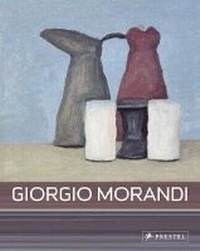
Giorgio Morandi
Paintings, Watercolors, Drawings, Etchings
Published on 1. April 2007
Book
Other book format
168 pages
978-3-7913-3953-5 (ISBN)
Description
Now available in a sleek and nicely priced new format, this book reveals why Giorgio Morandi is considered one of the most accomplished painters of his generation. Throughout his long career, Morandi focused on still lifes and landscapes that captured the simple beauty of light and form. While his contemporaries struggled with the intellectual turmoil and aesthetic experimentation of the twentieth century, Morandi remained faithful to the subjects that fascinated him most: bottles, vases, and jugs, and the view out his studio window in Bologna. This richly illustrated volume brings together more than one hundred of his most important works. Grouped according to technique - paintings, watercolors, drawings, and etchings - each aspect of his work is given thoughtful consideration by scholars who explore Morandi's genius for composition, his serene palette, and his expertise as a draftsman. AUTHOR: Ernst-Gerhard Guse is the director of the Foundation of Weimar Classics Museum. He is the author of numerous books on art. <<< Franz Armin Morat is an author and co-founder of the Morat Institute for Art and Artistic Research. << 178 illustrations
More details
Content
"He lived and worked in a medium-sized sitting room. Its one window faced a small courtyard with trees, which we know from several pictures of his and which he painted surrepticiously, as it were, under cover of this window. Here was his narrow camp bed, an old-fashioned combined desk and drawing table, a kind of bookcase, his easel. And all around, on narrow shelves, was the silent, patiently waiting arsenal of everyday objects, all of which we know from his still lifes: bottles, vessels, vases, pitchers, kitchen utensils, tins." That is how Werner Haftmann described Giorgio Morandi's flat in Via Fondazza in Bologna, where he lived with his three sisters and where, painting with concentration and quiet intensity, he studied the things of everyday life. A few objects sufficed for him to create his own poetic world in the still lifes of his paintings, watercolours, drawings and etchings. He seldom left Bologna, his native city. He never visited Paris, the centre of attraction for artists from all over Europe in the first half of the century. Nevertheless, his art - embedded in the traditions of Italian painting - gained international recognition. Morandi is one of the most highly esteemed outsiders among 20th-century artists. Critics have sometimes called him an eccentric, a monk or a saint, who refused any attempt at being put into service by art, and who created an oeuvre that precluded any metaphysical, religious, or political connections, or anything programmatic whatsoever. "Objective abstraction" is the name of the concept found to label Morandi's art, with its quality of remaining figurative while accenting formal elements. Artists Morandi admired were the Italian painters of the Renaissance, Giotto, Uccello, Masaccio and Piero della Francesca, as well as Chardin, whom he called "the greatest of all still life painters," and Corot, the master of stillness. He owned a drawing by Cezanne and one by Seurat - both artists providing inspiration for his own work.
As limited to a few motifs as Morandi's oeuvre may seem to the superficial viewer, it is rich to anyone who can let themselves be captured by the meditative stillness of these works. They demand quiet contemplation; they teach seeing. "Giorgio Morandi only painted bottles and jugs all his life," wrote the author Horst Bienek, and continued: "In these pictures he said more about life, about real life, than there is in all the colourful pictures around us."
As this century draws to a close, our views of its history are shifting. We still know surprisingly little about the driving historical forces behind the upheavals and revolutions that dramatically changed the face of art. Re-evaluations are in progress. They are apt to show us many an artist and many a work of art in a new light, bringing much to our awareness only just now. Morandi's oeuvre, too, is the object of a more profound process of assimilation that not only sanctions his 'classical' status but also creates opportunities for new approaches. Hence this volume may well be appearing at the right time. First and foremost, it presents a collection of works which is unequaled outside the Morandi Museum, and which concentrated on Morandi at a time when he was still overshadowed by widespread indifference. The collection's focal points create emphases capable of reshaping the image of the artist. They make the significance of Morandi's late works, his astonishing drawing technique and his revival of watercolour stand out more clearly. Our thoughts on the concept of this artist take this especially into account, though without ignoring other points of view.
Morandi's involvement in 20th-century art history is for the most part well known: his life-long preoccupation with Cezanne (figs 1 and 2), his heritage of Italian tradition as summed up in the concept of 'Italianità,' his brief reception of Cubism (fig. 3), his share of 'Pittura metafisica' (fig. 4) and his membership in the circle around the magazine Valori Plastici - these names and key terms indicate the major connections. As much as he may have moved in contemporary circles, however, for many viewers and critics he is a marginal figure of modern art history.
The historical and artistic assessment of Morandi has always depended upon the criteria used to define modernity. In the post-war period a model came into circulation that characterised the history of modern art as a process of increasing reduction. According to its stages, it was possible to gauge whether an artist was up-to-date. This idea possessed a certain plausibility: reduction is indeed fundamentally associated with modern art, and around 1950 abstraction had developed into a (supposedly) 'international language. Striving towards increasing reduction can even be shown to be the hidden or professed ideology of many modern artists and critics up to the beginning of the eighties. Hasn't the post-war development of art obeyed this very logic? Trends and movements from 'Art informel,' 'abolishing the picture frame' and 'departing from the picture' to 'Minimal art' or 'Conceptual art' seemed to brilliantly confirm this historic necessity. Abstraction eventually The second authority concerns his approach to history, particularly the history of art. He understood it as tradition, in which the binding orientations of the past were capable of being renewed over and over again. Decisive for him is not the timid preservation of bygones (which could be characterised as traditionalism), but rather the ability to tap, under completely different historical circumstances, the power of the legacy. The insights and pictorial ideas of classical modern art (Cezanne, Seurat, Monet, etc., up to Corot) and earlier Italian art belong to this kind of tradition. Morandi's colour sense can be said to have an elective affinity to earlier Bolognese painting, formulating similar basic tones, stemming from the very artistic landscape he himself came from. On the strength of the above, we can compare paintings such as those by Domenichino with his from the point of view of tonality.
As limited to a few motifs as Morandi's oeuvre may seem to the superficial viewer, it is rich to anyone who can let themselves be captured by the meditative stillness of these works. They demand quiet contemplation; they teach seeing. "Giorgio Morandi only painted bottles and jugs all his life," wrote the author Horst Bienek, and continued: "In these pictures he said more about life, about real life, than there is in all the colourful pictures around us."
As this century draws to a close, our views of its history are shifting. We still know surprisingly little about the driving historical forces behind the upheavals and revolutions that dramatically changed the face of art. Re-evaluations are in progress. They are apt to show us many an artist and many a work of art in a new light, bringing much to our awareness only just now. Morandi's oeuvre, too, is the object of a more profound process of assimilation that not only sanctions his 'classical' status but also creates opportunities for new approaches. Hence this volume may well be appearing at the right time. First and foremost, it presents a collection of works which is unequaled outside the Morandi Museum, and which concentrated on Morandi at a time when he was still overshadowed by widespread indifference. The collection's focal points create emphases capable of reshaping the image of the artist. They make the significance of Morandi's late works, his astonishing drawing technique and his revival of watercolour stand out more clearly. Our thoughts on the concept of this artist take this especially into account, though without ignoring other points of view.
Morandi's involvement in 20th-century art history is for the most part well known: his life-long preoccupation with Cezanne (figs 1 and 2), his heritage of Italian tradition as summed up in the concept of 'Italianità,' his brief reception of Cubism (fig. 3), his share of 'Pittura metafisica' (fig. 4) and his membership in the circle around the magazine Valori Plastici - these names and key terms indicate the major connections. As much as he may have moved in contemporary circles, however, for many viewers and critics he is a marginal figure of modern art history.
The historical and artistic assessment of Morandi has always depended upon the criteria used to define modernity. In the post-war period a model came into circulation that characterised the history of modern art as a process of increasing reduction. According to its stages, it was possible to gauge whether an artist was up-to-date. This idea possessed a certain plausibility: reduction is indeed fundamentally associated with modern art, and around 1950 abstraction had developed into a (supposedly) 'international language. Striving towards increasing reduction can even be shown to be the hidden or professed ideology of many modern artists and critics up to the beginning of the eighties. Hasn't the post-war development of art obeyed this very logic? Trends and movements from 'Art informel,' 'abolishing the picture frame' and 'departing from the picture' to 'Minimal art' or 'Conceptual art' seemed to brilliantly confirm this historic necessity. Abstraction eventually The second authority concerns his approach to history, particularly the history of art. He understood it as tradition, in which the binding orientations of the past were capable of being renewed over and over again. Decisive for him is not the timid preservation of bygones (which could be characterised as traditionalism), but rather the ability to tap, under completely different historical circumstances, the power of the legacy. The insights and pictorial ideas of classical modern art (Cezanne, Seurat, Monet, etc., up to Corot) and earlier Italian art belong to this kind of tradition. Morandi's colour sense can be said to have an elective affinity to earlier Bolognese painting, formulating similar basic tones, stemming from the very artistic landscape he himself came from. On the strength of the above, we can compare paintings such as those by Domenichino with his from the point of view of tonality.