

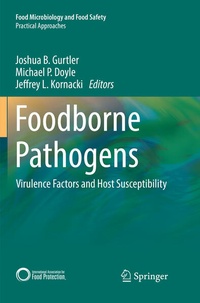
Foodborne Pathogens
Virulence Factors and Host Susceptibility
Published on 12. August 2018
Book
Paperback/Softback
VIII, 652 pages
978-3-319-86014-5 (ISBN)
Description
Foodborne illnesses continue to be a major public health concern. All members of a particular bacterial genera (e.g., Salmonella, Campylobacter) or species (e.g., Listeria monocytogenes, Cronobacter sakazakii) are often treated by public health and regulatory agencies as being equally pathogenic; however, this is not necessarily true and is an overly conservative approach to ensuring the safety of foods. Even within species, virulence factors vary to the point that some isolates may be highly virulent, whereas others may rarely, if ever, cause disease in humans. Hence, many food safety scientists have concluded that a more appropriate characterization of bacterial isolates for public health purposes could be by virotyping, i.e., typing food-associated bacteria on the basis of their virulence factors. The book is divided into two sections. Section I, "Foodborne Pathogens and Virulence Factors," hones in on specific virulence factors of foodborne pathogens and the role they play in regulatory requirements, recalls, and foodborne illness. The oft-held paradigm that all pathogenic strains are equally virulent is untrue. Thus, we will examine variability in virulence between strains such as Listeria, Salmonella, Campylobacter, Cronobacter, etc. This section also examines known factors capable of inducing greater virulence in foodborne pathogens. Section II, "Foodborne Pathogens, Host Susceptibility, and Infectious Dose" , covers the ability of a pathogen to invade a human host based on numerous extraneous factors relative to the host and the environment. Some of these factors include host age, immune status, genetic makeup, infectious dose, food composition and probiotics. Readers of this book will come away with a better understanding of foodborne bacterial pathogen virulence factors and pathogenicity, and host factors that predict the severity of disease in humans.
More details
Series
Edition
Softcover reprint of the original 1st ed. 2017
Language
English
Place of publication
Cham
Switzerland
Publishing group
Springer International Publishing
Target group
Professional and scholarly
Illustrations
13 s/w Abbildungen, 12 farbige Abbildungen
VIII, 652 p. 25 illus., 12 illus. in color.
Dimensions
Height: 235 mm
Width: 155 mm
Thickness: 33 mm
Weight
1123 gr
ISBN-13
978-3-319-86014-5 (9783319860145)
DOI
10.1007/978-3-319-56836-2
Schweitzer Classification
Other editions
Additional editions

Joshua B. Gurtler | Michael P. Doyle | Jeffrey L. Kornacki
Foodborne Pathogens
Virulence Factors and Host Susceptibility
Book
06/2017
Springer
€213.99
Shipment within 10-15 days
Persons
Editors:
Joshua B. GurtlerU. S. Department of AgricultureAgricultural Research ServiceEastern Regional ResearchWyndmoor, PA, USA
Jeffrey L. KornackiKornacki Microbiology Solutions, Inc.Madison, WI, USA
Michael P. DoyleUniversity of GeorgiaCenter of Food SafetyGriffin, GA, USA
Joshua B. GurtlerU. S. Department of AgricultureAgricultural Research ServiceEastern Regional ResearchWyndmoor, PA, USA
Jeffrey L. KornackiKornacki Microbiology Solutions, Inc.Madison, WI, USA
Michael P. DoyleUniversity of GeorgiaCenter of Food SafetyGriffin, GA, USA
Content
1. Advantages of Virulotyping Pathogens Over Traditional Identification and Characterization Methods.- 2. Varying pathogenicity of
Campylobacter jejuni
isolates.- 3. Strain-specific virulence differences in Listeria monocytogenes: current perspectives in addressing an old and vexing issue.- 4. The Listeria monocytogenes triad for success: food matrix, stress response and virulence.- 5. Virulence traits in the Cronobacter genus.- 6. Factors Affecting Variation in Salmonella Virulence.- 7. Shigella: Virulence Factors and Pathogenicity.- 8. Alterations in Shiga toxin-producing E. coli colonization and virulence following dietary modulation and administration of antimicrobials.- 9. The Role of Alternative Sigma Factors in Pathogen Virulence.- 10. The Effects of Food Composition on Foodborne Illness Infectious Dose and Host Susceptibility.- 11. The Rise of Genomics and the Promise of Whole Genome Sequencing for Understanding Microbial Foodborne Pathogens.- 12. Host innate immune factors influencing enterohemorrhagic Escherichia coli pathogenicity.- 13. In Defense of the European 100 CFU of Listeria monocytogenes/g in ready-to-eat foods.- 14. Science to Support the Prevention of Listeria monocytogenes in Ready-to-Eat Foods.- 15. Foodborne Pathogens: Virulence Factors and Host Susceptibility.- 16. Infectious Dose and an Aging Population: Susceptibility of the Aged to Foodborne Pathogens.- 18. Foodborne Pathogens and host predilection.- 19. The influence of virulence factors on dose response of food-borne pathogens.- 20. Clostridium botulinum and the Most Poisonous Poison.- 21. Mitigation of foodborne illnesses by probiotics.