

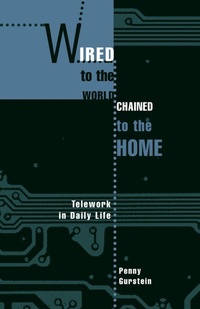
Wired to the World, Chained to the Home
Telework in Daily Life
Published on 1. May 2002
Book
Paperback/Softback
256 pages
978-0-7748-0847-7 (ISBN)
Description
How does working at home change people's activity patterns,social networks, and their living and working spaces? How will itchange the way we plan houses and communities in the future? Willtelecommuting solve many of society's ills, or create newghettos?
Gurstein combines a background in planning, sociology of work, andfeminist theory with qualitative and quantitative data from ten yearsof original research, including in-depth interviews and surveys, tounderstand the socio-spatial impact of home-based work on daily lifepatterns. She analyzes the experiences of teleworkers includingemployees, independent contractors, and self-employed entrepreneurs,and presents significant findings regarding the workload, mobility, thedistinct differences according to work status and gender, and thetensions in trying to combine work and domestic activities in the samesetting. As organizational structures, technology, and familypriorities continue to change, the often overlooked phenomenon ofteleworkers has important implications on everything from employmentpolicies to community planning and design.
Gurstein combines a background in planning, sociology of work, andfeminist theory with qualitative and quantitative data from ten yearsof original research, including in-depth interviews and surveys, tounderstand the socio-spatial impact of home-based work on daily lifepatterns. She analyzes the experiences of teleworkers includingemployees, independent contractors, and self-employed entrepreneurs,and presents significant findings regarding the workload, mobility, thedistinct differences according to work status and gender, and thetensions in trying to combine work and domestic activities in the samesetting. As organizational structures, technology, and familypriorities continue to change, the often overlooked phenomenon ofteleworkers has important implications on everything from employmentpolicies to community planning and design.
More details
Language
English
Place of publication
Vancouver
Canada
Target group
College/higher education
Professional and scholarly
Product notice
Paperback (trade)
Illustrations
21 b&w illustrations, 10 tables
Dimensions
Height: 228 mm
Width: 154 mm
Thickness: 18 mm
Weight
386 gr
ISBN-13
978-0-7748-0847-7 (9780774808477)
Copyright in bibliographic data and cover images is held by Nielsen Book Services Limited or by the publishers or by their respective licensors: all rights reserved.
Schweitzer Classification
Other editions
New editions
Book
09/2001
University of British Columbia Press
€40.50
Article not available at the moment
Person
Penny Gurstein is Associate Professor at the UBCSchool of Community and Regional Planning and Chair of the Centre forHuman Settlements, where she specializes in urban design, participatoryplanning processes, and the sociocultural aspects of communityplanning.
Content
Figures and Tables
Acknowledgments
1. Telework As Restructured Work
2. Profiling the Teleworker: Contextualizing Telework
3. Working at Home and Being at Home: Blurred Boundaries
4. A Strategy of a Dispensable Workforce: Telework in Canada
5. Localizing the Networked Economy: A Vancouver Case Study
6. "I Don't Have a Home, I Live in My Office": Transformations in the Spaces of Daily Life
7. Convergence: Telework As Everywhere, Every Time
8. Conclusion
Appendices
A. Survey Instrument of California Study: Interview Schedule for Study on Social and Environmental Impact of Working at Home
B. Survey Instrument of Canadian Survey: Telework and Home-Based Employment Survey
C. Respondent Occupations, California Study
D. Respondent Occupations, Canadian Survey
Notes
Bibliography
Index
Acknowledgments
1. Telework As Restructured Work
2. Profiling the Teleworker: Contextualizing Telework
3. Working at Home and Being at Home: Blurred Boundaries
4. A Strategy of a Dispensable Workforce: Telework in Canada
5. Localizing the Networked Economy: A Vancouver Case Study
6. "I Don't Have a Home, I Live in My Office": Transformations in the Spaces of Daily Life
7. Convergence: Telework As Everywhere, Every Time
8. Conclusion
Appendices
A. Survey Instrument of California Study: Interview Schedule for Study on Social and Environmental Impact of Working at Home
B. Survey Instrument of Canadian Survey: Telework and Home-Based Employment Survey
C. Respondent Occupations, California Study
D. Respondent Occupations, Canadian Survey
Notes
Bibliography
Index