

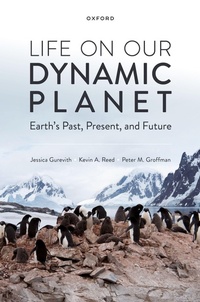
Life on Our Dynamic Planet
Earth's Past, Present, and Future
Will be published approx. on 16. December 2026
Book
Hardback
248 pages
978-0-19-761504-1 (ISBN)
Description
Life on Our Dynamic Planet explores the forces that shape our world-from weather systems and seasons to the intricate dance between climate and life. The engaging text offers readers keys to understanding how the interaction between atmospheric dynamics, the energy we receive from the sun, ocean circulation, and Earth's yearly journey in the solar system create and maintain the environments we inhabit with millions of other living things. Through clear and approachable writing, it bridges the gap between everyday experience and the science behind weather, climate, and the living world.
Answering and explaining everyday questions that pique readers' curiosity, the book explores a wide range of phenomena, from the formation of clouds, snow, and glaciers to the mechanisms behind hurricanes, droughts, and monsoons. It reveals the wonder of color, from rainbows to the patterns in flowers that are invisible to humans but act as bright UV road signs for pollinators. What makes the tropics warm and humid, and why do they have dry and wet seasons? Why do we have deserts, and four seasons in temperate regions? The subtle and dramatic ways living systems both respond to and shape their physical environments are revealed. The text clarifies how the land, ocean, and atmosphere interact with life on Earth and how those relationships shape everything from meerkats and penguins to our own human family.
Richly complemented with photographs and illustrations, Life on Our Dynamic Planet is written for those who are curious about their world and are seeking a deeper understanding of it. It opens a window to greater knowledge and appreciation of the complexity and beauty of the planet we share with all life.
Answering and explaining everyday questions that pique readers' curiosity, the book explores a wide range of phenomena, from the formation of clouds, snow, and glaciers to the mechanisms behind hurricanes, droughts, and monsoons. It reveals the wonder of color, from rainbows to the patterns in flowers that are invisible to humans but act as bright UV road signs for pollinators. What makes the tropics warm and humid, and why do they have dry and wet seasons? Why do we have deserts, and four seasons in temperate regions? The subtle and dramatic ways living systems both respond to and shape their physical environments are revealed. The text clarifies how the land, ocean, and atmosphere interact with life on Earth and how those relationships shape everything from meerkats and penguins to our own human family.
Richly complemented with photographs and illustrations, Life on Our Dynamic Planet is written for those who are curious about their world and are seeking a deeper understanding of it. It opens a window to greater knowledge and appreciation of the complexity and beauty of the planet we share with all life.
More details
Language
English
Place of publication
New York
United States
Dimensions
Height: 235 mm
Width: 156 mm
Weight
3 gr
ISBN-13
978-0-19-761504-1 (9780197615041)
Copyright in bibliographic data and cover images is held by Nielsen Book Services Limited or by the publishers or by their respective licensors: all rights reserved.
Schweitzer Classification
Persons
Jessica Gurevitch is an ecologist whose research spans the life of forests and grasslands, the effects of climate on the living world, and statistical methods in ecology. She has co-authored a major textbook in plant ecology and has written many scientific papers. She was a professor at Stony Brook University for many years before joining Purdue University as a Distinguished Professor. Her work is widely recognized for advancing ecological methodology and interdisciplinary approaches to environmental science.
Peter M. Groffman is a Professor at the City University of New York, affiliated with the Advanced Science Research Center, the Graduate Center's Earth and Environmental Sciences Program, and Brooklyn College. He is also a Senior Research Fellow at the Cary Institute of Ecosystem Studies. His research focuses on climate impacts on ecosystem biogeochemical processes, particularly carbon and nitrogen cycles. Groffman has served as a Convening Lead Author for the 2013 U.S. National
Climate Assessment and contributed to multiple IPCC assessment reports.
Kevin A. Reed is a Professor at the School of Marine and Atmospheric Sciences at Stony Brook University. He leads the Climate Extremes Modeling Group, which investigates how extreme weather events, such as hurricanes, may evolve under climate change. His work supports the development of methodologies to translate cutting-edge climate science into actionable insights for adaptation and policy.
Peter M. Groffman is a Professor at the City University of New York, affiliated with the Advanced Science Research Center, the Graduate Center's Earth and Environmental Sciences Program, and Brooklyn College. He is also a Senior Research Fellow at the Cary Institute of Ecosystem Studies. His research focuses on climate impacts on ecosystem biogeochemical processes, particularly carbon and nitrogen cycles. Groffman has served as a Convening Lead Author for the 2013 U.S. National
Climate Assessment and contributed to multiple IPCC assessment reports.
Kevin A. Reed is a Professor at the School of Marine and Atmospheric Sciences at Stony Brook University. He leads the Climate Extremes Modeling Group, which investigates how extreme weather events, such as hurricanes, may evolve under climate change. His work supports the development of methodologies to translate cutting-edge climate science into actionable insights for adaptation and policy.
Author
Distinguished Professor, Forestry and Natural ResourcesDistinguished Professor, Forestry and Natural Resources, Purdue University
Professor, Advanced Science Research Center at the Graduate CenterProfessor, Advanced Science Research Center at the Graduate Center, City University of New York
Professor, Atmospheric ScienceProfessor, Atmospheric Science, Stony Brook University
Content
- 1: Introduction
- 2: The seasons: Vivaldi didn't know the half of it
- 3: Why the Sahara is dry, the Atacama is really, really dry, and how Columbus got to the Americas
- 4: Why Earth is great for biodiversity and vice-versa
- 5: Soils: The earth beneath your feet and in your bones-don't treat it like dirt
- 6: Deserts, rainforests, and taiga, oh my!
- 7: Carbon: Where life and climate intersect most intimately
- 8: Heat, cold, and water
- 9: Adaptation
- 10: Light and color: Life is not all rainbows (and never mind about unicorns)
- 11: Clouds: Rows and flows of angels' hair
- 12: The mighty polar jet streams and their consequences
- 13: Extreme events: Tropical cyclones, tornados, and droughts
- 14: The long and the short of it: Changes in Earth's climate: Climates from the distant past to the present and future