

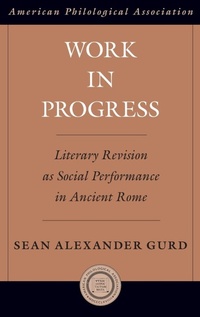
Work in Progress
Literary Revision as Social Performance in Ancient Rome
1st Edition
Published on 5. January 2012
Book
Hardback
192 pages
978-0-19-983751-9 (ISBN)
Description
Work in Progress offers an in-depth study of the role of literary revision in the compositional practices and representational strategies of Roman authors at the end of the republic and the beginning of the principate. It focuses on Cicero, Horace, Quintilian, Martial, and Pliny the Younger, but also offers discussions of Isocrates, Plato, and Hellenistic poetry. The book's central argument is that revision made textuality into a medium of social exchange. Revisions were not always made by authors working alone: often, they were the result of conversations between an author and friends or literary contacts, and these conversations exemplified a commitment to collective debate and active collaboration. Revision was thus much more than an unavoidable element in literary genesis: it was one way in which authorship became a form of social agency. Consequently, when we think about revision for authors of the late republic and early empire we should not think solely of painstaking attendance to craft aimed exclusively at the perfection of a literary work. Nor should we think of the resulting texts as closed and invariant statements sent from an author to his reader. So long as an author was still willing to revise, his text served as a temporary platform around and in which a community came into being.
The theories of revision that guide the author's study come from the new genetic criticism that has been successfully applied, especially in Europe, to modern authors. While many of the tools of analysis applicable to modern authors (author-written manuscripts, corrected proofs, etc.) are not available for ancient authors, Sean Gurd has amassed a surprising number of passages in ancient texts about revision, its importance to the author, and the circle of critics involved in the process of rewriting.
The theories of revision that guide the author's study come from the new genetic criticism that has been successfully applied, especially in Europe, to modern authors. While many of the tools of analysis applicable to modern authors (author-written manuscripts, corrected proofs, etc.) are not available for ancient authors, Sean Gurd has amassed a surprising number of passages in ancient texts about revision, its importance to the author, and the circle of critics involved in the process of rewriting.
Reviews / Votes
Gurd provides a coherent reading of the differing representations of audiences and of writers' responses to those audiences from Cicero to Pliny. * Martin Bloomer, Classical Journal *More details
Series
Language
English
Place of publication
New York
United States
Target group
College/higher education
Scholars and Graduate students in classics, textual studies, comparative literature, and media studies.
Dimensions
Height: 240 mm
Width: 161 mm
Thickness: 14 mm
Weight
440 gr
ISBN-13
978-0-19-983751-9 (9780199837519)
Copyright in bibliographic data and cover images is held by Nielsen Book Services Limited or by the publishers or by their respective licensors: all rights reserved.
Schweitzer Classification
Other editions
Additional editions
E-Book
12/2011
1st Edition
OUP eBook
€56.99
Available for download
E-Book
12/2011
1st Edition
OUP eBook
€42.49
Available for download
Person
Sean Alexander Gurd is Associate Professor of Classics, Modern Languages and Linguistics, Concordia University, Montreal.
Content
1. Introduction ; 2. Isocrates, Plato and Quintilian: Revision, Pedagogy, and the Formation of Selves ; 3. Cicero: Collective Revision and a Literary Republic ; 4. Horace: Revision, Ridicule, and Censorship ; 5. Pliny the Younger: Genetic and General Publics ; Conclusion ; Notes ; Works Cited