

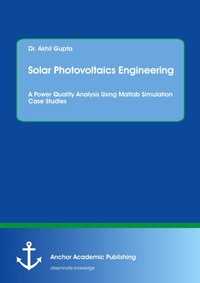
Solar Photovoltaics Engineering. A Power Quality Analysis Using Matlab Simulation Case Studies
1st Edition
Published on 27. October 2016
Book
Paperback/Softback
128 pages
978-3-96067-082-7 (ISBN)
Description
The solar Photovoltaic (PV) technology is gaining significant levels and is going to contribute a major share of total generated electricity in the coming years. PV technology is becoming a promising alternative source for fossil fuels. However, Power Quality (PQ) is the major concern that occurs between the grid and an end user. Any typical electrical distribution system exhibits a passive characteristic with respect to power flows when power flows from a substation to load. However, with inclusion of solar PV generators, this behaviour tends to be changed. The main characteristics related to PQ, such as voltage level, frequency, power factor and Total Harmonic Distortion (THD), may be affected.
This book presents the analysis of PQ with the integration of grid-connected PV systems as distributed generation. The role of Maximum Power Point Tracking (MPPT) technique is investigated through implementing few basic MPPT techniques. Using the Matlab-simulation platform, the analysis of PQ is demonstrated. This analysis is based on real measurements of THD, Voltage levels, Current levels, DC voltage levels, real power and reactive power flows.
More details
Edition
Erstauflage
Language
English
Place of publication
Germany
Product notice
Paperback (trade)
Unsewn / adhesive bound
Illustrations
73 Abb.
Dimensions
Height: 220 mm
Width: 155 mm
Thickness: 9 mm
Weight
216 gr
ISBN-13
978-3-96067-082-7 (9783960670827)
Copyright in bibliographic data and cover images is held by Nielsen Book Services Limited or by the publishers or by their respective licensors: all rights reserved.
Schweitzer Classification
Other editions
Additional editions
Akhil Gupta
Solar Photovoltaics Engineering. A Power Quality Analysis Using Matlab Simulation Case Studies
E-Book
11/2016
1st Edition
Diplomica Verlag
€29.99
Available for download
Person
Dr. Akhil Gupta received B.E. (Electrical Engineering) from Giani Zail Singh-Punjab Technical University Campus, Bathinda (affiliated with Inder Kumar Gujral PTU, Jalandhar, India) in 1999, and M.Tech. in Electrical Engineering from Kay Jay group of Institutes, Patiala (Institute of Advanced Studies In Education, Rajasthan) in 2005. He completed his Ph.D. from the Department of Electrical Engineering, National Institute of Technology,Kurukshetra, Haryana, India, in 2016. He is now Associate Professor in the Department of Electrical Engineering at Chandigarh University, Gharuan, Mohali, Punjab, India. He has around 17 years of experience in academics/industry and has published more than 40 publications in reputed International Journals/Conferences. His areas of research are integration of solar photovoltaic energy systems into electrical power systems, power quality and control.
Content
Text sample:
Chapter 5: Introduction to Power Quality:
5.1 Introduction:
Today, the electric power organizations are no longer being operated as independent ones. They are being part of big network of utility companies, which are connected together in a complex network of grid. Usually, it is required that the heavy electrical machines and switchgear devices in big industry require the electric power which is distortion-less. This quality of electric power shows that the good Power Quality (PQ) is essential for smooth functioning of interconnected electric grid network. This is due to the fact that majority of loads in distribution system are inductive in nature. As per Institution of Electrical and Electronic Engineering (IEEE)-1100, PQ is defined as "the concept of powering and grounding sensitive electronic equipment in a manner that is suitable to the operation of that equipment." The various parameters which affect PQ are found in reference [28] viz. Variations in voltage magnitude, harmonics in AC power waveform, transient and oscillatory nature of current-voltage, with continuity of service.
During these days, all interconnected electric power systems are complex in nature, where majority of power generating stations and load centers are interconnected. Here, the major concerns for customers are reliability of continuity and quality of power supply available at load centers. It is observed that the electric power generation in most of developed countries is reliable, but quality of power supply is not.
The power supply system can only control the quality of the voltage. It has no control over the currents that particular loads might draw. Therefore, the standards in the PQ area are devoted to maintaining the supply voltage within certain limits. Any significant deviation in the waveform magnitude, frequency or purity is a potential PQ problem. Of course, there is always a close relationship between voltage and current in any practical power system. Although the generators may provide a near-perfect sine-wave voltage, the current passing through the impedance of the system can cause a variety of disturbances to the voltage. PQ is often considered as a combination of voltage and current quality. In most of the cases, it is considered that the network operator is responsible for voltage quality at the point of connection while the customers load often influences the current quality at the point of connection.
5.2 Sources of Poor Power Quality:
The main sources of poor PQ in any electric power system are listed below: Adjustable speed drives; Switching power supplies; Arc furnaces; Electronic fluorescent lamp ballasts; A lightning strike; Non-Linear loads; Starting of large induction motors; Power electronic devices.
5.3 Need of Power Quality Concerns:
Since most of the industrial loads are non-linear in nature, there is an increased concern of PQ due to the following reasons: New-generation loads that use microprocessor and microcontroller based controls devices, are more sensitive to PQ variations than that equipment's used in the past.
The demand for improved system efficiency provided growth of some devices like speed motor drives etc. for correcting the power factor and also for reducing losses. This results in increased level of harmonics in power systems.
The client users have an awareness of issues related to PQ. Clients are now becoming knowledgeable about these issues like sag and swell etc. [29].
5.4 Power Quality Problems:
The various PQ problems, which have been found from the literature survey are enumerated below.
Voltage sag: It is also referred to as a voltage dip, Figure 5.1 and is the most common PQ problem in electric power system. It is defined as the decrease of Root Mean Square (rms) voltage from ist maximum value to a value between 0.1 p.u. to 0.9 p.u. It lasts for duration between 0.5 cycles to 1 minute.
Voltage swell: A voltage swell is defined as an increase in rms voltage from ist maximum value to in between 1.1 and 1.8 p.u. at power frequency during 0.5 cycles to 1 minute. As shown in Figure 5.2, a voltage swell likewise sag, is also characterized by ist rms magnitude and duration. The voltage swell is mainly caused by switching-off large capacitors, start and stop of heavy inductive loads.
Voltage interruption: As shown in Figure 5.3, a voltage interruption is defined a the decrease in rms system voltage to less than a small percentage of the nominal rated voltage, which is also called a complete loss of rms voltage. Voltage interruption may arise from faults, component malfunctions, and scheduled downtime. As compared, the short voltage interruptions are typically the result of malfunction of switching device or a deliberate or inadvertent operation of any switchgear, or ist re-closure in response to any fault and system disturbance.
Spikes: A spike is a sudden or short surge in system rms voltage. The voltage spike is caused by lightning, short circuits, power transitions, or power outages in large equipment on the same power line.
Transients: The transients also known as surge, are PQ disturbances that involve high magnitudes of destructive current and voltage or both. In magnitude, it may attain thousands of volts and amperes, even in low voltage type of systems. This type of PQ phenomenon exists in a very short duration from less than 50 nano-seconds to as long as 50 milli-seconds. The various sources of transients are: switching activities, lightning strikes, capacitor bank switching, re-closing operations, tap changing on transformers, loose connections in any distribution system that results arcing, accidents, opening and closing of disconnects of energized lines, human error, animals and bad weather conditions and neighboring facilities.
Impulsive transient: It is a type of transient disturbance which enters into any electric power system. This PQ issue is defined according to IEEE-1159 standard, as a sudden, non-power frequency change in the steady-state condition of rms voltage, current, or both which is unidirectional in polarity-either primarily positive or negative. For example, Lightning. The currents resulted from any lightning strike can reach as high to several thousand amps in about 2-3 µs time duration.
Chapter 5: Introduction to Power Quality:
5.1 Introduction:
Today, the electric power organizations are no longer being operated as independent ones. They are being part of big network of utility companies, which are connected together in a complex network of grid. Usually, it is required that the heavy electrical machines and switchgear devices in big industry require the electric power which is distortion-less. This quality of electric power shows that the good Power Quality (PQ) is essential for smooth functioning of interconnected electric grid network. This is due to the fact that majority of loads in distribution system are inductive in nature. As per Institution of Electrical and Electronic Engineering (IEEE)-1100, PQ is defined as "the concept of powering and grounding sensitive electronic equipment in a manner that is suitable to the operation of that equipment." The various parameters which affect PQ are found in reference [28] viz. Variations in voltage magnitude, harmonics in AC power waveform, transient and oscillatory nature of current-voltage, with continuity of service.
During these days, all interconnected electric power systems are complex in nature, where majority of power generating stations and load centers are interconnected. Here, the major concerns for customers are reliability of continuity and quality of power supply available at load centers. It is observed that the electric power generation in most of developed countries is reliable, but quality of power supply is not.
The power supply system can only control the quality of the voltage. It has no control over the currents that particular loads might draw. Therefore, the standards in the PQ area are devoted to maintaining the supply voltage within certain limits. Any significant deviation in the waveform magnitude, frequency or purity is a potential PQ problem. Of course, there is always a close relationship between voltage and current in any practical power system. Although the generators may provide a near-perfect sine-wave voltage, the current passing through the impedance of the system can cause a variety of disturbances to the voltage. PQ is often considered as a combination of voltage and current quality. In most of the cases, it is considered that the network operator is responsible for voltage quality at the point of connection while the customers load often influences the current quality at the point of connection.
5.2 Sources of Poor Power Quality:
The main sources of poor PQ in any electric power system are listed below: Adjustable speed drives; Switching power supplies; Arc furnaces; Electronic fluorescent lamp ballasts; A lightning strike; Non-Linear loads; Starting of large induction motors; Power electronic devices.
5.3 Need of Power Quality Concerns:
Since most of the industrial loads are non-linear in nature, there is an increased concern of PQ due to the following reasons: New-generation loads that use microprocessor and microcontroller based controls devices, are more sensitive to PQ variations than that equipment's used in the past.
The demand for improved system efficiency provided growth of some devices like speed motor drives etc. for correcting the power factor and also for reducing losses. This results in increased level of harmonics in power systems.
The client users have an awareness of issues related to PQ. Clients are now becoming knowledgeable about these issues like sag and swell etc. [29].
5.4 Power Quality Problems:
The various PQ problems, which have been found from the literature survey are enumerated below.
Voltage sag: It is also referred to as a voltage dip, Figure 5.1 and is the most common PQ problem in electric power system. It is defined as the decrease of Root Mean Square (rms) voltage from ist maximum value to a value between 0.1 p.u. to 0.9 p.u. It lasts for duration between 0.5 cycles to 1 minute.
Voltage swell: A voltage swell is defined as an increase in rms voltage from ist maximum value to in between 1.1 and 1.8 p.u. at power frequency during 0.5 cycles to 1 minute. As shown in Figure 5.2, a voltage swell likewise sag, is also characterized by ist rms magnitude and duration. The voltage swell is mainly caused by switching-off large capacitors, start and stop of heavy inductive loads.
Voltage interruption: As shown in Figure 5.3, a voltage interruption is defined a the decrease in rms system voltage to less than a small percentage of the nominal rated voltage, which is also called a complete loss of rms voltage. Voltage interruption may arise from faults, component malfunctions, and scheduled downtime. As compared, the short voltage interruptions are typically the result of malfunction of switching device or a deliberate or inadvertent operation of any switchgear, or ist re-closure in response to any fault and system disturbance.
Spikes: A spike is a sudden or short surge in system rms voltage. The voltage spike is caused by lightning, short circuits, power transitions, or power outages in large equipment on the same power line.
Transients: The transients also known as surge, are PQ disturbances that involve high magnitudes of destructive current and voltage or both. In magnitude, it may attain thousands of volts and amperes, even in low voltage type of systems. This type of PQ phenomenon exists in a very short duration from less than 50 nano-seconds to as long as 50 milli-seconds. The various sources of transients are: switching activities, lightning strikes, capacitor bank switching, re-closing operations, tap changing on transformers, loose connections in any distribution system that results arcing, accidents, opening and closing of disconnects of energized lines, human error, animals and bad weather conditions and neighboring facilities.
Impulsive transient: It is a type of transient disturbance which enters into any electric power system. This PQ issue is defined according to IEEE-1159 standard, as a sudden, non-power frequency change in the steady-state condition of rms voltage, current, or both which is unidirectional in polarity-either primarily positive or negative. For example, Lightning. The currents resulted from any lightning strike can reach as high to several thousand amps in about 2-3 µs time duration.