

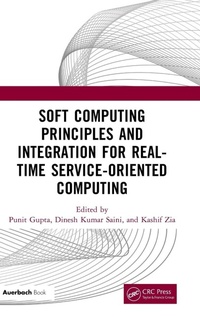
Soft Computing Principles and Integration for Real-Time Service-Oriented Computing
1st Edition
Published on 22. March 2024
Book
Hardback
250 pages
978-1-032-55188-3 (ISBN)
Description
In recent years, soft computing techniques have emerged as a successful tool to understand and analyze the collective behavior of service- oriented computing software. Algorithms and mechanisms of self- organization of complex natural systems have been used to solve problems, particularly in complex systems, which are adaptive, ever- evolving, and distributed in nature across the globe. What fits more perfectly into this scenario other than the rapidly developing era of Fog, IoT, and Edge computing environment? Service- oriented computing can be enhanced with soft computing techniques embedded inside the Cloud, Fog, and IoT systems.
Soft Computing Principles and Integration for Real-Time Service-Oriented Computing explores soft computing techniques that have wide application in interdisciplinary areas. These soft computing techniques provide an optimal solution to the optimization problem using single or multiple objectives.The book focuses on basic design principles and analysis of soft computing techniques. It discusses how soft computing techniques can be used to improve quality-of-service in serviceoriented architectures. The book also covers applications and integration of soft computing techniques with a service- oriented computing paradigm. Highlights of the book include:
A general introduction to soft computing
An extensive literature study of soft computing techniques and emerging trends
Soft computing techniques based on the principles of artificial intelligence, fuzzy logic, and neural networks
The implementation of SOC with a focus on service composition and orchestration, quality of service (QoS) considerations, security and privacy concerns, governance challenges, and the integration of legacy systems
The applications of soft computing in adaptive service composition, intelligent service recommendation, fault detection and diagnosis, SLA management, and security
Such principles underlying SOC as loose coupling, reusability, interoperability, and abstraction
An IoT based framework for real time data collection and analysis using soft computing
Soft Computing Principles and Integration for Real-Time Service-Oriented Computing explores soft computing techniques that have wide application in interdisciplinary areas. These soft computing techniques provide an optimal solution to the optimization problem using single or multiple objectives.The book focuses on basic design principles and analysis of soft computing techniques. It discusses how soft computing techniques can be used to improve quality-of-service in serviceoriented architectures. The book also covers applications and integration of soft computing techniques with a service- oriented computing paradigm. Highlights of the book include:
A general introduction to soft computing
An extensive literature study of soft computing techniques and emerging trends
Soft computing techniques based on the principles of artificial intelligence, fuzzy logic, and neural networks
The implementation of SOC with a focus on service composition and orchestration, quality of service (QoS) considerations, security and privacy concerns, governance challenges, and the integration of legacy systems
The applications of soft computing in adaptive service composition, intelligent service recommendation, fault detection and diagnosis, SLA management, and security
Such principles underlying SOC as loose coupling, reusability, interoperability, and abstraction
An IoT based framework for real time data collection and analysis using soft computing
More details
Language
English
Place of publication
London
United Kingdom
Publishing group
Taylor & Francis Ltd
Target group
College/higher education
Postgraduate
Illustrations
25 s/w Abbildungen, 25 s/w Zeichnungen
25 Line drawings, black and white; 25 Illustrations, black and white
Dimensions
Height: 240 mm
Width: 161 mm
Thickness: 19 mm
Weight
564 gr
ISBN-13
978-1-032-55188-3 (9781032551883)
Copyright in bibliographic data and cover images is held by Nielsen Book Services Limited or by the publishers or by their respective licensors: all rights reserved.
Schweitzer Classification
Other editions
Additional editions
Punit Gupta | Dinesh Kumar Saini | Kashif Zia
Soft Computing Principles and Integration for Real-Time Service-Oriented Computing
Book
07/2025
1st Edition
Auerbach
€91.30
Shipment within 10-20 days
Punit Gupta | Dinesh Kumar Saini | Kashif Zia
Soft Computing Principles and Integration for Real-Time Service-Oriented Computing
E-Book
03/2024
1st Edition
Taylor & Francis
€82.99
Available for download
Punit Gupta | Dinesh Kumar Saini | Kashif Zia
Soft Computing Principles and Integration for Real-Time Service-Oriented Computing
E-Book
03/2024
1st Edition
Taylor & Francis
€82.99
Available for download
Persons
Dr. Punit Gupta is currently working as associate professor in the department of computer and communication engineering at Manipal University Jaipur, India.
Prof. Dinesh Kumar Saini is a full professor at the School of Computing and Information Technology, Manipal University.
Dr. Kashif Zia is currently working as an associate professor in the faculty of computing and information technology, Sohar University, Oman.
Prof. Dinesh Kumar Saini is a full professor at the School of Computing and Information Technology, Manipal University.
Dr. Kashif Zia is currently working as an associate professor in the faculty of computing and information technology, Sohar University, Oman.
Content
1. Soft Computing Techniques Design and Analysis 2. Trends in the Applications of Soft Computing Techniques for IoT 3. Emerging Trends in the Applications of Soft Computing 4. Service-Oriented Computing Challenges, Benefits, and Emerging Trends 5. Role of Soft Computing Methodologies in Service-Oriented Computing 6. Fundamental Principles for Service-Oriented Computing Paradigm 7. Trends and Future Opportunities of Service-Oriented Computing in Social Benefits 8. Cloud Computing Based Service-Oriented Architecture for Agricultural Applications 9. Service-oriented Computing Paradigms: Opportunities and Challenges 10. Smart IoT System for Agricultural Production Improvement and Machine Learning Based Prediction 11. Service Oriented Computing Integration with Soft Computing for Quality-of-Service Improvement 12. Applications of Soft Computing Integration with Cloud, Fog, and IoT 13. Metaheuristic Methodologies in Service-Oriented Computing