

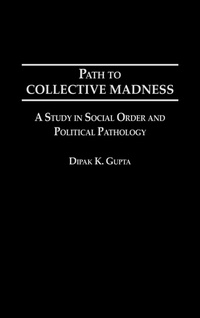
Path to Collective Madness
A Study in Social Order and Political Pathology
Published on 30. June 2001
Book
Hardback
296 pages
978-0-275-97220-2 (ISBN)
Description
Why did the Rwandan genocide take place? How could parents feed their own children drinks laced with poison in Jonestown? As we see many parts of the world being engulfed in fratricidal frenzy, we wonder if it can happen in this country. Gupta examines contemporary cases of genocide and mass murder and seeks to explain why certain societies are more prone to these actions and others are relatively immune.
Gupta sees a dialectical tension between our two identities: the self and the collective. The end of the medieval period was marked by the emergence of individualism in Europe. With time, the march of individualism engulfed the entire Western world and permeated every aspect of its culture, tradition, and academic paradigm. Neoclassical economics is the embodiment of this single-minded pursuit of the rationality of individualism. However, our psychobiological evolution has also imbued us with the irrepressible desire to form groups and to act upon its welfare. The reason for this eternal conflict lies in our own struggle with our two identities. When the pendulum swings to the extreme end of collectivism, genocide and other forms of social abnormalities--collective madness--occur. When we move too far into individualism, people tend to seek something greater beyond selfish pursuits. Through his panoramic view, Gupta provides an explanation for both social order and political pathology that will be of interest to students, scholars, and other researchers involved with ethnic conflict, collective behavior, and conflict resolution.
Gupta sees a dialectical tension between our two identities: the self and the collective. The end of the medieval period was marked by the emergence of individualism in Europe. With time, the march of individualism engulfed the entire Western world and permeated every aspect of its culture, tradition, and academic paradigm. Neoclassical economics is the embodiment of this single-minded pursuit of the rationality of individualism. However, our psychobiological evolution has also imbued us with the irrepressible desire to form groups and to act upon its welfare. The reason for this eternal conflict lies in our own struggle with our two identities. When the pendulum swings to the extreme end of collectivism, genocide and other forms of social abnormalities--collective madness--occur. When we move too far into individualism, people tend to seek something greater beyond selfish pursuits. Through his panoramic view, Gupta provides an explanation for both social order and political pathology that will be of interest to students, scholars, and other researchers involved with ethnic conflict, collective behavior, and conflict resolution.
More details
Language
English
Place of publication
United States
Publishing group
Bloomsbury Publishing Plc
Target group
College/higher education
Professional and scholarly
Dimensions
Height: 235 mm
Width: 157 mm
Thickness: 22 mm
Weight
634 gr
ISBN-13
978-0-275-97220-2 (9780275972202)
Copyright in bibliographic data and cover images is held by Nielsen Book Services Limited or by the publishers or by their respective licensors: all rights reserved.
Schweitzer Classification
Other editions
Additional editions

E-Book
06/2001
1st Edition
Praeger Publishers Inc
€38.99
Available for download
Person
DIPAK K. GUPTA is the Fred J. Hansen Professor of Peace Studies, Professor in the School of Public Administration and Urban Studies, and the Co-Director, Institute for International Security and Conflict Resolution at San Diego State University. He has held numerous visiting fellowships, including at the UN Terrorism Prevention Branch, Office for Drug Control and Crime Prevention. Professor Gupta has published extensively on issues of violence and ethnicity, including The Economics of Political Violence: The Effects of Political Instability on Economic Growth (Praeger, 1990).
Content
Preface Setting the Stage "The Children Didn't Cry": The Face of Insanity At the Great Divide of Identity: Individual and Collective The Confusions of a Singular World View Path to Collective Madness Homo Collectivus: The Social Man The Slippery Slope: From Identity to Madness Madness or Not: The Two Ends of the Spectrum In Search of Policy Where There is a Will The Insane Future: Looking Ahead into the Next Century Bibliography Index