

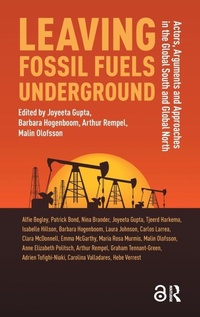
Leaving Fossil Fuels Underground
Actors, Arguments and Approaches in the Global South and Global North
Published on 2. September 2024
Book
Hardback
258 pages
978-90-485-6037-0 (ISBN)
Description
How can the world move away from a century-old global system based on fossil fuels? And how can societies in the Global South and Global North overcome the deeply vested economic, financial and political interests of the fossil fuel system? Despite the alarming effects of climate change and three decades of international climate negotiations, industrialized countries continue to exploit new fossil fuel reserves. Many countries in the Global South follow suit and still engage in large new fossil fuel projects and their related pollution, social injustice and debts. Increasingly, however, social and political actors are mobilising for leaving fossil fuels underground (LFFU).
This book examines the role of key actors, arguments and approaches in promoting the much-needed rapid phase-out of fossil fuels. It addresses the importance of linking effective climate action to socially and ecologically inclusive development. In addition to local resistance, the book explores initiatives for national and international policies and financial mechanisms carried out by actors ranging from social movements to governments and large investors.
In Leaving Fossil Fuels Underground, an international team of well-established scholars and early career researchers takes a global perspective to demonstrate the challenges and possibilities of reaching this goal. They pay special attention to Africa and Latin America, with case studies on South Africa and Ecuador.
This book examines the role of key actors, arguments and approaches in promoting the much-needed rapid phase-out of fossil fuels. It addresses the importance of linking effective climate action to socially and ecologically inclusive development. In addition to local resistance, the book explores initiatives for national and international policies and financial mechanisms carried out by actors ranging from social movements to governments and large investors.
In Leaving Fossil Fuels Underground, an international team of well-established scholars and early career researchers takes a global perspective to demonstrate the challenges and possibilities of reaching this goal. They pay special attention to Africa and Latin America, with case studies on South Africa and Ecuador.
More details
Series
Language
English
Place of publication
Oxford
Netherlands
Target group
Professional and scholarly
Academic
Illustrations
14 Illustrations, color; 12 Illustrations, black and white
Dimensions
Height: 240 mm
Width: 161 mm
Thickness: 19 mm
Weight
558 gr
ISBN-13
978-90-485-6037-0 (9789048560370)
Copyright in bibliographic data and cover images is held by Nielsen Book Services Limited or by the publishers or by their respective licensors: all rights reserved.
Schweitzer Classification
Other editions
Additional editions
Joyeeta Gupta | Barbara Hogenboom | Arthur Rempel
Leaving Fossil Fuels Underground
Actors, Arguments and Approaches in the Global South and Global North
Book
approx. 12/2025
1st Edition
Routledge
€73.31
Not yet published
Joyeeta Gupta | Barbara Hogenboom | Arthur Rempel
Leaving Fossil Fuels Underground
Actors, Arguments and Approaches in the Global South and Global North
E-Book
10/2025
Routledge
€0.00
Available for download
Joyeeta Gupta | Barbara Hogenboom | Arthur Rempel
Leaving Fossil Fuels Underground
Actors, Arguments and Approaches in the Global South and Global North
E-Book
10/2025
Routledge
€0.00
Available for download
Persons
Joyeeta Gupta is Professor of Environment and Development in the Global South at the University of Amsterdam, co-chair of the Earth Commission, Spinoza prize winner and editor-in-chief of International Environmental Agreements: Politics, Law and Economics. Barbara Hogenboom is Professor of Latin American Studies and director of the Centre for Latin American Research and Documentation (CEDLA) at the University of Amsterdam, and editor-in-chief of European Review of Latin American and Caribbean Studies (ERLACS). Arthur Rempel holds a PhD in International Development Studies from the University of Amsterdam, with a research focus on fossil fuel governance and the climate emergency. Malin Olofsson holds a PhD in International Development Studies from the University of Amsterdam, and works as a researcher and knowledge broker in the field of inclusive development.
Content
Foreword and Acknowledgements
1. Leaving Fossil Fuels Underground
2. Analytical framework: Inclusive development, justice and energy transition
3. Socio-environmental movements and LFFU: Framing, tactics and court cases
4. Latin America, Ecuador and social mobilisation for LFFU
5. South Africa and the political economy of fossil fuels: Rationales for LFFU
6. South Africa and social mobilisation for LFFU
7. Finance and LFFU
8. Supply-side and institutional mechanisms for LFFU
9. Phasing out fossil fuels: Synergies and trade-offs
1. Leaving Fossil Fuels Underground
2. Analytical framework: Inclusive development, justice and energy transition
3. Socio-environmental movements and LFFU: Framing, tactics and court cases
4. Latin America, Ecuador and social mobilisation for LFFU
5. South Africa and the political economy of fossil fuels: Rationales for LFFU
6. South Africa and social mobilisation for LFFU
7. Finance and LFFU
8. Supply-side and institutional mechanisms for LFFU
9. Phasing out fossil fuels: Synergies and trade-offs