

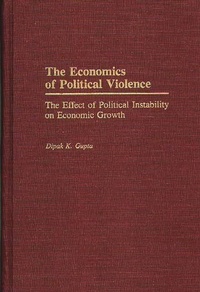
The Economics of Political Violence
The Effect of Political Instability on Economic Growth
Published on 23. April 1990
Book
Hardback
352 pages
978-0-275-93256-5 (ISBN)
Description
In this pioneering volume, Dipak Gupta takes a multidisciplinary approach to the study of the causes of political violence and the effects of political instability. The first work to expand the scope of traditional economic growth models to include political instability, The Economics of Political Violence examines the motivations an individual might have for participating in an act of political violence. Establishing the conceptual linkages between micro-level, individual-based theory and aggregate structural theories of political violence and revolution, Gupta also constructs a composite measure of political instability. He then develops an integrated model of economic growth that incorporates political instability as an endogenous variable. Students and scholars in both political science and economics will find this book enlightening reading.
Gupta begins by examining both the contributions various social science disciplines have made to the study of political violence and the theories of collective behavior that have guided many previous studies. Turning to a focus on the individual, Gupta analyzes the behavioral foundations of rebellion and explores the influences of the environment on individual political action. The next four chapters address political instability from a variety of perspectives. Gupta describes the relationship between political instability and the economy, offers an empirical definition of political instability, discusses structural explanations of political instability, and looks at the effects of political instability on economic growth. In his concluding chapter, Gupta makes policy recommendations based on the foregoing analysis. An appendix presents the index for political instability developed by the author.
Gupta begins by examining both the contributions various social science disciplines have made to the study of political violence and the theories of collective behavior that have guided many previous studies. Turning to a focus on the individual, Gupta analyzes the behavioral foundations of rebellion and explores the influences of the environment on individual political action. The next four chapters address political instability from a variety of perspectives. Gupta describes the relationship between political instability and the economy, offers an empirical definition of political instability, discusses structural explanations of political instability, and looks at the effects of political instability on economic growth. In his concluding chapter, Gupta makes policy recommendations based on the foregoing analysis. An appendix presents the index for political instability developed by the author.
More details
Language
English
Place of publication
United States
Publishing group
Bloomsbury Publishing Plc
Target group
College/higher education
Interest Age: From 7 to 17 years
Dimensions
Height: 240 mm
Width: 161 mm
Thickness: 24 mm
Weight
702 gr
ISBN-13
978-0-275-93256-5 (9780275932565)
Copyright in bibliographic data and cover images is held by Nielsen Book Services Limited or by the publishers or by their respective licensors: all rights reserved.
Schweitzer Classification
Person
DIPAK K. GUPTA is Professor at the School of Public Administration and Urban Studies and Co-Director of the Institute for International Security and Conflict Resolution at San Diego State University. He has published articles in journals such as Journal of Political Economy, Economic Development and Cultural Change, Southern Economic Journal, Urban Affairs Quarterly, Columbia Journal of World Business, Political Psychology, Fordham Urban Law Journal, Public Administration Quarterly, and Journal of Behavioral Economics.
Content
The Scope of the Study The Study of Political Violence in Perspective The Conflict-Free World of Western Social Science: Paradigm Lost Theories of Collective Rebellious Behavior: Paradigm Regained The Individual: The Logic of Participatory Decision The Behavioral Foundations of a Rational Participant in Collective Rebellion The Individual and His Environment The Aggregate: The Impact of Political Instability on the Economy Impact of Political Instability: The Anatomy of an Economic Crisis Political Instability: An Empirical Definition Political Instability: A Structural Explanation Political Instability and Economic Performance: A Political Economic Model of Growth Summary and Policy Implications Appendix: Index for Political Instability Bibliography Index