

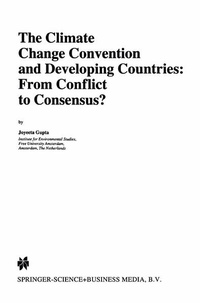
The Climate Change Convention and Developing Countries
From Conflict to Consensus?
Published on 15. December 2010
Book
Paperback/Softback
XII, 249 pages
978-90-481-4858-5 (ISBN)
Description
The climate change problem can only be effectively dealt with if global anthropogenic greenhouse gas (GHG) emissions can be reduced substantially. Since the emission of such gases is closely related to the economic growth of countries, a critical problem to be addressed by the United Nations Framework Convention on Climate Change (FCCC) is: how will the permissible emission levels be shared between industrialised (ICs) and developing countries (DCs)? The thesis of this book is that the long-term effectiveness of the FCCC runs the risk of a horizontal negotiation deadlock between countries and the risk of vertical standstill within countries if there is little domestic support for the domestic implementation of measures being announced in international negotiations. The research question is: Can one observe trends towards horizontal deadlock and vertical standstill and if yes, how can the treaty design be improved so as to avoid such potential future bottlenecks? The research focuses on the perspectives of domestic actors on the climate convention and related issues in four developing countries: India, Indonesia, Kenya and Brazil. The following key findings emerge from the research: 1. Handicapped negotiating power: The common theme of the foreign policy of DCs is that ICs are responsible for the bulk of the GHG emissions and need to take appropriate domestic action.
Reviews / Votes
` ... the book is an interesting study not only on the problem of the climate change, but also on the general issues of international environmental law. [...] The book is well-structured and presented in an orderly manner. It makes for fascinating reading. [...] the book under review constitutes a substantial contribution to the field of international environmental law in general, and merits recommendation to all persons interested in the common problems of environmental protections - lawyers and non-lawyers alike. 'Netherlands International Law Review, XLV:1 (1998)
More details
Series
Edition
1st ed. Softcover of orig. ed. 1997
Language
English
Place of publication
Dordrecht
Netherlands
Target group
Professional and scholarly
Research
Illustrations
XII, 249 p.
Dimensions
Height: 235 mm
Width: 155 mm
Thickness: 15 mm
Weight
411 gr
ISBN-13
978-90-481-4858-5 (9789048148585)
DOI
10.1007/978-94-015-8925-3
Schweitzer Classification
Other editions
Additional editions
E-Book
03/2013
Springer
€96.29
Available for download
Book
04/1997
Kluwer Academic Publishers
€106.99
Shipment within 15-20 days
Content
1. The climate change issue.- 2. A theoretical framework.- 3: The domestic context: Opportunities and risks.- 4: Foreign policy: Between solidarity and fighting inequity.- 5: GEF: The case of power politics.- 6: Joint Implementation: Between hope and angst.- 7: Policy options and related non-decisions.- 8: The politics of climate science.- 9: The science of climate politics.- 10: Towards enhanced cooperation.- References.- List of treaties and other international legal instruments.- Table of cases, UN and other international documents.- Appendix 1: The United Nations Framework Convention on Climate Change.- Appendix 2: List of questions for the interviews.- Appendix 3: Matrix of interviewees.