

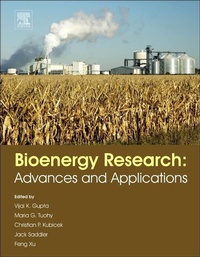
Bioenergy Research: Advances and Applications
Description
All the chapters in the book are derived from international scientific experts in their respective research areas. They provide you with clear and concise information on both standard and more recent bioenergy production methods, including hydrolysis and microbial fermentation. Chapters are also designed to facilitate early stage researchers, and enables you to easily grasp the concepts, methodologies and application of bioenergy technologies. Each chapter in the book describes the merits and drawbacks of each technology as well as its usefulness.
The book provides information on recent approaches to graduates, post-graduates, researchers and practitioners studying and working in field of the bioenergy. It is an invaluable information resource on biomass-based biofuels for fundamental and applied research, catering to researchers in the areas of bio-hydrogen, bioethanol, bio-methane and biorefineries, and the use of microbial processes in the conversion of biomass into biofuels.
More details
Primary Market (Who will buy the book?, eg library:buyer):
Audience (who is the user? eg chemical engineers:user): Students of final year undergraduate andpost-graduate courses and researchers across disciplines and sectors where bioenergy research and experimentation is undertaken.
Secondary Market (Who will buy the book?):
Students of relevant undergraduate and postgraduate courses, as well as researchers across disciplines and industrial scientists in sectors where bioenergy research and experimentation is undertaken.
Audience (who is the user?):
This book will cover all types of existing biofuel production methods in the world and therefore it will be very useful not only to graduate students, experienced researchers but also to bio-entrepreneurs.
Primary Market (who is the user? Who will buy the book? eg chemical engineers:user, library:buyer)
This book will appeal not only to scientists (i.e., biochemists, molecular biologists, chemists, and microbiologists) working to understand the fundamental problems associated with biomass conversion research, but also chemical and mechanical engineers working to design new conversion processes for advanced biofuels.
Secondary Market (who is the user? Who will buy the book?)
A secondary market will be DOE and another government staff looking for expert advice in the field of Biofuels production. For example: See "BP Biofuels chief calls biofuels "the new oil" as Advanced Biofuels Leadership Conference opens," Jim Lane, Biofuels Digest, April 22, 2010. "Oil Companies See Profits in Advanced Biofuels," Emily Gertz, BioFuels Energy, May 28, 2009. "Department of Energy Highlights New Advanced Biofuels Research and Development Facility at Lawrence Berkeley National Laboratory," U.S. DOE EERE, Biomass Program: News, Aug 19, 2011.
Other editions
Additional editions
Persons
Dr. Gupta is the editor-in-chief of the International Journal of Plant Pathology and a regional editorial board member of 8 other respected journals. He is the author of 40 journal articles and 27 book chapters. Gupta has also written and edited books and series from reputed publishers, including CRC Press, Taylor and Francis, USA; Springer, USA; Elsevier, USA; Nova Science Publisher, USA and LAP Lambert Academic Publishing, Germany. Dr. Maria G. Tuohy is the Head of the Molecular Glycobiotechnology Research Group, Department of Biochemistry, School of Natural Sciences, NUI Galway which has developed a strong track record in Glycobiotechnology and Enzyme Biotechnology. She has more than 20 years experience in the molecular biochemistry, genetics and biotechnology of fungi, with a special interest in thermophilic ascomycetes and the characterization of these fungi as cell factories for protein production, including novel thermostable enzymes/enzyme systems. Dr. Tuohy and her group have developed patented enzyme-based technologies for key bioenergy and biorefinery applications from terrestrial and marine biomass and wastes, including 3rd generation feedstocks. The group also investigates the use of enzymes for the recovery and selective modification of high-value biochemicals and plant carbohydrate-derived bioactives ('Glycobioengineering'). Dr. Tuohy is a PI in the Energy Research Centre, NUI, Galway and the recently funded national Bioenergy and Biorefinery Competence Centre, is a member of the EU FP7 Biofuels Platform and a national research PhytoNetwork. Dr. Tuohy has been a visiting researcher in RUGhent, Belgium and BSH Institut fur Holzchemie, Hamburg. Dr. Tuohy is author of ~132 research publications, including refereed publications, book chapters, conference papers poster/short communications. She is also a reviewer for international journals and funding agencies and several books as co-editor- Springer Science Publisher, USA; CRC Press, Taylor and Francis, USA; Germany; Nova Science Publisher, USA and Elsevier Press, USA (under Progress) with Dr. V. K. Gupta Dr. John (Jack) Saddler is the endowed Professor of Forest Products Biotechnology / Bioenergy (originally an NSERC Industry Chair) and also the former Dean, Faculty of Forestry at the University of British Columbia.Professor Saddler has been involved, for more than 30 years, in various national and international organizations that have advanced the global understanding of how woody biomass can be converted to useful fuels and chemicals. He is a Fellow of the Royal Society of Canada, Canada's highest recognition for scientists, and he has received many other awards such as the International Union of Forest Research Organizations (IUFRO's) Scientific Achievement Award, and the Charles D. Scott award for contributions to the field of "Biotechnology for fuels and Chemicals?. Professor Saddler is also the recipient of the prestigious Leadership award, presented from Life Sciences British Columbia for demonstrated leadership in the industry and given to individuals who have assisted in the creation and advancement of the broader life sciences communities over time.Professor Saddler has published more than 380 papers, several books, holds several patents, and is a regular reviewer/advisor for agencies such as the US Dept. of Energy, USDA, NSERC, and World Bank. He has trained more than 70 graduate students, Post Doc.s, and Research Associates, many of whom are now in senior positions in industry, government, and academia around the worldOutside of the research setting, Professor Saddler has not only advised policymakers at the highest levels provincially and nationally, but has been instrumental in the creation of long-standing initiatives to demonstrate, commercialize, and transfer promising biorefining technologies, such as the creation of the BC Bioenergy Network. Nationally, his influence extends to such bodies as the Science Directorate of the Canadian Forest Service, the Canadian Council of Forests Ministers, and the National Roundtable on Economy and Environment. Internationally, he has contributed significantly to the work of the UN's Food and Agricultural Organization (FAO), the US DoE, USDA, the International Energy Agency (IEA) Paris, and he has acted as the Co-Task Leader of the Liquid Biofuels network of IEA Bioenergy organization for many years.B.Sc. (Hons) Microbiology - University of Edinburgh, 1975Ph.D. Micobiology/Biochemistry - University of Glasgow, 1978Former Dean, Faculty of Forestry; Professor of Forest Products Biotechnology / Bioenergy Feng Xu is a Staff Scientist in the Department of Protein Chemistry at Novozymes, Inc. (a subsidiary of Novozymes A/S) where he has been a research scientist since 1992. His research interests are in enzymology and enzyme biotechnology, particularly that related to oxidoreductases (Cu-oxidase, heme peroxidase, flavoenzymes) and carbohydrases (cellulases, amylases). In the past decade, he has focused on enzymatic conversion of biomass and led the effort discovering the function of GH61 enzyme in enzymatic cellulose degradation.Feng Xu is the author or co-author of about 89 articles, reviews, or book chapters, and is the inventor or co-inventor of about 38 issued or pending patents. Feng Xu served at the Editorial Advisory Panel of Biochemical Journal (2005-2013) and is a member of the American Chemical Society.Feng Xu completed his doctorate at the University of Paris VII in France (1982-1986) and his bachelor's degree at Wuhan University in China (1978-1982). He worked as a postgraduate researcher at the University of California at San Diego (1986-1988) and a Research Investigator at the University of Michigan (1988-1992).
Content
2. Bioenergy Research: An Overview on Technological Developments and Bio-Resources
3. Use of Agro-Industrial Residues for Bioethanol Production
4. Recent Advancements in Pretreatment Technologies of Biomass to Produce Bio-energy
5. Bio-fuels and Bioproducts Produced through Microbial Conversion of Biomass
6. Databases for Bioenergy Related Enzymes
7. Isobutanol Production from Bioenergy Crops
8. Lipase Catalyzed Biodiesel Production: Technical Challenges
9. Bio-electrochemistry of Microbial Fuel Cells and their Potential Applications in Bio-energy
10. Anaerobic Digestion of Bio-waste to Bioenergy
11. Second-Generation Bio-energy from High-Efficiency Algal-Derived Bio-crude
12. Microalgae: The Tiny Microbes with a Big Impact
13. Biobased Fats (Lipids) and Oils from Biomass as a Source of Bioenergy
14. Use of Volatile Solids from Biomass for Energy Production
15. Biorefinery Systems: An Overview
16. Catalytic Thermochemical Processes for Biomass Conversion to Biofuels and Chemicals
17. Applications of Heterogeneous Catalysts in the Production of Biodiesel by Esterification and Transesterification
18. Lignocellulose-based Chemical Products
19. Industrial Lignin Production and Applications
20. Amino-based Products from Biomass and Microbial Amino Acid Production
21. Production of Phytochemicals, Dyes, and Pigments as Co/By-products in Bioenergy Processes
22. Recent Developments on Microalgae for Bio-hydrogen Photoproduction and its Importance in CO2 Reduction
23. Engineered Cyanobateria: Research & Application in Bioenergy
24. Sustainable Farming of Bioenergy Crops
25. Bioenergy Technology for Integrated Production of Poly 3-Hydroxybutyrate
26. Advances and Innovations in Biochar Production and Utilisation for Improving Environmental Quality
27. Biochar Processing for Sustainable Development in Current and Future Bioenergy Research
28. Development of Thermo-chemical & Bio-chemical Technologies for Biorefineries