

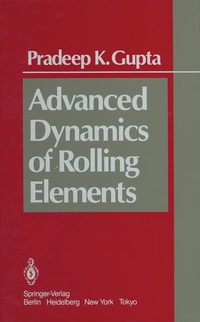
Advanced Dynamics of Rolling Elements
Published on 8. October 2011
Book
Paperback/Softback
XIV, 296 pages
978-1-4612-9767-3 (ISBN)
Description
In any rotating machinery system, the bearing has traditionally been a crit ical member of the entire system, since it is the component that permits the relative motion between the stationary and moving parts. Depending on the application, a number of different bearing types have been used, such as oil-lubricated hydrodynamic bearings, gas bearings, magnetic suspensions, rolling element bearings, etc. Hydrodynamic bearings can provide any desired load support, but they are limited in stiffness and the associated power loss may be quite large. Gas bearings are used for high-precision applications where the supported loads are relatively light, bearing power losses are very low, and the rotating speeds generally high. For super precision components where no frictional dissipation or bearing power loss can be tolerated, magnetic suspensions are employed; again, the load support requirements are very low. Rolling element bearings have been widely used for those applications that require greater bearing versatility, due to the requirements for high-load and high-stiffness characteristics, while allowing moderate power loss and permitting variable speeds. A study of the dynamic interaction of rolling elements is, therefore, the subject of this text. Texts covering the analysis and design methodology of rolling elements are very limited. Notable works include Analysis of Stresses and Deflections (Jones, 1946, Vols. I and II), Ball and Roller Bearings, Their Theory, Design and Application (Eschmann, Hasbargen, and Weigand, 1958), Ball and Roller Bearing Engineering (Palmgren, 1959, 3rd ed. ), Advanced Bearing Technology (Bisson and Anderson, 1965), and Rolling Bearing Analysis (Harris, 1966).
More details
Edition
Softcover reprint of the original 1st ed. 1984
Language
English
Place of publication
New York
United States
Target group
Professional and scholarly
Research
Illustrations
XIV, 296 p.
Dimensions
Height: 235 mm
Width: 155 mm
Thickness: 17 mm
Weight
476 gr
ISBN-13
978-1-4612-9767-3 (9781461297673)
DOI
10.1007/978-1-4612-5276-4
Schweitzer Classification
Other editions
Additional editions
P. K. Gupta
Advanced Dynamics of Rolling Elements
Book
10/1984
Springer
€89.13
Article exhausted; check different version
Person
Dr. P.K. Gupta, a Post-Doctorate from the University of Pretoria, South Africa (2015-16) in the Department of Electrical, Electronic and Computer Engineering, is currently a Assistant Professor (Sr. Grade) at Jaypee University of Information Technology (JUIT), Himachal Pradesh (HP), India. He has more than 15 years of national and international experience in the Information Technology (IT) industry and academics. He has authored a number of research papers in peer-reviewed international journals and conferences. Further, Dr. Gupta is an Associate Editor of IEEE Access. His research areas include Internet-of-Things, Cloud Computing, Sustainable Computing, and Storage networks.
Prof. Vipin Tyagi, Fellow-IETE, is currently working as Professor in Computer Science and Engineering department and Head - Faculty of Mathematical Sciences at Jaypee University of Engineering and Technology, Madhya Pradesh (MP), India. He is Vice President of the Computer Society ofIndia, Region 3, and is associated with the Society's Special Interest Group on Cyber Forensics. He was President of the Engineering Sciences Section of the Indian Science Congress Association for the term 2010-11. He has published a number of papers in various reputed journals and advanced research series, and has attended several national and international conferences. He is an expert in the area of Cyber Security, Cyber Forensics and Image Processing.
Prof. Sanjay Kumar Singh is an Associate Professor in the Department of Computer Science and Engineering, Indian Institute of Technology (IIT), Uttar Pradesh (UP), India. He has been certified as a Novell Engineer (CNE) and Novell Administrator (CNA) by Novell Netware, USA. He is a member of LIMSTE, the IEEE, International Association of Engineers and the ISCE. He has over 70 national and international journal publications, book chapters and conference papers to his credit. His research areas include Biometrics,Computer Vision, Image Processing, Video Processing, Pattern Recognition and Artificial Intelligence.
Content
1. Introduction.- 1.1 Rolling Bearing Elements and Basic Interactions.- 1.2 Types of Analytical Models.- 1.3 Nomenclature.- 1.4 Summary.- 2. Equations of Motion and Coordinate Transformations.- 2.1 Coordinate Frames and Transformations.- 2.2 Equations of Motion.- 2.3 Moving Coordinate Frames.- 2.4 General Motion Simulation.- 2.5 Summary.- 3. Geometric Interactions in Rolling Bearings.- 3.1 Rolling Element/Race Interactions.- 3.2 Rolling Element/Cage Interactions.- 3.3 Race/Cage Interactions.- 3.4 Interactions Between Rolling Elements.- 3.5 External System Interactions and Constraints.- 3.6 Summary.- 4. Elastohydrodynamic Lubrication.- 4.1 General Consideration in Lubricant Traction Modeling.- 4.2 An E1astohydrodynamic Traction Model.- 4.3 Traction Behavior of Some Lubricants.- 4.4 Summary.- 5. Churning and Drag Losses.- 5.l Estimation of Drag Forces.- 5.2 Estimation of Churning Moments.- 5.3 Effective Lubricant Viscosity and Density.- 5.4 Summary.- 6. Numerical Integration of the Equations of Motion.- 6.1 Dimensional Organization.- 6.2 Explicit Algorithms.- 6.3 Implicit Algorithms.- 6.4 Selection of a Method.- 6.5 External Constraints.- 6.6 Summary.- 7. The Computer Program ADORE.- 7.1 Program Overview.- 7.2 Structure of ADORE.- 7.3 ADORE Capabilities.- 7.4 Input/Output Data.- 7.5 Computer Resource Requirement.- 7.6 Summary.- 8. Some Dynamic Performance Simulations.- 8.1 Numerical Considerations.- 8.2 Vibrational Characteristics.- 8.3 General Ball Motion and Skid.- 8.4 Cage Stability.- 8.5 Roller and Cage Motion in Cylindrical Roller Bearings.- 8.6 Summary.- 9. Experimental Validation of ADORE.- 9.1 Ball Motion and Skid.- 9.2 Cage Motion.- 9.3 Summary.- 10. Guidelines for Rolling Bearing Design.- 10.1 System Overview.- 10.2 Rotor-Bearing System Interaction.- 10.3 ADORE:A Design and Performance Diagnosis Tool.- 10.4 Summary.- Appendix I: Hertz Point-Contact Solutions.- Appendix II: Shrink Fit and Thermal Expansion of Races.- Appendix III: Fatigue Life Computation.- Appendix IV: Source Listing of ADORE.- Appendix V: Typical Example.- References.- Author Index.