

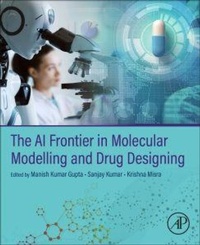
The AI Frontier in Molecular Modelling and Drug Designing
Will be published approx. on 1. May 2026
Book
Paperback/Softback
220 pages
978-0-443-40338-5 (ISBN)
Description
The AI Frontier in Molecular Modeling and Drug Designing aims to provide a comprehensive guide on the application of AI concepts in drug designing, discovery, and molecular modeling. It delves into machine and deep learning techniques that predict structural properties of molecules, identify druggable pockets, and assess physicochemical properties of targets. The book also explores current and potential computational resources to tackle complex biological challenges. Each chapter is enriched with relevant examples, text boxes, and case studies that illustrate the practical application of AI techniques, their outcomes, and the challenges faced during implementation. This resource is tailored for researchers, students, and professionals in both academia and industry, providing them with the latest methodologies, advancements in technology, and practical insights into AI-driven drug research, structural biology, computational biology, and translational science.
More details
Language
English
Place of publication
San Diego
United States
Publishing group
Elsevier Science Publishing Co Inc
Target group
Professional and scholarly
Product notice
Paperback (trade)
Unsewn / adhesive bound
Dimensions
Height: 235 mm
Width: 191 mm
Weight
450 gr
ISBN-13
978-0-443-40338-5 (9780443403385)
Copyright in bibliographic data and cover images is held by Nielsen Book Services Limited or by the publishers or by their respective licensors: all rights reserved.
Schweitzer Classification
Persons
Dr. Manish Kumar Gupta is Associate Professor in the Department of Biotechnology at Uttar Pradesh. Dr. Gupta has published more than twelve research papers, published one edited book, five book chapters and given more than twenty-seven invited lectures. Dr. Gupta is life member of various academic societies such as Federation of Asian Biotechnology Association (FABA), Association of Microbiologist of India (AMI), Society of Environmental Sustainability (Founder member) and Indian Science Congress Association (ISCA). Dr. Gupta's focus of the research work is to extract the key regulatory elements participating in the disease pathways through integrative biology approach. To investigate those, biological tools & databases with big scale data sets generated by state-of-the-art high-throughput technology integrated for computational analysis. Sanjay Kumar is Associate Professor of Bioengineering, Chair of the UC Berkeley & UCSF Graduate Program at UC Berkeley, Faculty Scientist at Lawrence Berkeley National Laboratory and Faculty Director of the UC Berkeley & UCSF Master of Translational Medicine Program. He earned a B.S. in chemical engineering (1996) from the University of Minnesota and then moved on to Johns Hopkins University, where he earned an M.D. (2003) and a Ph.D. in molecular biophysics (2003). Since joining the UC Berkeley faculty in 2005, Dr. Kumar has been fortunate to receive a number of honors, including the Presidential Early Career Award for Scientists and Engineers (PECASE), The NIH Director's New Innovator Award, The Arnold and Mabel Beckman Young Investigator Award, the NSF CAREER Award, the Hellman Family Faculty Fund Award, and the Stem Cells Young Investigator Award.
Prof (Mrs) Krishna Misra superannuated as Professor of Chemistry at University of Allahabad ,where she occupied the chair of head, Biochemistry department and was first coordinator of the Centre for Biotechnology. She is at present honorary professor and had been Co-ordinator of Indo-Russian Center for biotechnology, IIIT-Allahabad and honorary Professor at CBMR, SGPGI campus, Lucknow. She is senior scientist , fellow of National Academy of Sciences India. . She is chairperson of STEMM program of DST. She had been expert in many selection committees including UPSC, SGPGI and KGMU, Lucknow and is also on editorial boards of many national and international journals. She is member advisory board of department of Molecular Medicine, SGPGIMS , Lucknow, had been member of task force of DBT, Delhi.
Prof (Mrs) Krishna Misra superannuated as Professor of Chemistry at University of Allahabad ,where she occupied the chair of head, Biochemistry department and was first coordinator of the Centre for Biotechnology. She is at present honorary professor and had been Co-ordinator of Indo-Russian Center for biotechnology, IIIT-Allahabad and honorary Professor at CBMR, SGPGI campus, Lucknow. She is senior scientist , fellow of National Academy of Sciences India. . She is chairperson of STEMM program of DST. She had been expert in many selection committees including UPSC, SGPGI and KGMU, Lucknow and is also on editorial boards of many national and international journals. She is member advisory board of department of Molecular Medicine, SGPGIMS , Lucknow, had been member of task force of DBT, Delhi.
Content
1. Use of AI for computer aided drug designing
2. Use of AI for analysis of biological and chemical databases for drug discovery
3. Deep learning for protein folding
4. Drug target identification and validation using AI
5. AI based target-ligand binding methods
6. Generative models for molecule generation
7. AI enabled virtual screening
8. Natural Language Processing (NLP) for drug discovery
9. Role of AI in predicting drug efficacy and toxicity
10. AI enabled tools used in drug designing
11. AI driven clinical trials
12. AI, network biology and multiomics data in drug discovery
13. AI driven personalized medicine and biomarker discovery
14. AI powered precision oncology
15. AI emergence in nanomedicine, pharmacogenomics and biotechnology
16. AI in medical image processing and translational science
2. Use of AI for analysis of biological and chemical databases for drug discovery
3. Deep learning for protein folding
4. Drug target identification and validation using AI
5. AI based target-ligand binding methods
6. Generative models for molecule generation
7. AI enabled virtual screening
8. Natural Language Processing (NLP) for drug discovery
9. Role of AI in predicting drug efficacy and toxicity
10. AI enabled tools used in drug designing
11. AI driven clinical trials
12. AI, network biology and multiomics data in drug discovery
13. AI driven personalized medicine and biomarker discovery
14. AI powered precision oncology
15. AI emergence in nanomedicine, pharmacogenomics and biotechnology
16. AI in medical image processing and translational science