

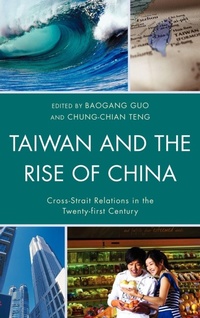
Taiwan and the Rise of China
Cross-Strait Relations in the Twenty-first Century
Published on 9. August 2012
Book
Hardback
186 pages
978-0-7391-6692-5 (ISBN)
Description
Coincided with China's economic reform and her rapid ascendance to a great power status, the relations between Taiwan and Chinese mainland since 1979 have also seen some encouraging development. However, the rapprochement is nothing but a smooth ride. Taiwan Strait has always been full of tensions and hostility since the communist took over the mainland over sixty years ago.The periodical tensions in the cross-Strait relations have from time to time threatened to derail the peace talks between the two sides, and poised to jeopardize the region's peace and stability.
This book studies the past, present and future relations across the Taiwan Strait and examines many important questions such as internal and external factors contributing to the Taiwan's shift in her mainland policy, impacts of Taiwan democratization on the cross-Strait relations, the development of Taiwanese identity and rise of Taiwanese nationalism, the possibility of expanding Taiwan's international space under the shadow of China, the prospect of reunification between Taiwan and China, and the roles of the third parties, such as U.S., NGOs and Taiwan businessmen, in the changing relationship between the two sides.
Taiwan and the Rise of China will certainly help readers, especially those who lack of historical perspective of the political division of the two political adversaries, to grasp the complexity and nature of the cross-Strait relations and faster a real understanding of the significance of this relationship to peace in the region as well as the world in the 21st century.
This book studies the past, present and future relations across the Taiwan Strait and examines many important questions such as internal and external factors contributing to the Taiwan's shift in her mainland policy, impacts of Taiwan democratization on the cross-Strait relations, the development of Taiwanese identity and rise of Taiwanese nationalism, the possibility of expanding Taiwan's international space under the shadow of China, the prospect of reunification between Taiwan and China, and the roles of the third parties, such as U.S., NGOs and Taiwan businessmen, in the changing relationship between the two sides.
Taiwan and the Rise of China will certainly help readers, especially those who lack of historical perspective of the political division of the two political adversaries, to grasp the complexity and nature of the cross-Strait relations and faster a real understanding of the significance of this relationship to peace in the region as well as the world in the 21st century.
Reviews / Votes
One of the strengths of the book is its methodological pluralism. . . .Interesting insights are contained throughout the book. * Journal of Chinese Political Science * Readers have good reasons to welcome this new volume that is put together by two accomplished experts involving a group of distinguished and active scholars whose contributions are uniquely significant to the field. -- Xiaobo Hu, professor of political science and director of Center for China Studies, Clemson UniversityMore details
Series
Language
English
Place of publication
United States
Publishing group
Bloomsbury Publishing Plc
Target group
Professional and scholarly
Dimensions
Height: 235 mm
Width: 157 mm
Thickness: 15 mm
Weight
429 gr
ISBN-13
978-0-7391-6692-5 (9780739166925)
Copyright in bibliographic data and cover images is held by Nielsen Book Services Limited or by the publishers or by their respective licensors: all rights reserved.
Schweitzer Classification
Other editions
Additional editions
Baogang Guo | Chung-Chian Teng
Taiwan and the Rise of China
Cross-Strait Relations in the Twenty-First Century
E-Book
08/2012
1st Edition
Lexington Books
€107.99
Available for download
Baogang Guo | Chung-Chian Teng
Taiwan and the Rise of China
Cross-Strait Relations in the Twenty-First Century
E-Book
08/2012
1st Edition
Lexington Books
€107.99
Available for download
Persons
Baogang Guo is Professor of Political Science and Director of Center for International Education at Dalton State College. He served as President of the Association of Chinese Political Studies between 2008 and 2010. He is also a research associate in ChinaResearchCenter in Metro Atlanta, GA. His research interests include comparative public policy, political culture and political legitimacy, and Chinese and Asia politics. He is author of China's Quest for Political Legitimacy (Lexington, 2010) and coeditor of nine books. His recent publications appeared on Asian Survey, Journal of Chinese Political Science, Modern China Studies, Journal of Comparative Asian Development, Twenty-first Century, and American Journal of China Studies.
Chung-chian Teng is Professor of Diplomacy and Dean of the College of International Affairs, National Chengchi University (Taipei, Taiwan). He received his M. A. and Ph. D. of Political Science at Northwestern University in 1981 and 1985 respectively. He is member of Board of Directors of Chinese Political Science Association as well as Association of International Relations of Republic of China. In addition, he serves on Editorial Boards in three prominent academic journals in Taiwan, Journal of International Relations, Review of Global Politics as well as Taiwan Political Science Review. He is specialized in international political economy, international negotiation and foreign policy. He has written and edited numerous books and articles and his most recent publications are "Democracy, Development, and China's Acquisition of Oil in Third World," in Dancing with the Dragon: China's Emergence in the Developing World (Lexington Books, 2010), "Conflict Management in East Asia: The China-Taiwan-North Korea Conundrum," in Conflict Management, Regional Security, and Third Party Intervention in East Asia (Routledge, 2008), and "Hegemony or Partnership: China's Strategy and Diplomacy Toward Latin America," in China and the Developing World: Beijing's Strategy for the Twenty-First Century (M.E. Sharpe, 2007). His co-authored books include Governments and Politics (2003, in Chinese), Political Communication and Skills of Negotiation (2003, in Chinese), and Latin American Studies (2002, in Chinese).
Chung-chian Teng is Professor of Diplomacy and Dean of the College of International Affairs, National Chengchi University (Taipei, Taiwan). He received his M. A. and Ph. D. of Political Science at Northwestern University in 1981 and 1985 respectively. He is member of Board of Directors of Chinese Political Science Association as well as Association of International Relations of Republic of China. In addition, he serves on Editorial Boards in three prominent academic journals in Taiwan, Journal of International Relations, Review of Global Politics as well as Taiwan Political Science Review. He is specialized in international political economy, international negotiation and foreign policy. He has written and edited numerous books and articles and his most recent publications are "Democracy, Development, and China's Acquisition of Oil in Third World," in Dancing with the Dragon: China's Emergence in the Developing World (Lexington Books, 2010), "Conflict Management in East Asia: The China-Taiwan-North Korea Conundrum," in Conflict Management, Regional Security, and Third Party Intervention in East Asia (Routledge, 2008), and "Hegemony or Partnership: China's Strategy and Diplomacy Toward Latin America," in China and the Developing World: Beijing's Strategy for the Twenty-First Century (M.E. Sharpe, 2007). His co-authored books include Governments and Politics (2003, in Chinese), Political Communication and Skills of Negotiation (2003, in Chinese), and Latin American Studies (2002, in Chinese).
Content
Introduction: Taiwan and the Rise of China: Cross-Strait Relations in the 21st Century
Baogang Guo and Chung-chian Teng
Chapter 1: The Political Economy of Taiwan and Cross-Strait Relations
Chung-chian Teng
Chapter 2: The Party Alliance in Taiwan and the Easing of Cross-Strait Tensions
Francis Tsu-ching Hu, Chi-ming Wang, and Helen Xiaoyan Wu
Chapter 3: Cross-Strait Hostility and Economic Cooperation
Mark Wen-yi Lai
Chapter 4: U.S.-China Relations and Its Impact on the Reconstruction of National Identity in Taiwan
C. X. George Wei
Chapter 5: Taipei's Strategy: Seeking More Diplomatic Ties or Involving in More International Regimes?
Peter Kien-hong Yu and Shawn S. F. Kao
Chapter 6: A Comparison between Intra-German Relations in the 1970s and Cross-Strait Relations since 2009
Shaocheng Tang
Chapter 7: Democratic Beliefs and Values among Taiwanese, Chinese and Americans: Some Baffling Patterns from Survey Research
Steve Chan
Chapter 8: Institutional Choices of Church-State Relations in Chinese Societies
Cheng-tian Kuo
Chapter 9: The Non-Governmental Channels of Intermediation in the Renewed Context of Cross-Strait Relations: The Taishang's Economic Dynamics
Jorge Tavares da Silva
Baogang Guo and Chung-chian Teng
Chapter 1: The Political Economy of Taiwan and Cross-Strait Relations
Chung-chian Teng
Chapter 2: The Party Alliance in Taiwan and the Easing of Cross-Strait Tensions
Francis Tsu-ching Hu, Chi-ming Wang, and Helen Xiaoyan Wu
Chapter 3: Cross-Strait Hostility and Economic Cooperation
Mark Wen-yi Lai
Chapter 4: U.S.-China Relations and Its Impact on the Reconstruction of National Identity in Taiwan
C. X. George Wei
Chapter 5: Taipei's Strategy: Seeking More Diplomatic Ties or Involving in More International Regimes?
Peter Kien-hong Yu and Shawn S. F. Kao
Chapter 6: A Comparison between Intra-German Relations in the 1970s and Cross-Strait Relations since 2009
Shaocheng Tang
Chapter 7: Democratic Beliefs and Values among Taiwanese, Chinese and Americans: Some Baffling Patterns from Survey Research
Steve Chan
Chapter 8: Institutional Choices of Church-State Relations in Chinese Societies
Cheng-tian Kuo
Chapter 9: The Non-Governmental Channels of Intermediation in the Renewed Context of Cross-Strait Relations: The Taishang's Economic Dynamics
Jorge Tavares da Silva