

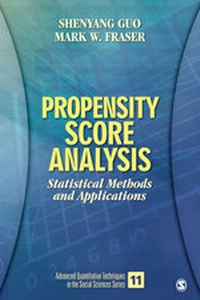
Propensity Score Analysis
Statistical Methods and Applications
Published on 1. July 2009
Book
Hardback
392 pages
978-1-4129-5356-6 (ISBN)
Description
Propensity Score Matching provides readers with a systematic review of the origins, history, and statistical foundations of PSM and illustrates how to use PSM methods for solving evaluation problems. With a strong focus on practical applications, the authors explore various types of data and evaluation problems, strategies for using the methods, and the limitations of PSM. Unlike the existing textbooks on program evaluation, Guo and Fraser's Propensity Score Matching delves into statistical concepts, formulas, and models underlying the application of PSM.
Reviews / Votes
"The approach the authors take in writing this book is very effective for novices and experiences users...This balance between the practical and applied approach is a useful model for researchers to understand the process and interpretation of these analyses...[it] goes a long way in making propensity score analysis techniques more accessible, understandable, and useful to psychologists." -- Karl N. Kelley PsycCRITIQUES 20110706 "Guo and Fraser's book Propensity Score Analysis: Statistical Methods and Applications is the first comprehensive book that discusses and compares different PS techniques from theoretical and practical points of view. One of the book's strengths is its focus on the application of PS to real data. [T]his textbook gives a good introduction to PS matching techniques and some alternative approaches for estimating causal treatment effects. With its many examples in Stata, it may be useful for graduate students and applied researchers who have no or limited experience with PS methods but are familiar with basic regression methods and mathematical/statistical notation." -- Peter M. Steiner PSYCHOMETRIKA-VOL. 75, NO. 4, 775-777 20101208More details
Series
Language
English
Place of publication
Thousand Oaks
United States
Target group
College/higher education
Dimensions
Height: 229 mm
Width: 152 mm
ISBN-13
978-1-4129-5356-6 (9781412953566)
Copyright in bibliographic data and cover images is held by Nielsen Book Services Limited or by the publishers or by their respective licensors: all rights reserved.
Schweitzer Classification
Other editions
New editions
Book
08/2014
2nd Edition
SAGE Publications Inc
€185.87
Shipment within 15-20 days
Persons
Shenyang Guo, PhD, is the Kuralt Distinguished Professor at the School of Social Work, University of North Carolina. The author of numerous articles on statistical methods and research reports in child welfare, child mental health services, welfare, and health care, Guo has expertise in applying advanced statistical models to solving social welfare problems and has taught graduate courses on event history analysis, hierarchical linear modeling, growth curve modeling, and program evaluation. He has given many invited workshops on statistical methods-including event history analysis and propensity score matching-at the NIH Summer Institute, Children's Bureau, and at conferences of the Society of Social Work and Research. He led the data analysis planning for the National Survey of Child and Adolescent Well-Being (NSCAW) longitudinal analysis. Mark W. Fraser, PhD, holds the Tate Distinguished Professorship at the School of Social Work, University of North Carolina at Chapel Hill, where he serves as associate dean for research. He has written numerous chapters and articles on risk and resilience, child behavior, child and family services, and research methods. With colleagues, he is the co-author or editor of eight books, including Families in Crisis, Evaluating Family-Based Services, Risk and Resilience in Childhood, Making Choices, The Context of Youth Violence, and Intervention with Children and Adolescents. His award-winning text Social Policy for Children and Families reviews the bases for public policy in child welfare, juvenile justice, mental health, developmental disabilities, and health. His most recent book, Intervention Research: Developing Social Programs, describes a design perspective on the development of innovative social and health programs.
Content
1. Introduction 2. Counterfactual Framework and Assumptions 3. Conventional Methods for Data Balancing 4. Sample Selection and Related Methods 5. Propensity Score Matching and Related Methods 6. Matching Estimators 7. Propensity Score Analysis with Nonparametric Regression 8. Selection Bias and Sensitivity Analysis 9. Concluding Remarks References Index