

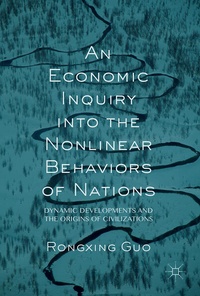
An Economic Inquiry into the Nonlinear Behaviors of Nations
Dynamic Developments and the Origins of Civilizations
Published on 17. February 2017
Book
Hardback
XVII, 294 pages
978-3-319-48771-7 (ISBN)
Description
This book applies an economic approach to examine the driving forces behind the dynamic behaviors of developing nations. Taking into account initial conditions and environmental and external factors often oversimplified by historians and anthropologists, Guo finds that the rise and fall of civilizations and nations followed an anti-Darwinian process: physical weakness, rather than strength, induced humans to adapt. Cultures facing unfavorable physical and environmental conditions developed complex societies to overcome these challenges, while favorable conditions did not incentivize major economic and cultural change. Over centuries of economic growth and development, nations and civilizations' adaptive behaviors have followed a cyclical path at both the country level and in an international context. This interdisciplinary book incorporates elements of history, anthropology, and development into an astute economic analysis that changes the way we think about the origins and evolutionsof civilizations.
Reviews / Votes
"Innovative and stimulating! Guo introduces a much-needed new perspective on the traditional topic of 'the emergence and fall of empires' that has become a much-discussed important field, given the ongoing reshaping of the international order that is due to the decline of the uni-polar world (dominated by the US), the emergence of a multi-polar world with some new international powers (such as China), and the re-emergence of old powers (such as Russia)." (Paolo Urio, University of Geneva, Switzerland) "Professor Guo explores the dynamics of civilizations from the beginnings to our perplexingly complex world. There are lots of thought-provoking ideas here on the rise and decline of nations as well as on China's current and future place in the world economy. Anyone wishing to understand global developments should give this book serious consideration." (John Komlos, University of Munich, Germany, and Duke University, USA)< "It is interesting to see a Chinese perspective on the questions of deep history that have engaged Jared Diamond, Yuval Harari and David Christian. Guo argues that understanding cyclical threats has been the key to human progress, which is driven by the dialectic of material privation and human ingenuity." (Peter Rutland, Wesleyan University, USA)More details
Edition
1st ed. 2017
Language
English
Place of publication
Cham
Switzerland
Publishing group
Springer International Publishing
Target group
Professional and scholarly
Illustrations
2 s/w Abbildungen, 16 farbige Abbildungen
XVII, 294 p. 18 illus., 16 illus. in color.
Dimensions
Height: 216 mm
Width: 153 mm
Thickness: 22 mm
Weight
518 gr
ISBN-13
978-3-319-48771-7 (9783319487717)
DOI
10.1007/978-3-319-48772-4
Schweitzer Classification
Other editions
Additional editions
Rongxing Guo
An Economic Inquiry into the Nonlinear Behaviors of Nations
Dynamic Developments and the Origins of Civilizations
Book
07/2018
Palgrave Macmillan
€139.09
Shipment within 10-15 days
Rongxing Guo
An Economic Inquiry into the Nonlinear Behaviors of Nations
Dynamic Developments and the Origins of Civilizations
E-Book
02/2017
1st Edition
Palgrave Macmillan
€128.39
Available for download
Person
Rongxing Guo is Professor and Head of the Regional Economics Committee in the Regional Science Association of China at Peking University in Beijing, China. He has 30 years of experience teaching and researching in China, Australia, Japan, South Korea, Italy, Germany, and the USA. He has led research projects for the OECD and the World Bank, and has undertaken consultation for the Chinese government.
Content
1. Introduction.- 2. Culture as an Anti-Darwinian Process.- 3. Good Environment, Bad Environment.- 4. Living in the Lands Threatened.- 5. Are there any Optimal Strategies for Nations?.- 6. Civilization as a Cyclical Human Process.- 7. China: Short Cycles, Long Cycles.- 8. The Western World: A Longer Cycle.- 9. In Cycles We Trust.