

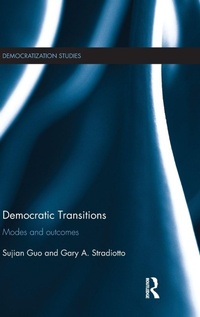
Democratic Transitions
Modes and Outcomes
1st Edition
Published on 4. April 2014
Book
Hardback
150 pages
978-0-415-64320-7 (ISBN)
Description
Democratic transitions have occurred in many countries in various regions across the globe, such as Southern Europe, Latin America, Africa, East and Southeast Asia, Eastern Europe and the Middle East, and these nations have undergone simuntaneously political, economic and social transformations. Yet, the patterns and characteristics of transitions have varied significantly, and different modes of transition have resulted in different outcomes.
This book offers cross-national comparisons of democratic transition since the turn of the twentieth century and asks what makes democracies succeed or fail. In doing so it explores the influence the mode of transition has on the longevity or durability of the democracy, by theoretically examining and quantitatively testing this relationship. The authors argue that the mode of transition directly impacts the success and failure of democracy, and suggest that cooperative transitions, where opposition groups work together with incumbent elites to peacefully transition the state, result in democracies that last longer and are associated with higher measures of democratic quality.
Based on a cross-national dataset of all democratic transitioning states since 1900, this book will be of great interest to students and scholars of international politics, comparative politics and democracy, and democratization studies.
This book offers cross-national comparisons of democratic transition since the turn of the twentieth century and asks what makes democracies succeed or fail. In doing so it explores the influence the mode of transition has on the longevity or durability of the democracy, by theoretically examining and quantitatively testing this relationship. The authors argue that the mode of transition directly impacts the success and failure of democracy, and suggest that cooperative transitions, where opposition groups work together with incumbent elites to peacefully transition the state, result in democracies that last longer and are associated with higher measures of democratic quality.
Based on a cross-national dataset of all democratic transitioning states since 1900, this book will be of great interest to students and scholars of international politics, comparative politics and democracy, and democratization studies.
More details
Series
Language
English
Place of publication
London
United Kingdom
Publishing group
Taylor & Francis Ltd
Target group
College/higher education
Illustrations
9 s/w Abbildungen, 9 s/w Zeichnungen, 19 s/w Tabellen
19 Tables, black and white; 9 Line drawings, black and white; 9 Illustrations, black and white
Dimensions
Height: 240 mm
Width: 161 mm
Thickness: 13 mm
Weight
399 gr
ISBN-13
978-0-415-64320-7 (9780415643207)
Copyright in bibliographic data and cover images is held by Nielsen Book Services Limited or by the publishers or by their respective licensors: all rights reserved.
Schweitzer Classification
Other editions
Additional editions
Book
04/2016
1st Edition
Routledge
€75.80
Shipment within 10-20 days
E-Book
04/2014
Routledge
€69.99
Available for download
E-Book
04/2014
Routledge
€69.99
Available for download
Persons
Sujian Guo is Distinguished Professor at Zhejiang University and Fudan University, and an academic committee member of Peking University-Fudan University-Jilin University Co-innovation Center for State Governance in China, and Professor in the Department of Political Science and Director of the Center for U.S.-China Policy Studies at San Francisco State University, U.S.A.
Gary A. Stradiotto is Professorial Lecturer of Political Science at The George Washington University, U.S.A.
Gary A. Stradiotto is Professorial Lecturer of Political Science at The George Washington University, U.S.A.
Content
1. Introduction 2. Modes of Democratic Transition 3. A Theory of Explaining Success Rate of Democratic Transitions 4. Research Design and Empirics 5. Democratic Prospects 6. Conclusion