

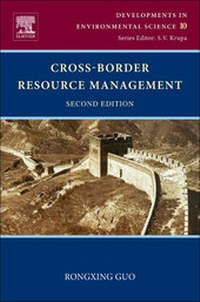
Cross-Border Resource Management: Volume 10
Theory and Practice
2nd Edition
Published on 17. August 2012
Book
Hardback
354 pages
978-0-08-098319-6 (ISBN)
Description
In discussing theoretical and analytical issues relating to cross-border resource management, this book explores a group of geographical, political, legal, economic and cultural factors that arise when political units (such as sovereign countries, dependent states and other administrative units) seek to maximize their political and economic interests while minimizing the resultant damage (e.g. resource degradation and preservation of the physical environment).
The book is organized into three parts. Part one discusses the theoretical issues relating to cross-border development and the cross-border management of natural and environmental resources. Part two provides a variety of alternatives to advancing cross-border development as well as of options for cross-border management of resource exploitation and for cross-border conflict management. In Part three, using the theoretical and methodological frameworks that have been discussed in Parts one and two, respectively, two in-depth case studies on cross-border development and resource management are provided.
The book is organized into three parts. Part one discusses the theoretical issues relating to cross-border development and the cross-border management of natural and environmental resources. Part two provides a variety of alternatives to advancing cross-border development as well as of options for cross-border management of resource exploitation and for cross-border conflict management. In Part three, using the theoretical and methodological frameworks that have been discussed in Parts one and two, respectively, two in-depth case studies on cross-border development and resource management are provided.
Reviews / Votes
"This latest edition from Rongxing is recommended, and will hopefully give inspiration to an emerging scholarship of cross-border resources management and planning across very complicated contexts. This book offered clear explanations on theories, sophisticated methodologies and addressing in-depth issues from case studies. Scholars, politicians and planners can gain inspiration from this text and achieve the best cross-border practice." --Environment and Urbanization AsiA, 2012More details
Series
Edition
2nd edition
Language
English
Place of publication
London
United Kingdom
Publishing group
Elsevier Health Sciences
Target group
Professional and scholarly
Regional Planning and Sustainable Development Policymakers, Natural and Environmental Resource Scientists, Cross-border Relations Experts, Resource Management Specialists
Dimensions
Height: 229 mm
Width: 152 mm
Weight
720 gr
ISBN-13
978-0-08-098319-6 (9780080983196)
Copyright in bibliographic data and cover images is held by Nielsen Book Services Limited or by the publishers or by their respective licensors: all rights reserved.
Schweitzer Classification
Other editions
Previous edition
Book
07/2005
Elsevier
€142.37
Article exhausted; check for reprint
Person
Rongxing Guo is Professor (Homepage: www.researchgate.net/profile/Rongxing_Guo; ORCID: 0000-0002-5368-793X), Capital University of Economics and Business, Beijing, China. He has led research projects for the OECD and the World Bank, and undertaken consultation for the Chinese government. An expert who is among the very few scholars to publish in six major disciplines of economics, geography, political science, management science, archaeology, and anthropology, Rongxing Guo has more than 30 years of experience teaching and researching in China, as well as in Australia, Japan, South Korea, Italy, Germany and the US. During the past 20 years or so, he has published more than 30 monographs and many valuable articles. His most recent research works are "Explaining the Human and Cultural Puzzles: A New Development Theory? - whose full text is available at https://www.sciencedirect.com/science/article/pii/S0040162519302513 -- and "Managing the Unruly Waters: An Imperative for Safety and Resilience along the Yellow River? (draft).
Content
Part One. Theory
1. Some basic concepts
2. Resource management and cross-border areas
3. Can cross-border resources be optimally managed?
4. Cross-border resource management: methodological puzzles
5. Institutions for cross-border resource management
6. Cross-border resource management in disputed areas
Part Two. Practice
7. The triangular resource management of the Tumen River area
8. The transnational water pollution in the Lower Mekong Basin
9. The U.S.-Mexico border environment cooperation
10. China's interprovincial border disputes at Lake Weishan
1. Some basic concepts
2. Resource management and cross-border areas
3. Can cross-border resources be optimally managed?
4. Cross-border resource management: methodological puzzles
5. Institutions for cross-border resource management
6. Cross-border resource management in disputed areas
Part Two. Practice
7. The triangular resource management of the Tumen River area
8. The transnational water pollution in the Lower Mekong Basin
9. The U.S.-Mexico border environment cooperation
10. China's interprovincial border disputes at Lake Weishan