

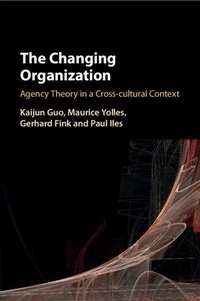
The Changing Organization
Agency Theory in a Cross-Cultural Context
Published on 24. March 2022
Book
Paperback/Softback
466 pages
978-1-316-60091-7 (ISBN)
Description
The Changing Organization provides a multidisciplinary approach for studying the management of change under conditions of complexity. Single-discipline approaches frequently miss essential elements that reduce the possibility of coherence within a multi-agency organizational setting. Combining a systems and cybernetic 'living system' perspective, Guo, Yolles, Fink, and Iles offer a new agency paradigm designed to model, diagnose and analyse complex, real-world situations. Its capacity to anticipate patterns of behaviour provides useful means by which the origin of crises can be understood, and resolutions reflected upon. Scholars and graduate students in fields as diverse as management, politics, anthropology and psychology will find numerous applications for this book when considering socio-political and organizational change, and it offers an invaluable guide for consultants who may wish to apply advanced techniques of contextual analysis to real-world situations.
More details
Language
English
Place of publication
Cambridge
United Kingdom
Target group
Professional and scholarly
Product notice
Paperback (trade)
Dimensions
Height: 229 mm
Width: 152 mm
Thickness: 25 mm
Weight
670 gr
ISBN-13
978-1-316-60091-7 (9781316600917)
Copyright in bibliographic data and cover images is held by Nielsen Book Services Limited or by the publishers or by their respective licensors: all rights reserved.
Schweitzer Classification
Other editions
Additional editions
Kaijun Guo | Maurice Yolles | Gerhard Fink
The Changing Organization
Agency Theory in a Cross-Cultural Context
Book
11/2016
Cambridge University Press
€173.80
Shipment within 15-20 days
Persons
Kaijun Guo is director of strategy at the Baoshang Bank in China, and associate chairman. He has a doctorate in Management from Liverpool John Moores University, and post-graduate teaching experience. He also has Asian responsibility for the Centre for the Creation of Coherent Change and Knowledge based at Liverpool John Moores University.
Content
Part I. The Agency: 1. The cultural agency; 1.1 Introduction; 1.2 The configuration approach; 1.3 Viable living systems and cultural agency; 2. The instrumental and strategic agencies; 2.1 Introduction; 2.2 The strategic agency; 2.3 Two views on strategic management; 2.4 The knowledge management paradigm; 2.5 Complexity and viable systems; 2.6 Knowledge cybernetics; 2.7 Agency pathology; 3. Agency personality; 3.1 Introduction; 3.2 Modelling the collective agency; 3.3 Agency trait theory and Maruyama types; 3.4 Intelligences and efficacy in agency traits; 3.5 Conclusion; 4. The intelligent agency; 4.1 Introduction; 4.2 Theories of intelligence; 4.3 Organisational intelligences; 4.4 Agency process intelligences and efficacy; 4.5 Knowledge strategy agency case; 5. Agency types and traits; 5.1 Introduction; 5.2 Traits, enantiomers and agency type; 5.3 Individualism and collectivism; 5.4 Some thoughts; 6. Agency consciousness; 6.1 Introduction; 6.2 Undecidability and generic system hierarchies; 6.3 Substructure modelling; 6.4 Illustration of superstructure modelling; 6.5 The case of negotiation and agency internalisation; Part II. Agency Change: 7. Joint alliances; 7.1 Introduction; 7.2 International alliances in Central Europe; 7.3 Knowledge management and knowledge transfer in a cross-cultural context; 7.4 Viable knowledge creation and learning in international alliances; 7.5 Modelling alliances; 7.6 Application of the model to a case study of the Czech Academic Link Project (CZALP); 7.7 Application of the model to a case study of the Czech Academic Link project (CZALP); The CZALP Project Phase 1; The CZALP Project Phase 2 and 3; 7.7 Outcome; 8. Agency dynamics; 8.1 Introduction; 8.2 Kuhn, Piaget: from paradigm crisis to transformation; 8.3 Understanding paradigms; 8.4 Paradigms under change; 8.5 Transformation and paradigms; 8.6 Trait system dynamics; 8.7 Baoshang Bank case study; 8.8 Some thoughts; Part III. Agency as Society: 9. The sociological and political agencies; 9.1 Introduction; 9.2 Parsons; 9.3 Luhmann; 9.4 Habermas; 9.5 Agency and socio-cultural processes; 9.6 The political dimension of agency; 9.7 Luhmann, Habermas, agency and practice; 10. The economic agency; 10.1 Introduction; 10.2 Economics and policy; 10.3 Macroeconomic modelling; 10.4 Economic agency; 10.5 Traits, policy and macroeconomics; 10.6 Case situation: the 2008 European Recession and mindscapes; 10.7 Observations; 11. The financial agency; 11.1 Introduction; 11.2 The Chinese context; 11.3 The impact of shadow banking; 11.4 Viewing banking through agency; 11.5 Agency pathologies and corruption; 11.6 Conclusions; Notes; References; Index.