

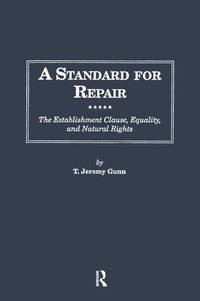
A Standard for Repair
The Establishment Clause, Equality, and Natural Rights
1st Edition
Will be published approx. on 1. November 1992
Book
Hardback
240 pages
978-0-8153-0893-5 (ISBN)
Description
The relationship between religion and government in the United States ultimately is governed by the Establishment Clause of the Constitution. Since the early 1970s, however, conservative scholars and jurists have been increasingly influential in arguing that the "wall of separation" metaphor is inappropriate for explaining the relationship between religion and government. They have suggested that the framers of the Constitution supported governmental accommodation and encouragement of religion through means that included sponsoring prayers in public fora, promoting public displays of religious symbols, and financing religious institutions. This book argues that this increasingly influential "Accommodationist" interpretation of the Establishment Clause of the Constitution is ill-founded. The historical arguments upon which the Accommodationists rely do not support the interpretation they offer. This argument does not challenge the Accommodationist belief in the importance of "founders' intent" adjudication. This book shows, instead, that the founders did not assume that the Establishment Clause had any specific meaning.
More details
Series
Language
English
Place of publication
New York
United States
Publishing group
Taylor & Francis Inc
Target group
College/higher education
Professional and scholarly
Postgraduate
Dimensions
Height: 229 mm
Width: 152 mm
Weight
453 gr
ISBN-13
978-0-8153-0893-5 (9780815308935)
Copyright in bibliographic data and cover images is held by Nielsen Book Services Limited or by the publishers or by their respective licensors: all rights reserved.
Schweitzer Classification
Other editions
Additional editions
E-Book
12/2023
1st Edition
Routledge
€60.49
Available for download
E-Book
12/2023
1st Edition
Routledge
€60.49
Available for download
Person
T. Jeremy Gunn
Content
Preface, PART I THE ESTABLISHMENT CLAUSE CHAPTER 1 Introduction: Religion and the Constitution A. The Centrality of the Constitution B. The Religion Clauses 1. Religious Test Clause 2. The First Amendment C. The Wall of Separation CHAPTER 2 Accommodation of Religion A. The Founders' Intent B. The Founders' Practices C. Legal Positivism CHAPTER 3 First Congress Debates on the Establishment Clause A. Prelude to the First Congress Debates B. The First Congress Debates C. The Debates of August 15,1789 D. Adoption of the Establishment Clause E. Conclusions CHAPTER 4 The Meaning of "Establishments of Religion" in Eighteenth-Century America A. Uses of "Establishment" B. The Quebec Act C. Tennent and the South Carolina Constitution D. Virginia's Establishment Bills E. Massachusetts and the Constitution of 1780; Conclusion PART II IDEOLOGICAL UNDERPINNINGS OF THE CONSTITUTION: NATURAL RIGHTS AND EQUALITY CHAPTER 5 Structure of Constitutional Rights I: The Revolutionary Period A. The Background to Revolution 1. Natural Rights 2. Sovereignty and Equality B. The Declaration of Independence C. The State Constitutions CHAPTER 6 Structure of Constitutional Rights II: The United States Constitution A The Constitutional Convention B. Ratification Debates 1. Pennsylvania as Prolegomenon 2. National Proliferation C. The First Congress Debates and the Ninth Amendment CHAPTER 7 A Standard for Repair: Principles, Practices, and Equality A. Equality and Religion B. Equality: Principle or Practice? 1. Three Chief Justices 2. Practices over Principles CHAPTER 8 Conclusion