

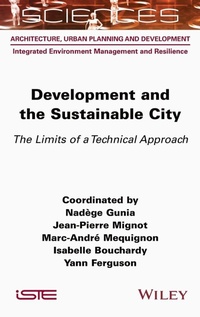
Development and the Sustainable City
The Limits of a Technical Approach
1st Edition
Published on 4. February 2025
Book
Hardback
304 pages
978-1-78945-184-9 (ISBN)
Description
This book examines the city and its rapid growth, as well as the sustainability issues it poses, in several ways. First, there is a critical approach to development, as expressed by the concept of sustainable development. The city, as a complex system, primarily refers to questions of sustainability performance, which we believe to be capable of resolving problems and difficulties, even when viewed from a local perspective, and therefore from the point of view of the areas in which it must act.
Lastly, the issue of sustainability cannot be addressed without contemplating and concluding how acceptable it is to the populations concerned. All challenges raised by the urban character of the city are therefore linked to the more general question of how to define the concept of sustainable development and the sustainable city as a key area of concern.
Lastly, the issue of sustainability cannot be addressed without contemplating and concluding how acceptable it is to the populations concerned. All challenges raised by the urban character of the city are therefore linked to the more general question of how to define the concept of sustainable development and the sustainable city as a key area of concern.
More details
Series
Language
English
Place of publication
London
United Kingdom
Target group
Professional and scholarly
Product notice
sewn/stitched
Cloth over boards
Dimensions
Height: 234 mm
Width: 156 mm
Thickness: 18 mm
Weight
594 gr
ISBN-13
978-1-78945-184-9 (9781789451849)
Copyright in bibliographic data and cover images is held by Nielsen Book Services Limited or by the publishers or by their respective licensors: all rights reserved.
Schweitzer Classification
Other editions
Additional editions
Nadège Gunia | Jean-Pierre Mignot | Marc-André Mequignon
Development and the Sustainable City
The Limits of a Technical Approach
E-Book
01/2025
1st Edition
Wiley
€130.99
Available for download
Nadège Gunia | Jean-Pierre Mignot | Marc-André Mequignon
Development and the Sustainable City
The Limits of a Technical Approach
E-Book
01/2025
1st Edition
Wiley
€130.99
Available for download
Persons
Nadege Gunia is Senior Lecturer in Management at the Universite Paul Sabatier, France. Her research focuses on cities at all scales and on global cost analysis.
Jean-Pierre Mignot is a researcher in Economic Sciences at the Universite Paul Sabatier, France. His research focuses on sustainable development and its application to cities.
Marc-Andre Mequignon is a qualified architect and teacher-researcher at the Universite Paul Sabatier, France. His research focuses on sustainable development and its applications in buildings and cities.
Isabelle Bouchardy is Senior Lecturer in Management at the Universite Paul Sabatier, France. She specializes in public strategic management, service performance measurement tools and organizational change representation among other topics.
Yann Ferguson is a sociologist of cities and work at INRIA, France, a research associate at Jean Jaures University and Scientific Director of the LaborIA research program. His research focuses on the instrumentation of human decisions in complex environments.
Jean-Pierre Mignot is a researcher in Economic Sciences at the Universite Paul Sabatier, France. His research focuses on sustainable development and its application to cities.
Marc-Andre Mequignon is a qualified architect and teacher-researcher at the Universite Paul Sabatier, France. His research focuses on sustainable development and its applications in buildings and cities.
Isabelle Bouchardy is Senior Lecturer in Management at the Universite Paul Sabatier, France. She specializes in public strategic management, service performance measurement tools and organizational change representation among other topics.
Yann Ferguson is a sociologist of cities and work at INRIA, France, a research associate at Jean Jaures University and Scientific Director of the LaborIA research program. His research focuses on the instrumentation of human decisions in complex environments.
Content
Introduction ix
Jean-Pierre MIGNOT
Chapter 1 From Development to Sustainable Development: Stakes and Issues Around the Sustainable City 1
Jean-Pierre MIGNOT
1.1 Introduction 1
1.2 Development: a concept, a history and its limits 3
1.2.1 The question of economic development 4
1.2.2 A brief history of a concept 5
1.2.3 Return to a definition and its consequences 8
1.2.4 Development and growth: a functional approach 12
1.2.5 Development, productivism and consumer society 13
1.2.6 The environmental consequences of development 17
1.3 Economic development and collateral damage 21
1.3.1 Production, consumption and fossil fuels 22
1.3.2 From economic development to endangering the planet 28
1.4 The neoliberal city and the environment 38
1.4.1 A redefinition of the neoliberal city 39
1.4.2 From the Fordist city to the neoliberal city 41
1.4.3 Population growth, economic development and urbanization 44
1.4.4 Urbanization and environment 46
1.5 From sustainable development to sustainable cities: issues and limits 54
1.5.1 Origins, foundations and evolution of the concept of sustainable development 55
1.5.2 A critical approach to the concept of sustainable development 69
1.5.3 The sustainable city and its limits 83
1.6 To not conclude 94
1.7 References 96
Chapter 2 The City, Decision-Making Tools and Performance 103
Marc-Andre MEQUIGNON and Jean-Pierre MIGNOT
2.1 Introduction 103
2.2 The city approached as a system 104
2.2.1 The city, a complex system 104
2.2.2 The city, a complexity in motion 105
2.2.3 The city: the constraints of sustainability 106
2.2.4 Difficulties and priorities for the future 109
2.3 The city of the future 111
2.3.1 Avenues for improvement 111
2.3.2 Interdisciplinarity, a necessity 113
2.3.3 Technological change and the city 124
2.4 Proposal for an approach to improving decision support tools 128
2.4.1 A multidisciplinary approach to the design of decision support tools 128
2.4.2 Decision support tools and their place in the project process 129
2.4.3 Multidisciplinary approach to tool design 130
2.5 The city and LCA 132
2.5.1 Maturities of the different aspects of LCA 132
2.5.2 LCA, an unsuitable tool for the city 135
2.6 Agenda 21, a dedicated tool 142
2.6.1 Probable causes of a standstill 142
2.6.2 Ways to avoid becoming bogged down again 143
2.7 Conclusion 143
2.8 References 145
Chapter 3 Rural Eco-territoriality or the Subtle Alchemy Between Locality and Globality 149
Isabelle BOUCHARDY
3.1 Introduction 149
3.2 Rural territory: what does it mean? 150
3.2.1 The state of affairs 150
3.2.2 Specificities of identity 155
3.3 "Glocalization" of the territory 158
3.3.1 Globality 160
3.3.2 Locality 162
3.4 Sustainable rurality 165
3.4.1 Radical or incremental change? 165
3.4.2 Strategic areas of action 168
3.5 Prequel 192
3.5.1 A neglected model 194
3.5.2 Moderation versus austerity 198
3.6 References 202
Chapter 4 The Sustainable City, Between Political Project and Theoretical Cooling 209
Yann FERGUSON
4.1 Introduction 209
4.2 The plan: a positivist paradigm of the modern city 212
4.2.1 Progress as a regulatory ideal 213
4.2.2 Science as a resolutive modality 218
4.2.3 The state's omniscience and omnipotence 222
4.3 The urban project, operational paradigm of the sustainable city 227
4.3.1 Uncertainty as regulatory disillusionment 228
4.3.2 Partnership as a resolutive modality 232
4.3.3 The territory as a legitimate actor 237
4.4 The political nature of creating the sustainable city 242
4.4.1 The instrumentation of public action: from the "what" to the "how" 242
4.4.2 A semi-elitist and unitary democracy 250
4.4.3 The sustainable city: a standardized and denatured politics? 255
4.5 Conclusion 261
4.6 References 262
List of Authors 275
Index 277
Jean-Pierre MIGNOT
Chapter 1 From Development to Sustainable Development: Stakes and Issues Around the Sustainable City 1
Jean-Pierre MIGNOT
1.1 Introduction 1
1.2 Development: a concept, a history and its limits 3
1.2.1 The question of economic development 4
1.2.2 A brief history of a concept 5
1.2.3 Return to a definition and its consequences 8
1.2.4 Development and growth: a functional approach 12
1.2.5 Development, productivism and consumer society 13
1.2.6 The environmental consequences of development 17
1.3 Economic development and collateral damage 21
1.3.1 Production, consumption and fossil fuels 22
1.3.2 From economic development to endangering the planet 28
1.4 The neoliberal city and the environment 38
1.4.1 A redefinition of the neoliberal city 39
1.4.2 From the Fordist city to the neoliberal city 41
1.4.3 Population growth, economic development and urbanization 44
1.4.4 Urbanization and environment 46
1.5 From sustainable development to sustainable cities: issues and limits 54
1.5.1 Origins, foundations and evolution of the concept of sustainable development 55
1.5.2 A critical approach to the concept of sustainable development 69
1.5.3 The sustainable city and its limits 83
1.6 To not conclude 94
1.7 References 96
Chapter 2 The City, Decision-Making Tools and Performance 103
Marc-Andre MEQUIGNON and Jean-Pierre MIGNOT
2.1 Introduction 103
2.2 The city approached as a system 104
2.2.1 The city, a complex system 104
2.2.2 The city, a complexity in motion 105
2.2.3 The city: the constraints of sustainability 106
2.2.4 Difficulties and priorities for the future 109
2.3 The city of the future 111
2.3.1 Avenues for improvement 111
2.3.2 Interdisciplinarity, a necessity 113
2.3.3 Technological change and the city 124
2.4 Proposal for an approach to improving decision support tools 128
2.4.1 A multidisciplinary approach to the design of decision support tools 128
2.4.2 Decision support tools and their place in the project process 129
2.4.3 Multidisciplinary approach to tool design 130
2.5 The city and LCA 132
2.5.1 Maturities of the different aspects of LCA 132
2.5.2 LCA, an unsuitable tool for the city 135
2.6 Agenda 21, a dedicated tool 142
2.6.1 Probable causes of a standstill 142
2.6.2 Ways to avoid becoming bogged down again 143
2.7 Conclusion 143
2.8 References 145
Chapter 3 Rural Eco-territoriality or the Subtle Alchemy Between Locality and Globality 149
Isabelle BOUCHARDY
3.1 Introduction 149
3.2 Rural territory: what does it mean? 150
3.2.1 The state of affairs 150
3.2.2 Specificities of identity 155
3.3 "Glocalization" of the territory 158
3.3.1 Globality 160
3.3.2 Locality 162
3.4 Sustainable rurality 165
3.4.1 Radical or incremental change? 165
3.4.2 Strategic areas of action 168
3.5 Prequel 192
3.5.1 A neglected model 194
3.5.2 Moderation versus austerity 198
3.6 References 202
Chapter 4 The Sustainable City, Between Political Project and Theoretical Cooling 209
Yann FERGUSON
4.1 Introduction 209
4.2 The plan: a positivist paradigm of the modern city 212
4.2.1 Progress as a regulatory ideal 213
4.2.2 Science as a resolutive modality 218
4.2.3 The state's omniscience and omnipotence 222
4.3 The urban project, operational paradigm of the sustainable city 227
4.3.1 Uncertainty as regulatory disillusionment 228
4.3.2 Partnership as a resolutive modality 232
4.3.3 The territory as a legitimate actor 237
4.4 The political nature of creating the sustainable city 242
4.4.1 The instrumentation of public action: from the "what" to the "how" 242
4.4.2 A semi-elitist and unitary democracy 250
4.4.3 The sustainable city: a standardized and denatured politics? 255
4.5 Conclusion 261
4.6 References 262
List of Authors 275
Index 277