

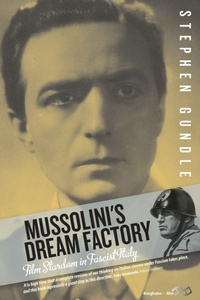
Mussolini's Dream Factory
Film Stardom in Fascist Italy
1st Edition
Published on 1. December 2015
Book
Paperback/Softback
336 pages
978-1-78533-041-4 (ISBN)
Description
The intersection between film stardom and politics is an understudied phenomenon of Fascist Italy, despite the fact that the Mussolini regime deemed stardom important enough to warrant sustained attention and interference. Focused on the period from the start of sound cinema to the final end of Fascism in 1945, this book examines the development of an Italian star system and evaluates its place in film production and distribution. The performances and careers of several major stars, including Isa Miranda, Vittorio De Sica, Amedeo Nazzari, and Alida Valli, are closely analyzed in terms of their relationships to the political sphere and broader commercial culture, with consideration of their fates in the aftermath of Fascism. A final chapter explores the place of the stars in popular memory and representations of the Fascist film world in postwar cinema.
Reviews / Votes
"In this excellent study of film stars under Fascism, Stephen Gundle explores the tenuous relationship between the film industry and Mussolini's regime through the lens of film stars and discovers that, like so many other aspects of the Fascist era, this was yet another example of the regime's inability to fully fascistize society...The achievement of Gundle's book is to demonstrate the complexity and nuances of the film stars' lives under Mussolini's dictatorship." ? European History Quarterly"Mussolini's Dream Factory is a meticulously researched study, drawing extensively on primary and secondary Italian language sources and providing a wealth of information to support further research." ? Celebrity Studies
"Gundle has written the book that will become a standard in the fields of historiography on Italian Fascism, Italian Fascist cinema and film scholarship on star culture. The mixture of intimate sources such as diaries, letters and photographs with exhaustive archival material breathes life into this period, allowing us new and necessary insight on this complicated era of cinematic and Italian history." ? Historical Journal of Film, Radio and Television
"This is an outstanding book in every respect. It is beautifully written, clear, concise, no professional jargon, yet based on a confident grasp of all the relevant criticism as well as primary sources in a number of languages... It is high time that a complete revision of our thinking on Italian cinema under fascism takes place, and this book represents a giant step in this direction." ? Peter Bondanella, Emeritus, Indiana University
"I thoroughly enjoyed reading this book. It is obviously a study written with great enthusiasm for its subject-Italian stardom. The work covers a wide terrain involving the nature of the regime as it entails cinema, examines the roles that the fascist state played from the late 1920s to the early 1940s (and shortly thereafter), designating the figures responsible for its development and implementation, the producers and film directors who played a major role, and most central for the study, the evolution of the star system over the course of the twenty years of the regime." ? Marcia Landy, University of Pittsburgh
More details
Language
English
Place of publication
Oxford
United Kingdom
Target group
College/higher education
Product notice
Paperback (trade)
Illustrations
20 Illustrations
Dimensions
Height: 229 mm
Width: 152 mm
Thickness: 18 mm
Weight
485 gr
ISBN-13
978-1-78533-041-4 (9781785330414)
DOI
10.3167/9781782382447
Copyright in bibliographic data and cover images is held by Nielsen Book Services Limited or by the publishers or by their respective licensors: all rights reserved.
Schweitzer Classification
Other editions
Additional editions
E-Book
12/2013
1st Edition
Berghahn Books
€32.49
Available for download
E-Book
12/2013
1st Edition
Berghahn Books
€24.49
Available for download
Person
Stephen Gundle is Professor of Film and Television Studies at the University of Warwick. His books include Between Hollywood and Moscow: the Italian Communists and the Challenge of Mass Culture, 1943-91 (2000), Bellissima: Feminine Beauty and the Idea of Italy (2007), Mass Culture and Italian Society from Fascism to the Cold War (2008, with David Forgacs), Glamour: A History (2008) and Death and the Dolce Vita: The Dark Side of Rome in the 1950s (2011). He is co-editor, with Christopher Duggan and Giuliana Pieri, of The Cult of the Duce: Mussolini and the Italians (2013).
Content
List of Figures
Acknowledgements
Introduction
Part I: Fascism, Cinema and Stardom
Chapter 1. Italian cinema under Fascism
Chapter 2. The creation of a star system
Chapter 3. Stars and commercial culture
Chapter 4. The public and the stars
Part II: Italian Stars of the Fascist Era
Chapter 5. The national star: Isa Miranda
Chapter 6. The matinee idol: Vittorio De Sica
Chapter 7. Everybody's fiancee: Assia Noris
Chapter 8. The star as hero: Amedeo Nazzari
Chapter 9. The uniformed role model: Fosco Giachetti
Chapter 10. The photogenic beauty: Alida Valli
Chapter 11. The Duce's whim: Miria Di San Servolo
Part III: The Aftermath of Stardom
Chapter 12. Civil war, liberation and reconstruction
Chapter 13. Survival, memory and forgetting
Bibliography
Index
Acknowledgements
Introduction
Part I: Fascism, Cinema and Stardom
Chapter 1. Italian cinema under Fascism
Chapter 2. The creation of a star system
Chapter 3. Stars and commercial culture
Chapter 4. The public and the stars
Part II: Italian Stars of the Fascist Era
Chapter 5. The national star: Isa Miranda
Chapter 6. The matinee idol: Vittorio De Sica
Chapter 7. Everybody's fiancee: Assia Noris
Chapter 8. The star as hero: Amedeo Nazzari
Chapter 9. The uniformed role model: Fosco Giachetti
Chapter 10. The photogenic beauty: Alida Valli
Chapter 11. The Duce's whim: Miria Di San Servolo
Part III: The Aftermath of Stardom
Chapter 12. Civil war, liberation and reconstruction
Chapter 13. Survival, memory and forgetting
Bibliography
Index