

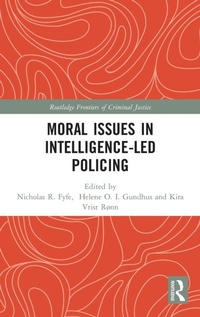
Moral Issues in Intelligence-led Policing
1st Edition
Published on 19. September 2017
Book
Hardback
330 pages
978-0-415-37379-1 (ISBN)
Description
The core baseline of Intelligence-led Policing is the aim of increasing efficiency and quality of police work, with a focus on crime analysis and intelligence methods as tools for informed and objective decisions both when conducting targeted, specialized operations and when setting strategic priorities. This book critically addresses the proliferation of intelligence logics within policing from a wide array of scholarly perspectives. It considers questions such as:
How are precautionary logics becoming increasingly central in the dominant policing strategies?
What kind of challenges will this move entail?
What does the criminalization of preparatory acts mean for previous distinctions between crime prevention and crime detection?
What are the predominant rationales behind the proactive use of covert cohesive measures in order to prevent attacks on national security?
How are new technological measures, increased private partnerships and international cooperation challenging the core nature of police services as the main providers of public safety and security?
This book offers new insights by exploring dilemmas, legal issues and questions raised by the use of new policing methods and the blurred and confrontational lines that can be observed between prevention, intelligence and investigation in police work.
How are precautionary logics becoming increasingly central in the dominant policing strategies?
What kind of challenges will this move entail?
What does the criminalization of preparatory acts mean for previous distinctions between crime prevention and crime detection?
What are the predominant rationales behind the proactive use of covert cohesive measures in order to prevent attacks on national security?
How are new technological measures, increased private partnerships and international cooperation challenging the core nature of police services as the main providers of public safety and security?
This book offers new insights by exploring dilemmas, legal issues and questions raised by the use of new policing methods and the blurred and confrontational lines that can be observed between prevention, intelligence and investigation in police work.
Reviews / Votes
"In seeking to examine the dilemmas and legal implications of proactive policing through an intelligence-led approach, the editors have collated some insightful chapters that raise important questions about risk and accountability in the crime prevention domain. As Western police services are increasingly interested in forecasting threats rather than reacting to events, the chapters in this book are a timely discussion of the challenges of reducing uncertainty while retaining democratic principles. Chapter authors are largely Scandinavian, lending a refreshing perspective to this interesting book."- Jerry H. Ratcliffe, Professor in the Department of Criminal Justice and Director of the Center for Security and Crime Science, Temple University, USA
"Nordic criminology has long been appreciated internationally for its penetrating theoretical insights and solid research tradition. This book is a welcome contribution to the literature on intelligence-led policing by the leading lights of 21st century Scandinavian police research. Pre-crime, preventive and pro-active policing, surveillance and intelligence analysis are all part of a complex professional language usually only addressed in terms of efficacy. This book goes beyond questions concerning 'what works in intelligence-led policing'. Instead, this book asks the ethical questions and gets at what matters in policing."
- James Sheptycki, Professor of Criminology, Faculty of Liberal Arts and Professional Studies, York University, Canada
"This rich collection of academic contributions on intelligence-led policing should be regarded as a timely arrival in the era of counter-terrorism, in which surveillance, undercover methods and predictive risk assessment are becoming widely accepted and applied to a growing range of crimes and public offences. By its very nature intelligence-led policing is covert and intrusive, which leaves no opportunity for citizens to consent. The reduction of due process guarantees should be a major source of concern: not only border police but all forms of law enforcement and social scrutiny now routinely work with predictive algorithms, in which each and every individual is framed, whether criminal or not. The authors are right to claim that this reconfiguration of powers, organizational rationales and technological innovations is potentially toxic and that it should spark a social debate about the relationship between police, politics and communities."
- Monica den Boer, Director of SeQure Research & Consultancy and Adjunct Professor at the Department of Criminology and Security Studies, Macquarie University, Sydney, Australia. "Nordic criminology has long been appreciated internationally for its penetrating theoretical insights and solid research tradition. This book is a welcome contribution to the literature on intelligence-led policing by the leading lights of 21st century Scandinavian police research. Pre-crime, preventive and pro-active policing, surveillance and intelligence analysis are all part of a complex professional language usually only addressed in terms of efficacy. This book goes beyond questions concerning 'what works in intelligence-led policing'. Instead, this book asks the ethical questions and gets at what matters in policing."
- James Sheptycki, Professor of Criminology, Faculty of Liberal Arts and Professional Studies, York University, Canada
"This rich collection of academic contributions on intelligence-led policing should be regarded as a timely arrival in the era of counter-terrorism, in which surveillance, undercover methods and predictive risk assessment are becoming widely accepted and applied to a growing range of crimes and public offences. By its very nature intelligence-led policing is covert and intrusive, which leaves no opportunity for citizens to consent. The reduction of due process guarantees should be a major source of concern: not only border police but all forms of law enforcement and social scrutiny now routinely work with predictive algorithms, in which each and every individual is framed, whether criminal or not. The authors are right to claim that this reconfiguration of powers, organizational rationales and technological innovations is potentially toxic and that it should spark a social debate about the relationship between police, politics and communities."
- Monica den Boer, Director of SeQure Research & Consultancy and Adjunct Professor at the Department of Criminology and Security Studies, Macquarie University, Sydney, Australia.
More details
Series
Language
English
Place of publication
London
United Kingdom
Publishing group
Taylor & Francis Ltd
Target group
College/higher education
Illustrations
1 s/w Abbildung, 1 s/w Zeichnung, 4 s/w Tabellen
4 Tables, black and white; 1 Line drawings, black and white; 1 Illustrations, black and white
Dimensions
Height: 240 mm
Width: 161 mm
Thickness: 22 mm
Weight
663 gr
ISBN-13
978-0-415-37379-1 (9780415373791)
Copyright in bibliographic data and cover images is held by Nielsen Book Services Limited or by the publishers or by their respective licensors: all rights reserved.
Schweitzer Classification
Other editions
Additional editions
Helene Gundhus | Kira Ronn | NICK FYFE
Moral Issues in Intelligence-led Policing
Book
02/2019
1st Edition
Routledge
€72.00
Shipment within 15-20 days
Helene Gundhus | Kira Ronn | NICK FYFE
Moral Issues in Intelligence-led Policing
E-Book
09/2017
Routledge
€64.49
Available for download
Helene Gundhus | Kira Ronn | NICK FYFE
Moral Issues in Intelligence-led Policing
E-Book
09/2017
Routledge
€64.49
Available for download
Persons
Nicholas R. Fyfe is Professor and Associate Dean in the School of Social Sciences at the University of Dundee, UK, and Director of the Scottish Institute for Policing Research
Helene O. I. Gundhus is a professor at the Department of Criminology and Sociology of Law at the University of Oslo, Norway, and Professor II at the Norwegian Police University College
Kira Vrist Ronn is a lecturer at the Metropolitan University College in Copenhagen, Denmark
Helene O. I. Gundhus is a professor at the Department of Criminology and Sociology of Law at the University of Oslo, Norway, and Professor II at the Norwegian Police University College
Kira Vrist Ronn is a lecturer at the Metropolitan University College in Copenhagen, Denmark
Content
Introduction, Nicholas R. Fyfe, Helene O.I. Gundhus and Kira Vrist Ronn, Part I: The proliferation of intelligence-led policing. 1. Police practices in the age of precaution: A moral typology, Vidar Halvorsen, 2. Investigation or instigation? Enforcing grooming legislation, Heidi Mork Lomell, 3. Predicting crime? On challenges to the police in becoming knowledgeable organizations, Nadja K. Hestehave, Part II: New logics - new measures? 4. The preventive use of surveillance measures in the protection of National security: A comparative analysis of Dutch, Norwegian and Swedish legislation, Ingvild Bruce, 5. On the hunt: Aspects of the use of communication control in Norway, Paul Larsson, 6. The professional ethics of intelligence: On the feasibility of ethics as internal self-regulation of intelligence activities, Kira Vrist Ronn, Part III: Innovations and new technologies. 7. The co-construction of crime predictions: Dynamics between digital data, software and human beings, Mareile Kaufmann, 8. Grey zone creativity: The case of proactive policing, Mia R.K. Hartmann, Part IV: Outsourcing police work. 9. Plural policing webs: Unveiling the various forms of partnering and knowledge exchange in the production of nightlife territoriality, Thomas Friis Sogaard and Esben Houborg, 10. Privatization of intelligence-led policing: Auditors doing forensic work, Janne Flyghed, Part V: Joining forces. 11. Negotiating risks and threats: Securing the border through the lens of intelligence, Helene O. I. Gundhus, 12. The changing ecology and equity of policing: Some implications of reconfiguring boundaries in an era of police reform, Nicholas R. Fyfe, Part VI: Old crimes, new ways. 13. Policy making without politics: Overstating objectivity in intelligence-led policing, Annette Vestby, 14. Banning and banishing outlaw motorcycle gangs, Synnove Jahnsen, Index.