

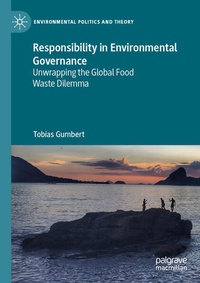
Responsibility in Environmental Governance
Description
This book provides a comprehensive study of the notion of responsibility in environmental governance. It starts with the observation that, although the rhetoric of responsibility is indeed all-pervasive in environmental and sustainability-related fields, decisive political action is still lacking. Governance architectures increasingly strive to hold different stakeholders responsible by installing accountability and transparency mechanisms to manage environmental problems, yet the structural background conditions affecting these issues continue to generate unevenly distributed, socially unjust, and ecologically devastating consequences. Responsibility in Environmental Governance develops the concept of responsibility as an analytical approach to map and understand these dynamics and to situate diverse meanings of responsibility within larger socio-political contexts. It applies this approach to the study of food waste governance, uncovering a narrow governance focus on accountability, optimization, and consumer behavior change strategies, opening up spaces for organizing more democratic solutions to a truly global problem.
Reviews / Votes
"The single greatest transformation of contemporary environmentalism over the past three decades has been the insidiously engineered emaciation of everyday and elite understandings of responsibility and action for planetary sustainability. Hidden from view, this slow, inexorable narrowing of environmental responsibility is a potent barrier to human and ecological flourishing in the 21st century. Tobias Gumbert does us all - academics, policymakers, and activists - a great service by illuminating these dynamics and charting ethically compelling and political practical paths forward. More than a compelling analysis of global food waste, Responsibility in Environmental Governance is both a savvy expose of shifting notions of duty, responsibility, and blame in a warming world, and a primer for reclaiming earlier, more robust notions of responsibility in service of person and planet." (Michael Maniates, Professor of Social Science (Environmental Studies), Yale-NUS College)" Responsibility in Environmental Governance challenges the all-pervasive neoliberal tendency to put the onus for sustainability action on individuals rather than systems such as the political economy of capitalism. It patiently and methodically points out that it is not (only) our individual behaviours that need to change but the radical transformation of the structures within which those behaviours take place. Integrating theoretical analysis and empirical case studies on food waste governance, Gumbert has produced a pioneering work highlighting the urgent need for collective not individual modes of responding to the planetary crisis. Such collective responses are, as he suggests, deeply ethical and political. In opposition to responsibilising individuals Gumbert calls, echoing Hans Jonas, for the politicisation of collective responsibility." (John Barry, Professor of Green Political Economy at the School of History, Anthropology, Philosophy and Politics at Queen's University Belfast, Northern Ireland)
"In the mid-1980s Ulrich Beck introduced the idea of organized irresponsibility to make sense of how modern science, technology and business managed to avoid any charge for ecological damages. Forty years later, and faced with global threats and increasingly intricate value chains, responsibility is increasingly invoked, yet mostly as an individual affair and with rhetoric far exceeding actual outcomes. This timely book offers a comprehensive discussion of the multi-layered meaning and politics of responsibility in environmental governance, focusing on the crucial field of food waste, and making a case for a more robust institutional set-up that puts at its centre democracy, justice and solidarity." (Luigi Pellizzoni, University of Pisa, Italy, author of "Ontological Politics in a Disposable World: The New Mastery of Nature" (Routledge, 2016))
More details
Other editions
Additional editions
Person
Tobias Gumbert is a postdoctoral researcher and lecturer at the Institute of Political Science and the Center for Interdisciplinary Sustainability Research at the University of Münster, Germany. He works on contemporary issues of environmental politics, particularly in the areas of food policy, waste policy, sustainable consumption, and democratic governance.
Content
Chapter 1: Responsibility and the Environment - What's at Stake?.- Chapter 2: Environmental Governance and the Organization of Irresponsibility.- Chapter 3: The Narrow Conception of Responsibility in Environmental Governance.- Chapter 4: Ethics, Justice, and Power: Widening the Meaning(s) of Responsibility.- Chapter 5: Responsibility and Interpretive Research.- Chapter 6: Food Waste Governance - Introduction to the Case Study.- Chapter 7: Tracing the Meanings of Responsibility in Food Waste Governance.- Chapter 8: Contextualizing Responsibilit(ies) in Food Waste Governance.- Chapter 9: Conclusion - Towards Institutions of Forward-Looking Collective Responsibility.