

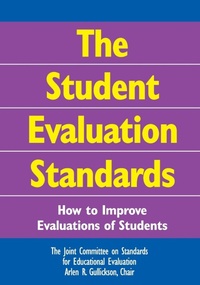
The Student Evaluation Standards
How to Improve Evaluations of Students
1st Edition
Published on 18. December 2002
Book
Paperback/Softback
264 pages
978-0-7619-4663-2 (ISBN)
Description
"Teachers make judgments about students every day, based on such formal and informal appraisals of their work as classroom observation, homework assignments, and teacher-made quizzes. Soon, they'll have the first set of professional standards to help guide them in making such decisions."
-Education Week
-Education Week A practical guide to designing and assessing student evaluation.
Student evaluation and assessment are central to every school and classroom. Evaluation and assessment are how we find out what students are learning, how they are progressing, and how we can make improvements for their future development. With requirements for testing and standards-based instruction at an all-time high, effective student evaluation is more essential today than ever before. But where in the instructional process should assessments occur? What kinds of questions should be asked? How is the information used to direct student learning? Who has the right to access and use this information?
The Joint Committee presents 28 certified standards for assessing evaluation practices in elementary and secondary classrooms. These standards are broken down into four essential attributes of sound evaluation, each providing definitions, guidelines, common errors, supportive documentation, and illustrative case studies:
Propriety standards, which protect individual rights
Utility standards, which ensure that evaluations are timely, informative, and influential
Feasibility standards, which recognize "real-world" dynamics and environmental influences
Accuracy standards, which determine whether an evaluation has produced sound information
These standards provide teachers and administrators with the tools they need to master every "nuance" of student evaluation, including validity, political viability, teacher biases, conflicts of interest, a student's right to privacy, and much more. But most important, they will help ensure that student evaluation practices are on track, so we can properly serve and improve student learning.
These standards have been approved by the American National Standards Institute (ANSI), and were developed with assistance from members of 16 professional societies:
American Association of School Administrators
American Counseling Association
American Educational Research Association
American Evaluation Association
American Psychological Association
Association for Supervision and Curriculum Development
Canadian Evaluation Society
Canadian Society for the Study of Education
Consortium for Research on Educational Accountability and Teacher Evaluation
Council of Chief State School Officers
National Association of Elementary School Principals
National Association of Secondary School Principals
National Council on Measurement in Education
National Education Association
National Legislative Program Evaluation Society
National School Boards Association
-Education Week
-Education Week A practical guide to designing and assessing student evaluation.
Student evaluation and assessment are central to every school and classroom. Evaluation and assessment are how we find out what students are learning, how they are progressing, and how we can make improvements for their future development. With requirements for testing and standards-based instruction at an all-time high, effective student evaluation is more essential today than ever before. But where in the instructional process should assessments occur? What kinds of questions should be asked? How is the information used to direct student learning? Who has the right to access and use this information?
The Joint Committee presents 28 certified standards for assessing evaluation practices in elementary and secondary classrooms. These standards are broken down into four essential attributes of sound evaluation, each providing definitions, guidelines, common errors, supportive documentation, and illustrative case studies:
Propriety standards, which protect individual rights
Utility standards, which ensure that evaluations are timely, informative, and influential
Feasibility standards, which recognize "real-world" dynamics and environmental influences
Accuracy standards, which determine whether an evaluation has produced sound information
These standards provide teachers and administrators with the tools they need to master every "nuance" of student evaluation, including validity, political viability, teacher biases, conflicts of interest, a student's right to privacy, and much more. But most important, they will help ensure that student evaluation practices are on track, so we can properly serve and improve student learning.
These standards have been approved by the American National Standards Institute (ANSI), and were developed with assistance from members of 16 professional societies:
American Association of School Administrators
American Counseling Association
American Educational Research Association
American Evaluation Association
American Psychological Association
Association for Supervision and Curriculum Development
Canadian Evaluation Society
Canadian Society for the Study of Education
Consortium for Research on Educational Accountability and Teacher Evaluation
Council of Chief State School Officers
National Association of Elementary School Principals
National Association of Secondary School Principals
National Council on Measurement in Education
National Education Association
National Legislative Program Evaluation Society
National School Boards Association
Reviews / Votes
"Teachers make judgments about students every day, based on such formal and informal appraisals of their work as classroom observation, homework assignments, and teacher-made quizzes. Soon, they'll have the first set of professional standards to help guide them in making such decisions." -- Education Week " . . . is [a] recommended and seminal reference which competently and accessibly address the issues of Propriety Standards, Utility Standards, Feasibility Standards, and Accuracy Standards." -- Library Bookwatch, February 2003 "This book is rich with illustrative evaluation cases and analyses and is intended to aid all those who conduct or use student evaluations. Appropriate for teachers, parents, school board members, school administrators, and professors of teacher education, this volume is a must-read that will enrich reflective practice of evaluation of student learning at the elementary and secondary levels." -- CHOICE, May 2003More details
Language
English
Place of publication
Thousand Oaks
United States
Target group
Professional and scholarly
Dimensions
Height: 254 mm
Width: 178 mm
Thickness: 15 mm
Weight
511 gr
ISBN-13
978-0-7619-4663-2 (9780761946632)
Copyright in bibliographic data and cover images is held by Nielsen Book Services Limited or by the publishers or by their respective licensors: all rights reserved.
Schweitzer Classification
Other editions
Additional editions
Book
12/2002
1st Edition
SAGE Publications Inc
€90.00
Shipment within 15-20 days
Person
Arlen R. Gullickson, Ph.D., is professor emeritus at Western Michigan University. He served as The Evaluation Center director from 2002 to 2007 and as its Chief of Staff of from 1991-2002. Dr. Gullickson chaired the Joint Committee on Standards for Educational Evaluation from 1998 to 2008 during which time the Committee developed The Student Evaluation Standards (2002), revised The Personnel Evaluation Standards, Second Edition (2007), and was engaged in revising The Program Evaluation Standards, Second Edition (1994) for the 3rd edition published in 2010. He has worked extensively in education as a secondary math and science teacher, professor of educational research and evaluation, and in the conduct of federally funded research and evaluation projects. In 2011 he stepped down from directing an NSF funded Advanced Technological Education evaluation resource center (EvaluATE) to become its co-director. He has received several major service awards including: the Western Michigan University's Distinguished Service Award (2002), the American Evaluation Association's Alva and Gunnar Myrdal Evaluation Practice (2007), and the Consortium for Research on Educational Accountability and Teacher Evaluation's Jason Millman Scholar award (2oo8). Although his primary work emphasis for the past 20 years has focused on program evaluation, he maintains a strong interest in classroom evaluation practices. He has authored numerous journal articles, book chapters and book materials. With Peter Airasian he authored the Teacher Self-Evaluation Tool Kit (1997) which presaged many of the ideas presented in this book.
Content
Functional Table of Contents
The Joint Committee
Acknowledgments
Invitation to Users
Preface
Introduction
Applying the Standards
The Standards
1. Proprietary Standards
Service to Students
Appropriate Policies and Procedures
Access to Evaluation Information
Treatment of Students
Rights of Students
Balanced Evaluation
Conflict of Interest
2. Utility Standards
Constructive Orientation
Defined Users and Uses
Information Scope
Evaluator Qualifications
Explicit Values
Effective Reporting
Follow-Up
3. Feasibility Standards
Practical Orientation
Political Viability
Evaluation Support
4. Accuracy Standards
Validity Orientation
Defined Expectations for Students
Context Analysis
Documented Procedures
Defensible Information
Reliable Information
Bias Identification and Management
Handling Information and Quality Control
Analysis of Information
Justified Conclusions
Metaevaluation
Appendix: The Support Groups
Appendix: Checklist for Applying the Standards
Glossary
Index
The Joint Committee
Acknowledgments
Invitation to Users
Preface
Introduction
Applying the Standards
The Standards
1. Proprietary Standards
Service to Students
Appropriate Policies and Procedures
Access to Evaluation Information
Treatment of Students
Rights of Students
Balanced Evaluation
Conflict of Interest
2. Utility Standards
Constructive Orientation
Defined Users and Uses
Information Scope
Evaluator Qualifications
Explicit Values
Effective Reporting
Follow-Up
3. Feasibility Standards
Practical Orientation
Political Viability
Evaluation Support
4. Accuracy Standards
Validity Orientation
Defined Expectations for Students
Context Analysis
Documented Procedures
Defensible Information
Reliable Information
Bias Identification and Management
Handling Information and Quality Control
Analysis of Information
Justified Conclusions
Metaevaluation
Appendix: The Support Groups
Appendix: Checklist for Applying the Standards
Glossary
Index