

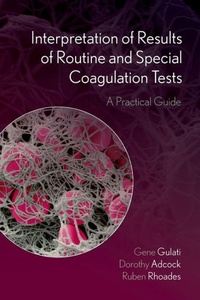
Interpretation of Results of Routine and Special Coagulation Tests
A Practical Guide
Published on 20. October 2025
Book
Paperback/Softback
176 pages
978-0-19-779543-9 (ISBN)
Description
Knowledge of the laboratory tests which most effectively work-up a patient presenting with bleeding or clotting manifestations is crucial to develop a sound and timely action plan for the benefit of the patient. It is important for medical professionals to know which tests best evaluate the causes of hemostasis disorders and what common clinical scenarios can significantly interfere with accurate test results, such as the impact of anticoagulant agents on routine and special coagulation assay results.
Interpretation of Results of Routine and Special Coagulation Tests: A Practical Guide is a concise, comprehensive, and accessible reference text for any medical professional who must order, understand, or interpret tests of the hemostasis system. For each test, this book provides the causes of abnormal results, including what can lead to false-positive and false-negative results. When possible, information is provided in table form for quick reference, such as the impact of commonly used anticoagulants on the results of hemostasis tests. This practical guide also includes tests that evaluate global hemostasis and clot lysis by viscoelastometry, as well as a discussion of laboratory monitoring of anticoagulants, antiplatelet agents, antifibrinolytics, and thrombolytics.
Interpretation of Results of Routine and Special Coagulation Tests: A Practical Guide is a concise, comprehensive, and accessible reference text for any medical professional who must order, understand, or interpret tests of the hemostasis system. For each test, this book provides the causes of abnormal results, including what can lead to false-positive and false-negative results. When possible, information is provided in table form for quick reference, such as the impact of commonly used anticoagulants on the results of hemostasis tests. This practical guide also includes tests that evaluate global hemostasis and clot lysis by viscoelastometry, as well as a discussion of laboratory monitoring of anticoagulants, antiplatelet agents, antifibrinolytics, and thrombolytics.
More details
Language
English
Place of publication
New York
United States
Target group
Professional and scholarly
Product notice
Paperback (trade)
Unsewn / adhesive bound
Illustrations
4
Dimensions
Height: 206 mm
Width: 145 mm
Thickness: 15 mm
Weight
204 gr
ISBN-13
978-0-19-779543-9 (9780197795439)
Copyright in bibliographic data and cover images is held by Nielsen Book Services Limited or by the publishers or by their respective licensors: all rights reserved.
Schweitzer Classification
Other editions
Additional editions
Gene L. Gulati | Dorothy M. Adcock | Ruben Rhoades
Interpretation of Results of Routine and Special Coagulation Tests
A Practical Guide
E-Book
08/2025
OUP eBook
€32.99
Available for download
Gene L. Gulati | Dorothy M. Adcock | Ruben Rhoades
Interpretation of Results of Routine and Special Coagulation Tests
A Practical Guide
E-Book
08/2025
OUP eBook
€32.99
Available for download
Persons
Gene Gulati is a nationally and internationally known clinical laboratory hematologist. Dr Gulati's professional career spans nearly four decades, directing hematology and coagulation laboratories and teaching hematology to hematopathology fellows, pathology residents, medical students, and laboratory professionals among two teaching institutions (Muhlenberg Regional Medical Center affiliated with Robert Wood Johnson Medical School of Rutgers University in New Jersey and Jefferson Medical College (now Sidney Kimmel Medical College) and Hospital of Thomas Jefferson University in Philadelphia, PA). His accomplishments include five books, many articles in peer-reviewed medical journals, and multiple presentations at regional, national, and international conferences organized by professional societies. He has been honored with Distinguished Emeritus Membership by American Society of Hematology and Emeritus Membership by American Society for Clinical Pathology.
Dorothy Adcock is an eminent specialist in the field of pathology, with expertise in clinical pathology, particularly hemostasis, in national and international settings for over 30 years. Dr. Adcock has chaired the Hematology and Pathology Device Panel for the FDA, served on the Hematopathology Test Development Committee of the ABP, is the past-president of North American Specialized Coagulation Laboratory Association, and received the 2019 ASCP Mastership Award, which recognizes individuals who have significantly contributed to the field of pathology/laboratory medicine. She has drafted several hemostasis guideline documents for the International Council for Standardization in Hematology and has authored over 130 peer-reviewed hemostasis-related articles and book chapters.
Ruben Rhoades is a classical hematologist with a clinical and research interest in disorders of thrombosis and hemostasis. He directs the Cardeza Foundation Hemophilia and Thrombosis Center at Thomas Jefferson University, caring for patients with inherited and acquired bleeding disorders and thrombophilias. He conducts outcomes research in these patients and studies laboratory testing in coagulopathies, and is a principal investigator on studies of novel therapies, including in heparin-induced thrombocytopenia and gene therapy in hemophilia A.
Dorothy Adcock is an eminent specialist in the field of pathology, with expertise in clinical pathology, particularly hemostasis, in national and international settings for over 30 years. Dr. Adcock has chaired the Hematology and Pathology Device Panel for the FDA, served on the Hematopathology Test Development Committee of the ABP, is the past-president of North American Specialized Coagulation Laboratory Association, and received the 2019 ASCP Mastership Award, which recognizes individuals who have significantly contributed to the field of pathology/laboratory medicine. She has drafted several hemostasis guideline documents for the International Council for Standardization in Hematology and has authored over 130 peer-reviewed hemostasis-related articles and book chapters.
Ruben Rhoades is a classical hematologist with a clinical and research interest in disorders of thrombosis and hemostasis. He directs the Cardeza Foundation Hemophilia and Thrombosis Center at Thomas Jefferson University, caring for patients with inherited and acquired bleeding disorders and thrombophilias. He conducts outcomes research in these patients and studies laboratory testing in coagulopathies, and is a principal investigator on studies of novel therapies, including in heparin-induced thrombocytopenia and gene therapy in hemophilia A.
Author
Professor, Emeritus, Division of Hematopathology and Director of Hematology and Coagulation Laboratory (retired)Professor, Emeritus, Division of Hematopathology and Director of Hematology and Coagulation Laboratory (retired), Department of Pathology, Sidney Kimmel Medical College at Thomas Jefferson University
Chief Medical Officer (retired)Chief Medical Officer (retired), Laboratory Corporation of America
Assistant Professor of Medicine, Division of Hematology, DirectorAssistant Professor of Medicine, Division of Hematology, Director, Cardeza Foundation Hemophilia and Thrombosis Center, Thomas Jefferson University
Content
Part I: General Consideration
Chapter 1. Basics of laboratory evaluation of bleeding and clotting disorders
Chapter 2. Laboratory evaluation of bleeding disorders
Part II: Tests for Individual Phases of Hemostasis
Chapter 3. Tests for bleeding disorders due to defects in primary hemostasis
Chapter 4. Tests for bleeding disorders due to defects in secondary hemostasis
Chapter 5. Tests for bleeding and thrombotic/clotting disorders due to defects in tertiary hemostasis (fibrinolytic system)
Part III: Laboratory evaluation of specific clotting/thrombotic disorders
Chapter 6. Tests for disseminated intravascular coagulation (DIC) and for excluding
vein thrombosis (DVT) and pulmonary embolism (PE) in an outpatient setting
Chapter 7. Tests for antiphospholipid syndrome
Chapter 8. Tests for hereditary thrombophilia
Chapter 9. Tests for heparin induced thrombocytopenia and thrombosis and adenovirus & vaccine induced thrombocytopenia and thrombosis:
Chapter 10. Tests for thrombotic thrombocytopenic purpura (TTP)
Part IV: Viscoelastic global hemostasis assays
Chapter 11. Global tests to assess overall hemostasis and fibrinolysis
Part V: Laboratory monitoring of therapeutic agents
Chapter 12. Anticoagulants
Chapter 13. Antiplatelet agents
Chapter 14. Other agents
Part VI: Impact of anticoagulants on results of coagulation tests
Chapter 15. Influence of anticoagulants on results of routine and special coagulation assays
Chapter 1. Basics of laboratory evaluation of bleeding and clotting disorders
Chapter 2. Laboratory evaluation of bleeding disorders
Part II: Tests for Individual Phases of Hemostasis
Chapter 3. Tests for bleeding disorders due to defects in primary hemostasis
Chapter 4. Tests for bleeding disorders due to defects in secondary hemostasis
Chapter 5. Tests for bleeding and thrombotic/clotting disorders due to defects in tertiary hemostasis (fibrinolytic system)
Part III: Laboratory evaluation of specific clotting/thrombotic disorders
Chapter 6. Tests for disseminated intravascular coagulation (DIC) and for excluding
vein thrombosis (DVT) and pulmonary embolism (PE) in an outpatient setting
Chapter 7. Tests for antiphospholipid syndrome
Chapter 8. Tests for hereditary thrombophilia
Chapter 9. Tests for heparin induced thrombocytopenia and thrombosis and adenovirus & vaccine induced thrombocytopenia and thrombosis:
Chapter 10. Tests for thrombotic thrombocytopenic purpura (TTP)
Part IV: Viscoelastic global hemostasis assays
Chapter 11. Global tests to assess overall hemostasis and fibrinolysis
Part V: Laboratory monitoring of therapeutic agents
Chapter 12. Anticoagulants
Chapter 13. Antiplatelet agents
Chapter 14. Other agents
Part VI: Impact of anticoagulants on results of coagulation tests
Chapter 15. Influence of anticoagulants on results of routine and special coagulation assays