

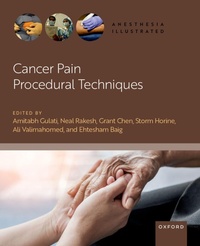
Cancer Pain Procedural Techniques
Published on 26. May 2025
Book
Paperback/Softback
364 pages
978-0-19-093350-0 (ISBN)
Description
Multiple books on techniques of interventional pain management are available, however, applications to cancer pain management are lacking. The cancer pain specialists at Memorial Sloan Kettering have spent the last decade perfecting techniques in regional anesthesia, pain medicine, neuromodulation, and rehabilitation and applying what they have learned to alleviating pain in the oncologic population. Cancer Pain Procedural Techniques imparts to readers a clear understanding of the techniques currently available to manage cancer pain; focusing not only on indications specific to the cancer patient, but providing a guide to appropriately apply these techniques, and apply them safely, in the oncologic patient.
The text surveys important procedures necessary for a pain practitioner to treat an oncologic patient. Specific guidelines for indications and procedure descriptions along with anatomical and image-guided descriptions are included in each chapter. Chapters address both acute cancer related pain syndromes and treatment related pain syndromes. New interventional options such as percutaneous cordotomy and radiofrequency ablation of vertebral bodies are also detailed. This book functions as a practical aid and should appeal to established pain practitioners as well as pain practitioners in training.
The text surveys important procedures necessary for a pain practitioner to treat an oncologic patient. Specific guidelines for indications and procedure descriptions along with anatomical and image-guided descriptions are included in each chapter. Chapters address both acute cancer related pain syndromes and treatment related pain syndromes. New interventional options such as percutaneous cordotomy and radiofrequency ablation of vertebral bodies are also detailed. This book functions as a practical aid and should appeal to established pain practitioners as well as pain practitioners in training.
More details
Series
Language
English
Place of publication
New York
United States
Target group
Professional and scholarly
Product notice
Paperback (trade)
Unsewn / adhesive bound
Dimensions
Height: 233 mm
Width: 192 mm
Thickness: 17 mm
Weight
898 gr
ISBN-13
978-0-19-093350-0 (9780190933500)
Copyright in bibliographic data and cover images is held by Nielsen Book Services Limited or by the publishers or by their respective licensors: all rights reserved.
Schweitzer Classification
Other editions
Additional editions
Amitabh Gulati | Neal Rakesh | Grant Chen
Cancer Pain Procedural Techniques
E-Book
03/2025
OUP eBook
€82.49
Available for download
Amitabh Gulati | Neal Rakesh | Grant Chen
Cancer Pain Procedural Techniques
E-Book
03/2025
OUP eBook
€82.49
Available for download
Persons
Amitabh Gulati, MD is a board certified anesthesiologist and chronic pain specialist who specializes in treating cancer related pain syndromes at Memorial Sloan Kettering Center in New York.
Neal Rakesh, MD, MSE is an assistant attending physician specializing in acute and chronic pain medicine at Memorial Sloan Kettering Center in New York.
Grant Chen, MD is a double board-certified anesthesiologist and pain management specialist at Memorial Sloan Kettering Center in New York.
Storm Horine, MD is an anesthesiologist with a sub-specialization in pain management based at Memorial Sloan Kettering Center in New York.
Ali Valimahomed, MD is a double board certified interventional pain medicine physician based at the Advanced Orthopedics and Sports Medicine Institute.
Ehtesham Baig, MD is a double board-certified anesthesiologist and pain medicine physician based at the University of Toronto.
Neal Rakesh, MD, MSE is an assistant attending physician specializing in acute and chronic pain medicine at Memorial Sloan Kettering Center in New York.
Grant Chen, MD is a double board-certified anesthesiologist and pain management specialist at Memorial Sloan Kettering Center in New York.
Storm Horine, MD is an anesthesiologist with a sub-specialization in pain management based at Memorial Sloan Kettering Center in New York.
Ali Valimahomed, MD is a double board certified interventional pain medicine physician based at the Advanced Orthopedics and Sports Medicine Institute.
Ehtesham Baig, MD is a double board-certified anesthesiologist and pain medicine physician based at the University of Toronto.
Editor
Anesthesiologist and Chronic Pain SpecialistAnesthesiologist and Chronic Pain Specialist, Memorial Sloan Kettering Center
Assistant Attending PhysicianAssistant Attending Physician, Memorial Sloan Kettering Center
Anesthesiologist and Pain Management SpecialistAnesthesiologist and Pain Management Specialist, Memorial Sloan Kettering Center
AnesthesiologistAnesthesiologist, Memorial Sloan Kettering Center
Interventional Pain Medicine PhysicianInterventional Pain Medicine Physician, Advanced Orthopedics and Sports Medicine Institute
Anesthesiologist and Pain Medicine PhysicianAnesthesiologist and Pain Medicine Physician, University of Toronto
Content
I. Introduction
1. Brief discussion on cancer pain syndromes
2. Critical evaluation for interventions in oncologic pain medicine
3. Physiology of cryo and radiofrequency ablation
4. Evaluating image guidance for interventions
5. Oncologic considerations
6. Drug allergy and chemoneurolytic agents
II. Muscle plane blocks
8. Chest wall planes
9. Abdominal planes
10. Other conceptual locations
11. Muscular targets TPI
III. Peripheral nerve blocks
12. Nerves of the scalp
13. Branches of the superficial cervical plexus
14. Branches of the trigeminal nerve
15. Branches innervating the shoulder girdle
16. Branches innervating the thorax
17. Branches innervating the upper extremities
18. Branches innervating the lower extremity
19. Pelvic targets
IV. Joint injections and denervation
20. Shoulder
21. Hip and trochanter
22. Sacroiliac joint
23. Facet joint
24. Knee
25. Other targets (scapula etc)
V. Sympathetic blocks
26. Stellate ganglion block
27. Thoracic sympathetic block
28. Celiac and thoracolumbar splanchnics
29. Lumbar splanchnics and sympathetic chain
30. Superior hypogastric plexus
31. Ganglion of impar
VI. Neuromodulation and neuroablation
32. Intrathecal drug delivery
33. Epidural procedures
34. Intrathecal neurolysis
35. Spinal Cord stimulation
36. Peripheral nerve stimulation and TENS
37. Percutaneous cordotomy
VII. Augumentation procedures
38. Kyphoplasty
39. Sacroplasty
40. Radiologic ablation
1. Brief discussion on cancer pain syndromes
2. Critical evaluation for interventions in oncologic pain medicine
3. Physiology of cryo and radiofrequency ablation
4. Evaluating image guidance for interventions
5. Oncologic considerations
6. Drug allergy and chemoneurolytic agents
II. Muscle plane blocks
8. Chest wall planes
9. Abdominal planes
10. Other conceptual locations
11. Muscular targets TPI
III. Peripheral nerve blocks
12. Nerves of the scalp
13. Branches of the superficial cervical plexus
14. Branches of the trigeminal nerve
15. Branches innervating the shoulder girdle
16. Branches innervating the thorax
17. Branches innervating the upper extremities
18. Branches innervating the lower extremity
19. Pelvic targets
IV. Joint injections and denervation
20. Shoulder
21. Hip and trochanter
22. Sacroiliac joint
23. Facet joint
24. Knee
25. Other targets (scapula etc)
V. Sympathetic blocks
26. Stellate ganglion block
27. Thoracic sympathetic block
28. Celiac and thoracolumbar splanchnics
29. Lumbar splanchnics and sympathetic chain
30. Superior hypogastric plexus
31. Ganglion of impar
VI. Neuromodulation and neuroablation
32. Intrathecal drug delivery
33. Epidural procedures
34. Intrathecal neurolysis
35. Spinal Cord stimulation
36. Peripheral nerve stimulation and TENS
37. Percutaneous cordotomy
VII. Augumentation procedures
38. Kyphoplasty
39. Sacroplasty
40. Radiologic ablation