

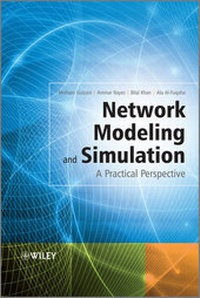
Network Modeling and Simulation
A Practical Perspective
Will be published approx. on 12. February 2010
Book
Hardback
304 pages
978-0-470-03587-0 (ISBN)
Description
This book introduces the basic concepts behind using Modelling and simulation in solving real-life problems. It addresses some of the practical limitations that are usually faced by developers when Modelling complex or large-scale systems. Some of the ways to alleviate these problems are looked at and discussed. Followed by an industry-standard Modelling methodology that can be applied in steps to tackle any Modelling problem in practice.
The book introduces the OPNET software product and its different modules, and some practical examples where it has been used to conduct practical studies in network analysis and design.
More details
Product info
gebunden
Edition
1. Auflage
Language
English
Place of publication
United States
Publishing group
John Wiley & Sons Inc
Target group
Professional and scholarly
Product notice
Unsewn / adhesive bound
Paper over boards
Dimensions
Height: 255 mm
Width: 177 mm
Thickness: 27 mm
Weight
713 gr
ISBN-13
978-0-470-03587-0 (9780470035870)
Schweitzer Classification
Other editions
Additional editions
E-Book
01/2010
Wiley
€80.99
Available for download
Persons
Dr. Guizani is currently a Full Professor and the Chair of the Computer Science Department at Western Michigan University.
Mr. Qadan is the General Manager of Equinox International. He worked and served as a Senior Technical Director for OPNET Technologies (leading modelling and simulation vendor) between 2002 and 2005.
Mr. Qadan is the General Manager of Equinox International. He worked and served as a Senior Technical Director for OPNET Technologies (leading modelling and simulation vendor) between 2002 and 2005.
Content
Preface
Acknowledgements
1 Basic Concepts and Techniques
1.1 Why Is Simulation Important?
1.2 What Is a Model?
1.3 Performance Evaluation Techniques
1.4 Development of Systems Simulation
1.5 Summary
Recommended Reading
2 Designing and Implementing a Discrete-Event Simulation Framework
2.1 The Scheduler
2.2 The Simulation Entities
2.3 The Events
2.4 Tutorial 1: Hello World
2.5 Tutorial 2: Two-Node Hello Protocol
2.6 Tutorial 3: Two-Node Hello through a Link
2.7 Tutorial 4: Two-Node Hello through a Lossy Link
2.8 Summary
Recommended Reading
3 Honeypot Communities: A Case Study with the Discrete-Event Simulation Framework
3.1 Background
3.2 System Architecture
3.3 Simulation Modeling
3.4 Simulation Execution
3.5 Output Analysis
3.6 Summary
Recommended Reading
4 Monte Carlo Simulation
4.1 Characteristics of Monte Carlo Simulations
4.2 The Monte Carlo Algorithm
4.3 Merits and Drawbacks
4.4 Monte Carlo Simulation for the Electric Car Charging Station
4.5 Summary
Recommended Reading
5 Network Modeling
5.1 Simulation of Networks
5.2 The Network Modeling and Simulation Process
5.3 Developing Models
5.4 Network Simulation Packages
5.5 OPNET: A Network Simulation Package
5.6 Summary
Recommended Reading
6 Designing and Implementing CASiNO: A Network Simulation Framework
6.1 Overview
6.2 Conduits
6.3 Visitors
6.4 The Conduit Repository
6.5 Behaviors and Actors
6.6 Tutorial 1: Terminals
6.7 Tutorial 2: States
6.8 Tutorial 3: Making Visitors
6.9 Tutorial 4: Muxes
6.10 Tutorial 5: Factories
6.11 Summary
Recommended Reading
7 Statistical Distributions and Random Number Generation
7.1 Introduction to Statistical Distributions
7.2 Discrete Distributions
7.3 Continuous Distributions
7.4 Augmenting CASiNO with Random Variate Generators
7.5 Random Number Generation
7.6 Frequency and Correlation Tests
7.7 Random Variate Generation
7.8 Summary
Recommended Reading
8 Network Simulation Elements: A Case Study Using CASiNO
8.1 Making a Poisson Source of Packets
8.2 Making a Protocol for Packet Processing
8.3 Bounding Protocol Resources
8.4 Making a Round-Robin (De)multiplexer
8.5 Dynamically Instantiating Protocols
8.6 Putting It All Together
8.7 Summary
9 Queuing Theory
9.1 Introduction to Stochastic Processes
9.2 Discrete-Time Markov Chains
9.3 Continuous-Time Markov Chains
9.4 Basic Properties of Markov Chains
9.5 Chapman-Kolmogorov Equation
9.6 Birth-Death Process
9.7 Little's Theorem
9.8 Delay on a Link
9.9 Standard Queuing Notation
9.10 The M/M/1 Queue
9.11 The M/M/m Queue
9.12 The M/M/1/b Queue
9.13 The M/M/m/m Queue
9.14 Summary
Recommended Reading
10 Input Modeling and Output Analysis
10.1 Data Collection
10.2 Identifying the Distribution
10.3 Estimation of Parameters for Univariate Distributions
10.4 Goodness-of-Fit Tests
10.5 Multivariate Distributions
10.6 Selecting Distributions without Data
10.7 Output Analysis
10.8 Summary
Recommended Reading
11 Modeling Network Traffic
11.1 Introduction
11.2 Network Traffic Models
11.3 Traffic Models for Mobile Networks
11.4 Global Optimization Techniques
11.5 Particle Swarm Optimization
11.6 Optimization in Mathematics
11.7 Summary
Recommended Reading
Index