

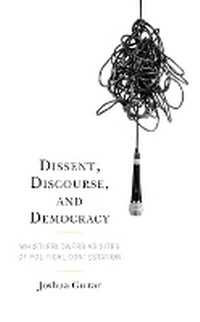
Dissent, Discourse, and Democracy
Whistleblowers as Sites of Political Contestation
Published on 1. October 2021
Book
Hardback
220 pages
978-1-7936-3925-7 (ISBN)
Description
Government whistleblowers contest authoritarian power. Yet, critical scholars have only minimally examined whistleblower discourses and hesitate to substantively interrogate the ideology of statism. In Dissent, Discourse, and Democracy: Whistleblowers as Sites of Political Contestation, the author addresses this exigency and critiques government whistleblowing discourses through an Anarchist lens, reifying a pattern of discursive statist behaviors. Upon exposing government malfeasance, whistleblowers and their corresponding symbolic designations endure an erasure of agency via abstraction. Joshua Guitar conceptualizes the totality of abstruction, identifying it both as a rhetorical manifestation of ideology and a method of critical rhetorical inquiry. The author reveals how whistleblowing, a quintessential tool of dissent within democracy, has been systematically constrained within the public forum and weaponized for statist interests. Scholars of political communication and rhetoric will find this book particularly interesting.
Reviews / Votes
In combining an uncommon alchemy of critical theory, rhetorical analysis, and a methodology as extraordinary as his subject matter, Guitar painstakingly deconstructs in literal terms how no good deed goes unpunished. The magician's trick in this book is not just how the democratic work of whistleblowing becomes transformed into manifestations of authoritarian state power but also how those sites of transformation are underexplored, fertile grounds for further critical inquiry. What emerges is a work deep in thought and in need of immediate attention by critical theorists, whistleblower researchers, and scholars. -- Alan Chu, Kent State University Stark As anarchist protests have attracted the eyes of the mainstream media, Guitar's book is perfectly timed. His anti-statist historical critique explains how the treatment and approval of whistleblowing often gives tacit acceptance to authoritarian ideology that lurks beneath. This book is a must for those looking to understand how the State legitimizes itself through shifts in discourse surrounding whistleblowing. Guitar brings a novel method of analysis, abstruction analysis, that should find its way into the toolbox of ideological critics. -- Craig Hennigan, Truman State University Joshua Guitar radically transforms the doxa surrounding whistleblowing. This book draws on anarchist theory to devise a theoretical framework for analyzing whistleblowing discourse. The analysis illuminates the statist ideological underpinnings that permeate whistleblowing narratives. Whistleblowing can signify speaking truth to power, but it can also be appropriated by those in power. This critique is a must read for anyone concerned with democratic speech and those who speak out against abuse of power. -- Avery Henry, Florida State UniversityMore details
Language
English
Place of publication
United States
Publishing group
Bloomsbury Publishing Plc
Target group
Professional and scholarly
Dimensions
Height: 228 mm
Width: 160 mm
Thickness: 23 mm
Weight
526 gr
ISBN-13
978-1-7936-3925-7 (9781793639257)
Copyright in bibliographic data and cover images is held by Nielsen Book Services Limited or by the publishers or by their respective licensors: all rights reserved.
Schweitzer Classification
Other editions
Additional editions

E-Book
10/2021
1st Edition
Lexington Books
€94.99
Available for download

E-Book
10/2021
1st Edition
Bloomsbury eBooks US
€94.99
Available for download
Person
Joshua Guitar is assistant professor of communication at Young Harris College, Georgia.
Content
Table of Contents
Acknowledgments
Chapter 1: Introduction
Chapter 2: Theory
Chapter 3: Abstruction
Chapter 4: Revolutionary Era
Chapter 5: Early Nation
Chapter 6: Vietnam Era
Chapter 7: Millennium Turn
Chapter 8: Post 9/11 Part I
Chapter 9: Post 9/11 Part II
Chapter 10: 2020
Chapter 11: Conclusion
Bibliography
About the Author
Acknowledgments
Chapter 1: Introduction
Chapter 2: Theory
Chapter 3: Abstruction
Chapter 4: Revolutionary Era
Chapter 5: Early Nation
Chapter 6: Vietnam Era
Chapter 7: Millennium Turn
Chapter 8: Post 9/11 Part I
Chapter 9: Post 9/11 Part II
Chapter 10: 2020
Chapter 11: Conclusion
Bibliography
About the Author