

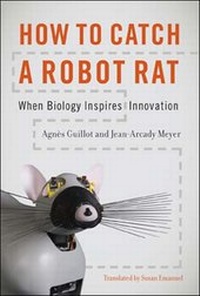
How to Catch a Robot Rat
When Biology Inspires Innovation
Published on 13. August 2010
Book
Hardback
240 pages
978-0-262-01452-6 (ISBN)
Description
How biology has inspired technology -- from a watch with an alarm modeled on a cricket's noisemaking to a robot that can dance.
Humans have modeled their technology on nature for centuries. The inventor of paper was inspired by a wasp's nest; Brunelleschi demonstrated the principles of his famous dome with an egg; a Swiss company produced a wristwatch with an alarm modeled on the sound-producing capabilities of a cricket. Today, in the era of the "new bionics," engineers aim to reproduce the speed and maneuverability of the red tuna in a submarine; cochlear implants send sound signals to the auditory nerve of a hearing-impaired person; and robots replicate a baby's cognitive development. How to Catch a Robot Rat examines past, present, and future attempts to apply the methods and systems found in nature to the design of objects and devices.
The authors look at "natural technology transfers": how the study of nature inspired technological breakthroughs -- including the cricket-inspired watch; Velcro, which duplicates the prickly burrs of a burdock flower; and self-sharpening blades that are modeled on rats' self-sharpening teeth. They examine autonomous robots that imitate animals and their behaviors -- for example, the development of an unmanned microdrone that could fly like an albatross. And they describe hybrids of natural and artificial systems: neuroprostheses translating the thought of quadriplegics; and a nanorobot controlled by muscle cells. Some of the ideas described have outstripped technology's capacity to realize them; nature has had more than three billion years to perfect its designs, humankind not quite so long.
Humans have modeled their technology on nature for centuries. The inventor of paper was inspired by a wasp's nest; Brunelleschi demonstrated the principles of his famous dome with an egg; a Swiss company produced a wristwatch with an alarm modeled on the sound-producing capabilities of a cricket. Today, in the era of the "new bionics," engineers aim to reproduce the speed and maneuverability of the red tuna in a submarine; cochlear implants send sound signals to the auditory nerve of a hearing-impaired person; and robots replicate a baby's cognitive development. How to Catch a Robot Rat examines past, present, and future attempts to apply the methods and systems found in nature to the design of objects and devices.
The authors look at "natural technology transfers": how the study of nature inspired technological breakthroughs -- including the cricket-inspired watch; Velcro, which duplicates the prickly burrs of a burdock flower; and self-sharpening blades that are modeled on rats' self-sharpening teeth. They examine autonomous robots that imitate animals and their behaviors -- for example, the development of an unmanned microdrone that could fly like an albatross. And they describe hybrids of natural and artificial systems: neuroprostheses translating the thought of quadriplegics; and a nanorobot controlled by muscle cells. Some of the ideas described have outstripped technology's capacity to realize them; nature has had more than three billion years to perfect its designs, humankind not quite so long.
More details
Series
Language
English
Place of publication
Cambridge, Mass.
United States
Publishing group
MIT Press Ltd
Target group
Interest Age: From 18 years
Illustrations
103 s/w Abbildungen
103 b&w illus.
Dimensions
Height: 229 mm
Width: 152 mm
Thickness: 13 mm
Weight
567 gr
ISBN-13
978-0-262-01452-6 (9780262014526)
Copyright in bibliographic data and cover images is held by Nielsen Book Services Limited or by the publishers or by their respective licensors: all rights reserved.
Schweitzer Classification
Persons
Agnès Guillot is Assistant Professor in Psychophysiology at the University of Paris X. Jean-Arcady Meyer is Emeritus Research Director at CNRS (Centre National de la Recherche Scientifique). Both are researchers at the Institute of Intelligent Systems and Robotics, University Pierre and Marie Curie, Paris.
Agnès Guillot is Assistant Professor in Psychophysiology at the University of Paris X and a researcher at the Institute of Intelligent Systems and Robotics, University Pierre and Marie Curie, Paris.
Agnès Guillot is Assistant Professor in Psychophysiology at the University of Paris X and a researcher at the Institute of Intelligent Systems and Robotics, University Pierre and Marie Curie, Paris.