

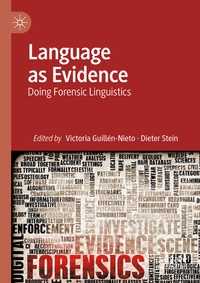
Language as Evidence
Doing Forensic Linguistics
Published on 10. February 2023
Book
Paperback/Softback
XVI, 464 pages
978-3-030-84332-8 (ISBN)
Description
This edited book provides a comprehensive survey of the modern state of the art in forensic linguistics. Part I of the book focuses on the role of the linguist as an expert witness in common law and civil law jurisdictions, the relation of expert witnesses and lawyers, ethics standards, and courtroom interaction. Part II deals with some of the major areas of expertise of forensic linguistics as the scientific study of language as evidence, namely authorship identification, speaker identification, text authentication, deception and lie detection, plagiarism detection, and cyber language crimes. This book is intended to be used as a reference for academics, students and practitioners of Linguistics, Forensic Linguistics, Law, Criminology, and Forensic Psychology, among other disciplines.
More details
Edition
2022 ed.
Language
English
Place of publication
Cham
Switzerland
Publishing group
Springer International Publishing
Target group
Professional and scholarly
Illustrations
27 s/w Abbildungen
XVI, 464 p. 27 illus.
Dimensions
Height: 210 mm
Width: 148 mm
Thickness: 26 mm
Weight
615 gr
ISBN-13
978-3-030-84332-8 (9783030843328)
DOI
10.1007/978-3-030-84330-4
Schweitzer Classification
Other editions
Additional editions
Book
02/2022
Palgrave Macmillan
€181.89
Shipment within 7-9 days
Persons
Victoria Guillén-Nieto is Senior Lecturer at the Department of English Studies, University of Alicante, Spain
Dieter Stein is Emeritus Professor at Anglistik III Englische Sprachwissenschaft, Heinrich-Heine-Universität Düsseldorf, Germany.
Content
Introduction: Theory and practice in forensic linguistics: Victoria Guillén-Nieto & Dieter Alfred Stein.- Chapter 1. Serving science and serving justice: Ethical issues faced by forensic linguists in their role as expert witnesses: Janet Ainsworth.- Chapter 2. Linguistic expert evidence in the common law: Andrew Hammel.- Chapter 3. Expert evidence in civil law systems: Mercedes López Fernández.- Chapter 4. Interacting with the expert witness: Courtroom epistemics under a discourse analyst's lens: Magdalena Szczyrbak.- Chapter 5. A lie or not a lie, that is the question. Trying to take arms against a sea of conceptual troubles: Methodological and theoretical issues in linguistic approaches to lie detection: Martina Nicklaus & Dieter Alfred Stein.- Chapter 6. Authorship identification: Eilika Fobbe.- Chapter 7. Automatic authorship investigation: Hans van Halteren.- Chapter 8. Speaker identification: Gea de Jong-Lendle.- Chapter 9. Plagiarism detection: Methodological approaches: Victoria Guillén-Nieto.- Chapter 10. The linguistic analysis of suicide notes: Monika Zasko-Zielinska.- Chapter 11. Fighting Cybercrime through linguistic analysis: Patrizia Anesa.- Chapter 12. Linguistic approaches to the analysis of online terrorist threats: Julien Longhi.