

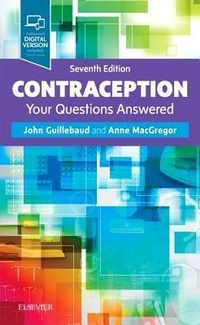
Contraception: Your Questions Answered
7th Edition
Published on 14. August 2017
Book
Paperback/Softback
424 pages
978-0-7020-7000-6 (ISBN)
Description
This seventh edition has been completely revised and updated, incorporating relevant WHO and national guidance documents: therefore imparting best evidence-based practice for all methods.
Combined oral contraceptives (COCs) Based on the long-established evidence that 7 days of routinely not-taking pills in each cycle is too long for maintained ovarian suppression - and this necessarily leads to too little margin for errors in pill-taking - the authors recommend that providers switch to a new norm for all users of either:
Tricycling, the 84/4 regimen, or totally continuous use (365/365),
OR, for women who remain keen to see monthly pill-bleeds (which are completely unnecessary for health), one of the regimens (24/4 or 21/4) that shorten the contraception-non-taking time to 4 days
New methods, and their importance or otherwise:
Intrauterine system: Jaydess (R)
Subcutaneous, self-injectable alternative to Depo-Provera: Sayana (R) Press
24/4 combined hormonal contraceptives: Zoely (R), Eloine (R)
Diaphragm: Caya (R)
Updates
Quick starting and bridging (the Proving not Pregnant Protocol)
Emergency contraception (EC), how advice differs for ulipristal acetate EC
Drug metabolism (implications with norethisterone) and interactions (eg affecting lamotrigine)
Question and answer format
Important information boxes
Unwanted side effects boxes
Frequent patient questions at the end of relevant chapters
Management advice
Follow-up advice
Comes with free e-book on ExpertConsult for the first time
This seventh edition has been completely revised and updated, incorporating relevant WHO and national guidance documents: therefore imparting best evidence-based practice for all methods.
Combined oral contraceptives (COCs) Based on the long-established evidence that 7 days of routinely not-taking pills in each cycle is too long for maintained ovarian suppression - and this necessarily leads to too little margin for errors in pill-taking - the authors recommend that providers switch to a new norm for all users of either:
Tricycling, the 84/4 regimen, or totally continuous use (365/365),
OR, for women who remain keen to see monthly pill-bleeds (which are completely unnecessary for health), one of the regimens (24/4 or 21/4) that shorten the contraception-non-taking time to 4 days
New methods, and their importance or otherwise:
Intrauterine system: Jaydess (R)
Subcutaneous, self-injectable alternative to Depo-Provera: Sayana (R) Press
24/4 combined hormonal contraceptives: Zoely (R), Eloine (R)
Diaphragm: Caya (R)
Updates
Quick starting and bridging (the Proving not Pregnant Protocol)
Emergency contraception (EC), how advice differs for ulipristal acetate EC
Drug metabolism (implications with norethisterone) and interactions (eg affecting lamotrigine)
Intermittent quizzes for CPD portfolio purposes
Now on ExpertConsult
Combined oral contraceptives (COCs) Based on the long-established evidence that 7 days of routinely not-taking pills in each cycle is too long for maintained ovarian suppression - and this necessarily leads to too little margin for errors in pill-taking - the authors recommend that providers switch to a new norm for all users of either:
Tricycling, the 84/4 regimen, or totally continuous use (365/365),
OR, for women who remain keen to see monthly pill-bleeds (which are completely unnecessary for health), one of the regimens (24/4 or 21/4) that shorten the contraception-non-taking time to 4 days
New methods, and their importance or otherwise:
Intrauterine system: Jaydess (R)
Subcutaneous, self-injectable alternative to Depo-Provera: Sayana (R) Press
24/4 combined hormonal contraceptives: Zoely (R), Eloine (R)
Diaphragm: Caya (R)
Updates
Quick starting and bridging (the Proving not Pregnant Protocol)
Emergency contraception (EC), how advice differs for ulipristal acetate EC
Drug metabolism (implications with norethisterone) and interactions (eg affecting lamotrigine)
Question and answer format
Important information boxes
Unwanted side effects boxes
Frequent patient questions at the end of relevant chapters
Management advice
Follow-up advice
Comes with free e-book on ExpertConsult for the first time
This seventh edition has been completely revised and updated, incorporating relevant WHO and national guidance documents: therefore imparting best evidence-based practice for all methods.
Combined oral contraceptives (COCs) Based on the long-established evidence that 7 days of routinely not-taking pills in each cycle is too long for maintained ovarian suppression - and this necessarily leads to too little margin for errors in pill-taking - the authors recommend that providers switch to a new norm for all users of either:
Tricycling, the 84/4 regimen, or totally continuous use (365/365),
OR, for women who remain keen to see monthly pill-bleeds (which are completely unnecessary for health), one of the regimens (24/4 or 21/4) that shorten the contraception-non-taking time to 4 days
New methods, and their importance or otherwise:
Intrauterine system: Jaydess (R)
Subcutaneous, self-injectable alternative to Depo-Provera: Sayana (R) Press
24/4 combined hormonal contraceptives: Zoely (R), Eloine (R)
Diaphragm: Caya (R)
Updates
Quick starting and bridging (the Proving not Pregnant Protocol)
Emergency contraception (EC), how advice differs for ulipristal acetate EC
Drug metabolism (implications with norethisterone) and interactions (eg affecting lamotrigine)
Intermittent quizzes for CPD portfolio purposes
Now on ExpertConsult
Reviews / Votes
'Bought this one as and update to the older version I have. The Q&A format is so easy to use. You could just read it but it's even better as a problem solving tool - anyone who provides contraceptive services should have a copy.''I'm a GP trainee doing an O&G rotation and this book is invaluable in providing me with answers to common and not so common questions that patients come in with. Very happy with this purchase.'
'It's up to date and innovative, easier to navigate than previous edition, and I like John Guillebaud's approach and style.'
'The bible for all medical practitioners regarding contraception. Very easy to use and find what you want. Seller was excellent too- arrived promptly and well packaged and the cheapest source.'
'Perfect book to have at hand for either quick revision or brief check when working in family planning. Easy to read with good explanations that can be memorised with very little effort.'
'Very well known book from the guru of contraception! A must have guide for the tricky subject of contraception for GPs.'
'Detailed but you can find the answer to your query. Up to date, a good reference manual. Would recommend it.'
'Bought this book whilst doing a family planning course and, now in practice, it has become my bible. Full of information, easy to understand, clear and concise. Helps with problem solving and also contains relevant physiology. Recommended for GPs, nurse practitioners, midwives, school nurses and anyone with an interest in family planning.'
'Great Reference book for medical professionals.'
More details
Series
Edition
7th edition
Language
English
Place of publication
London
United Kingdom
Target group
Professional and scholarly
General Practitioners
Women's health
Family planning
Healthcare policy
Global health
Illustrations
approx. 65 illustrations
Dimensions
Height: 134 mm
Width: 217 mm
Thickness: 19 mm
Weight
562 gr
ISBN-13
978-0-7020-7000-6 (9780702070006)
Copyright in bibliographic data and cover images is held by Nielsen Book Services Limited or by the publishers or by their respective licensors: all rights reserved.
Schweitzer Classification
Other editions
Additional editions
John Guillebaud | Anne MacGregor
Contraception: Your Questions Answered E-Book
E-Book
06/2017
7th Edition
Elsevier
€38.99
Available for download
Previous edition
John Guillebaud | Anne MacGregor
Contraception: Your Questions Answered
Book
10/2012
6th Edition
Churchill Livingstone
€64.56
Article exhausted; check for reprint
Persons
Author
Emeritus Professor of Family Planning and Reproductive Health, University College London, UK; Trustee of the Margaret Pyke Trust, Formerly Medical Director of the Margaret Pyke Family Planning Centre, London, UK
Associate Specialist Sexual and Reproductive Healthcare, Bart's Sexual Health Centre, St. Bartholomew's Hospital; Honorary Professor, Centre for Neuroscience and Trauma, Bart's and the London School of Medicine and Dentistry
Content
1. Introduction
2. Aspects of human fertility and fertility awareness: natural birth control
3. Male methods of contraception
4. Vaginal methods of contraception
5. The combined oral contraceptive - selection and eligibility
6. The combined oral contraceptive - follow-up arrangements and new routes of administration
7. The progestogen-only pill
8. Injectables and implants
9. Intrauterine devices and systems
10. Emergency (postcoital) contraception
11. Contraception for the young, the not quite so young - and in future
Further reading
Websites
Appendices
2. Aspects of human fertility and fertility awareness: natural birth control
3. Male methods of contraception
4. Vaginal methods of contraception
5. The combined oral contraceptive - selection and eligibility
6. The combined oral contraceptive - follow-up arrangements and new routes of administration
7. The progestogen-only pill
8. Injectables and implants
9. Intrauterine devices and systems
10. Emergency (postcoital) contraception
11. Contraception for the young, the not quite so young - and in future
Further reading
Websites
Appendices