

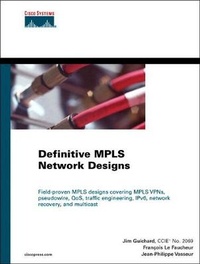
Definitive MPLS Network Designs (paperback)
Published on 8. July 2010
Book
Paperback/Softback
552 pages
978-1-58714-241-3 (ISBN)
Description
Service providers can turn to numerous sources that describe technologies used in MPLS networks, such as QoS, Traffic Engineering (TE), and VPN; however there is no single resource that illustrates how to actually design a network that benefits from the latest technologies, and combines them optimally for a specific environment. Definitive MPLS Network Designs fills this void by providing a series of design studies showing how to combine key techniques and technologies at the heart of IP/MPLS networks in line with real-life network best practices. The book starts with a technology refresher for each of the technologies involved in the design studies, including VPNs, TE, QoS, multicast, pseudowires, network recovery, and IPv6. Following this overview are detailed design studies, each based on a set of characteristics and objectives common to a profile of networks deploying MPLS. The book contains a design study for an Inter-eXchange Carrier (IXC), for a National Telco, for a Global Service Provider, and for an enterprise. The authors develop each design study in a consistent manner, starting with a description of the network environment and supported services. They then identify the objectives which influenced the design. Each design study then details all aspects of the network design using the latest MPLS technologies. Finally, a number of lessons which can be drawn from the design study are pointed out, allowing readers to apply the solutions that meet their needs. Jean-Philippe Vasseur is a system architect at Cisco, where he develops protocols and solutions for service provide customers and specializes in IP/MPLS. JP has been involved in many service provider backbone designs.
Jim Guichard, CCIE No. 2069, is a technical leader in Cisco's Internet Technologies Division, focusing on MPLS/IP. He has implemented many large-scale WAN and LAN networks and is coauthor of MPLS and VPN Architectures, Vol I and II.
Francois Le Faucheur is a system architect at Cisco, working in IP QoS and MPLS product development. He is coauthoring many IETF specifications on MPLS and QoS and previously worked for telecom carriers on enhanced service development.
1587051869
Jim Guichard, CCIE No. 2069, is a technical leader in Cisco's Internet Technologies Division, focusing on MPLS/IP. He has implemented many large-scale WAN and LAN networks and is coauthor of MPLS and VPN Architectures, Vol I and II.
Francois Le Faucheur is a system architect at Cisco, working in IP QoS and MPLS product development. He is coauthoring many IETF specifications on MPLS and QoS and previously worked for telecom carriers on enhanced service development.
1587051869
More details
Series
Language
English
Place of publication
Indianapolis
United States
Publishing group
Pearson Education (US)
Target group
Professional and scholarly
Dimensions
Height: 232 mm
Width: 189 mm
Thickness: 29 mm
Weight
940 gr
ISBN-13
978-1-58714-241-3 (9781587142413)
Copyright in bibliographic data and cover images is held by Nielsen Book Services Limited or by the publishers or by their respective licensors: all rights reserved.
Schweitzer Classification
Other editions
Additional editions
Jim Guichard | Francois Le Faucheur | Jean-Philippe Vasseur
Definitive MPLS Network Designs
Defini MPLS Networ ePub _1
E-Book
03/2005
1st Edition
Cisco Press
€69.99
Available for download
Jim Guichard | Francois Le Faucheur | Jean-Philippe Vasseur
Definitive MPLS Network Designs
E-Book
03/2005
1st Edition
Cisco Press
from
€77.79
Available for download
Previous edition

Jim Guichard | Francois Le Faucheur | Jean-Philippe Vasseur
Definitive MPLS Network Designs
Book
04/2005
Cisco Press
€73.22
Article exhausted; check for reprint
Persons
Jim Guichard, CCIE (R) No. 2069, is a system architect at Cisco Systems (R), with a primary focus on MPLS/IP Layer-2 and Layer-3 VPN technologies. During the last eight years at Cisco (R), and previously at IBM, Jim has been involved in the design, implementation, and planning of many large-scale WAN and LAN networks.
Francois Le Faucheur is a system architect at Cisco Systems working in product development and IETF standardization in the area of IP QoS and MPLS. Prior to joining Cisco, he worked for several telecom carriers in France and Australia on the development of enhanced services on ATM, Frame Relay, SMDS, and IP.
Jean-Philippe Vasseur is Cisco Distinguished Engineer where he works on IP/MPLS architecture specifications, focusing on IP, TE, and network recovery. He holds an engineering degree from France and an M.S. from the SIT (New Jersey, USA). Before joining Cisco, he worked for several service providers in large multiprotocol environments. He is an active member of the IETF, co-chair of the IETF PCE (Path Computation Element) Working Group and coauthor of several IETF RFCs. He is a regular speaker at various international conferences and is involved in various projects in the area of IP and MPLS. He has also filed several patents in the area of IP and MPLS and is the coauthor of "Network Recovery".
Francois Le Faucheur is a system architect at Cisco Systems working in product development and IETF standardization in the area of IP QoS and MPLS. Prior to joining Cisco, he worked for several telecom carriers in France and Australia on the development of enhanced services on ATM, Frame Relay, SMDS, and IP.
Jean-Philippe Vasseur is Cisco Distinguished Engineer where he works on IP/MPLS architecture specifications, focusing on IP, TE, and network recovery. He holds an engineering degree from France and an M.S. from the SIT (New Jersey, USA). Before joining Cisco, he worked for several service providers in large multiprotocol environments. He is an active member of the IETF, co-chair of the IETF PCE (Path Computation Element) Working Group and coauthor of several IETF RFCs. He is a regular speaker at various international conferences and is involved in various projects in the area of IP and MPLS. He has also filed several patents in the area of IP and MPLS and is the coauthor of "Network Recovery".
Content
Contents
Foreword
Introduction
Chapter 1 Technology Primer: Layer 3 VPN, Multicast VPNs, IPv6, and Pseudowire
MPLS VPN Services in MPLS/IP Networks
Layer 3 MPLS VPN Network Components
Separation of Routing State at PE Routers
Customer-to-Service Provider Routing Exchange
Label Allocation at the PE Router
Advertisement of VPNv4 Routes Across the IP/MPLS Backbone
Import of Remote Routing Information into VRFs
Forwarding of Layer 3 MPLS VPN Packets
Remote Access to the Layer 3 MPLS VPN Service
Dial-in Access Via L2TP VPDN
Dial-in Access Via Direct ISDN
DSL Access Using PPPoA or PPPoE and VPDN (L2TP)
Carrier's Carrier Architecture
Packet Forwarding with Carrier's Carrier
Layer 3 MPLS VPN Services Across Autonomous System Boundaries
Inter-AS Back-to-Back VRFs (Option A)
Inter-AS VPNv4 Exchange (Option B)
Inter-AS VPNv4 Exchange Between Route Reflectors (Option C)
Multicast VPNs
Source Distribution Multicast Trees
IP Multicast Shared Trees
Protocol-Independent Multicast (PIM)
PIM Dense Mode (PIM-DM)
PIM Sparse Mode (PIM-SM)
Source-Specific Multicast (SSM)
Multicast Support Within a Layer 3 MPLS VPN
Multicast Domains
mVPN PIM Adjacencies
Multicast Forwarding with mVPN
IPv6 Over MPLS Networks
Overview of IPv6
IPv6 Header
IPv6 Addressing
Neighbor Discovery and Autoconfiguration
IPv6 Routing
IPv6 Quality of Service
IPv6 Security
Deploying IPv6 Over an MPLS Network
IPv6 Provider Edge (6PE)
IPv6 VPN Provider Edge (6VPE)
Layer 2 Services and Pseudowires
Pseudowire Network Components
Pseudowire Forwarding Equivalent Class
Pseudowire Creation and Signaling
Pseudowire Encapsulation
Pseudowire Packet Flow
Chapter 2 Technology Primer: Quality of Service, Traffic Engineering, and Network Recovery
Quality of Service in MPLS Networks
Traffic Requirements and Service Level Agreements
Application Requirements
Service Level Agreement
QoS Mechanisms
The Fundamental QoS Versus Utilization Curve
The IETF DiffServ Model and Mechanisms
MPLS Support of DiffServ
Combining Tools to Support SLA
Core QoS Engineering
Edge QoS Engineering
QoS Models
Traffic Engineering
MPLS Traffic Engineering Components
Destination
Bandwidth
Affinities
Preemption
Protection by Fast Reroute
Optimized Metric
Hierarchy of Attributes (Set of Ordered Path Option)
TE LSP Path Computation
MPLS TE IGP Routing Extensions
Signaling of a Traffic Engineering LSP
Routing onto a Traffic Engineering LSP
Solving the Fish Problem
TE LSP Deployment Scenarios
Reoptimizing a Traffic Engineering LSP
MPLS Traffic Engineering and Load Balancing
MPLS Traffic Engineering Forwarding Adjacency
Automatic Meshing of a Mesh of TE LSPs
DiffServ-Aware MPLS Traffic Engineering
Bandwidth Constraints Model
Extensions to the Traffic Engineering LSP Attribute
Extensions to TE LSP Path Computation
Extensions to Traffic Engineering IGP Routing
Extensions to TE LSP Signaling
Routing onto DiffServ-Aware TE LSPs
Example of DS-TE Deployment
MPLS Traffic Engineering in the Context of Multiarea and Multi-AS
Core Network Availability
Protection Versus Restoration
Local Versus Global Recovery
Network Recovery with IP Routing
Use of Dynamic Timers for LSA Origination and SPF Triggering
Computing the Convergence Time with IP Routing
Network Recovery with MPLS Traffic Engineering
MPLS TE Reroute
MPLS TE Path Protection
MPLS TE Fast Reroute
Chapter 3 Interexchange Carrier Design Study
USCom's Network Environment
USCom's Network Design Objectives
Routing and Backbone Label Forwarding Design
Separation of Internet and Layer 3 MPLS VPN Services
Internet Service Route Reflection Deployment
Layer 3 MPLS VPN Service Design Overview
PE Router Basic Engineering Guidelines
VRF Naming Convention
Route Distinguisher Allocation
Route Target Allocation for Import/Export Policy
Basic PE Router Configuration Template
PE Router Control-Plane Requirements
PE Router Path MTU Discovery
VPNv4 Route Reflector Deployment Specifics
Deployment Location for VPNv4 Route Reflectors
Preventing Input Drops at the VPNv4 Route Reflectors
PE Router and Route Reflector VPNv4 MP-BGP Peering Template
PE-CE Routing Protocol Design
Static Routing Design Considerations
PE-CE BGP Routing Design Considerations
PE-CE IGP Routing Design Considerations
Specifics of the OSPF Service Deployment
Specifics of the EIGRP Service Deployment
IP Address Allocation for PE-CE Links
Controlling Route Distribution with Filtering
Security Design for the Layer 3 MPLS VPN Service
Quality of Service Design
SLA for Internet Service
SLA for the Layer 3 MPLS VPN Service
QoS Design in the Core Network
QoS Design on the Network Edge
Traffic Engineering Within the USCom Network
Network Recovery Design
Network Availability Objectives
Operational Constraints on Network Recovery Design
Cost Constraints for the Network Recovery Design
Network Recovery Design for Link Failures
Prefix Prioritization Within the USCom Network
Temporary Loop Avoidance
Forwarding Adjacency for Loop Avoidance
Reuse of a Restored Link
Multiple Failures Within the USCom Network
Link Failure Detection Within the USCom Network
Node Failures Within the USCom Network
Planned Router Maintenance
Unexpected Router Failures
Convergence of IS-IS
IS-IS Failure Detection Time
Flooding of New IS-IS LSPs
Routing Table Computation on Each Node
IS-IS Configuration Within the USCom Network
Design Lessons to Be Taken from USCom
Chapter 4 National Telco Design Study
Telecom Kingland Network Environment
Telecom Kingland POP Structure
Telecom Kingland Design Objectives
Routing and Backbone Label-Forwarding Design
Shared-Edge Internet and Layer 3 MPLS VPN Services
Internet Service: Route Reflection Deployment
Layer 3 MPLS VPN Service: Design Overview
Multiservice PE Router Basic Engineering Guidelines
Customer VRF Naming Convention
RT/RD Allocation Schemes
Network Management VPN
Load-Balancing Support
iBGP Multipath Support for VPNv4
eiBGP Multipath Support for VPNv4
mPE Router Control-Plane Requirements
VPNv4 Route Reflector Placement
PE-CE Routing Protocol Design
Carrier's Carrier Service
Load-Balancing Support with Carrier's Carrier
Large Carrier's Carrier Customer Attachment Example
Remote Access to the Layer 3 MPLS VPN Service
Dial-In Access Via L2TP VPDN
Dial-In Access Via Direct ISDN
DSL Access Using PPPoE or PPPoA and VPDN (L2TP)
mVPN Service Application
Multicast Address Allocation
Multicast Routing Protocol Support
Rendezvous Point and BSR Design for PIM-SM
Use of Data-MDTs in the mVPN Design
Restricting Multicast Routing State at mPE Routers
Quality of Service Design
Layer 3 MPLS VPN and Internet SLA
QoS Design in the Core Network
QoS Design on the Network Edge for Layer 3 MPLS VPN and Internet
CE Router Egress Policy
mPE Router Ingress Policy
mPE Router Egress Policy
QoS Design on the Network Edge for Voice Trunking
QoS Design on the Network Edge for Layer 3 MPLS VPN CsC
SLA Monitoring and Reporting
MPLS Traffic Engineering Design
Setting the Maximum Reservable Bandwidth on Each MPC Link
TE LSPs Bandwidth
Path Computation
TE LSPs Between PE-PSTN1 Routers
TE LSPs Between PE-PSTN1 and PE-PSTN2 Routers or Between PE-PSTN2 Routers
Reoptimization of TE LSPs
MPLS Traffic Engineering Simulation
TE Scaling Aspects
Use of Refresh Reduction
Provisioning the Mesh of TE LSPs
Monitoring
Last Resort Unconstrained Option
Network Recovery Design
Network Recovery Design for the Internet and Layer 3 MPLS VPN Traffic
Failure Detection Time
LSA Generation
Failure Notification Time
SPF Triggering
RIB and FIB Updates
OSPF Design Conclusions
Network Recovery Design for the PSTN Traffic
Failure Detection
Set of Backup Tunnels
Backup Tunnel Constraints
Backup Tunnel Design Between Level 1 POPs
Relaxing the SRLG Diversity Constraint
Design of the Backup Tunnels Between Level 2 and Level 1 POPs
Period of Time During Which Backup Tunnels Are in Use
Configuration of a Hold-Off Timer
Failure of a PE-PSTN Router
IPv6 Internet Access Service Design
Design Lessons to Be Taken from Telecom Kingland
Chapter 5 Global Service Provider Design Study
Globenet Network Environment
Globenet Service Portfolio
Globenet POP Network Structure
Type 1 POP Structure
Type 2 POP Structure
Type 3 POP Structure
Globenet Worldwide Network Architecture
EMEA Region
Asia-Pacific Region
North America Region
South America Region
Intercontinental Connectivity
Globenet Routing Architecture
Interoperator Partnerships
Link Types and Protection Details
Design Objectives for the Globenet Network
Layer 3 MPLS VPN Service Design
Shared-Edge Internet and MPLS VPN Services
Connectivity Between Globenet Regions
Filtering VPNv4 Routes at the ASBRs
Route Target/Route Distinguisher Allocation Between Regions
Connectivity with Regional Service Providers
Providing Internet Services to MPLS VPN Customers
Internet Via the Global or VRF Routing Table
Internet Access Following the Default Route
Full Internet Access Via the PE-CE Access Link
Internet Access Via Globenet NAT/Firewall Services
mVPN Service Design
MP-BGP Support of Inter-AS mVPN
Establishing mVPN MDT Groups Between Globenet Regions
Inter-AS mVPN System Flow
MPLS VPN Security and Scalability
VPN Operational Security
VPN Control Plane Protection
VPN Data Plane Protection
Scaling and Convergence of the Layer 3 MPLS VPN Service
Protocol Interaction
MP-BGP Scaling Considerations
Globenet Routing Convergence Strategy
Layer 3 MPLS VPN Service-Routing Convergence
Tuning the BGP Protocol
Edge Router Capabilities
IPv6 VPN Service Design
IPv6 VPN Design Within a Globenet Region
IPv6 VPN Design Across Globenet Regions
ATM Pseudowire Design
Quality of Service Design
VPN and Internet SLA
QoS Design in the Core Network in the EMEA, AsiaPac, and South America Regions
QoS Design in the Core Network on ATM PVCs
QoS Design in the Core Network in North America
QoS Design in the Core Network Across Regions
QoS Design on the Network Edge for Layer 3 MPLS VPN and Internet
CE Router Egress Policy
PE Router Ingress Policy
PE Router Egress Policy
QoS Design for the Interprovider VPN with Telecom Kingland
QoS Design for Multicast Traffic
QoS Design for the IPv6 VPN
Pseudowire QoS Design for ATM Trunking
SLA Monitoring and Reporting
MPLS Traffic Engineering Design
Setting the Maximum Reservable Bandwidth on Each Link
Automatic Setup and Provisioning of a Full Mesh of TE LSPs
Dynamic Traffic Engineering LSP Bandwidth Adjustment
Additional Resizing Parameters
Additional Advantages of Dynamic TE LSP Resizing
TE LSP Path Computation
MPLS Traffic Engineering in North America
MPLS Traffic Engineering in the AsiaPac, EMEA, and South America Regions
Reoptimization of TE LSPs
Traffic Engineering Scaling Aspects
Use of Refresh Reduction
Monitoring TE LSPs
Last-Resort Unconstrained Option
TE Design for ATM Pseudowires
Network Recovery Design
MPLS TE Fast Reroute Design Within Globenet Regions
Failure Detection
Set of Backup Tunnels
Backup Tunnel Constraints
Provisioning the Set of Backup Tunnels
Configuring a Hold-Off Timer
IS-IS Routing Design
Failure of a PE Router Supporting ATM Pseudowires
Network Recovery for IPv6 VPN
Virtual POP Design
Conversion of the Johannesburg POP to a VPOP
Attributes of the Inter-AS TE LSPs
Globenet VPOP Migration Strategy
Path Computation for Inter-AS TE LSPs
Reoptimization of Inter-AS TE LSPs
Routing onto Inter-AS TE LSPs
VPOP QoS Design
Recovery of Inter-AS TE LSPs
Policy Control at ASBR Boundaries
Africa Telecom VPOP
Design Lessons to Be Taken from Globenet
Chapter 6 Large Enterprise Design Study
EuroBank's Network Environment
Description of the Branch Office
Description of an Office Location
Description of a Core Network POP
Description of the Data Centers
Description of the Metro Connections in the UK
EuroBank Design Objectives
EuroBank Network Core Routing Design
Host Routing
Layer 3 MPLS VPN Service Design
Intersubsidiary and DataCenter Connectivity Requirements
Office Location Requirements
EuroBank Group VPN Definitions
Route Target and Route Distinguisher Allocation
Data Center Layer 3 MPLS VPN Design
POP Layer 3 MPLS VPN Design
Core MP-BGP Design
UK Office Location Layer 3 MPLS VPN Design
Routing Within Each Multi-VRF VRF
EuroBank Multicast Deployment and Design
EuroBank Brokerage Encryption Deployment and Design
Layer 3 MPLS VPN Design for VoIP
Architecture of the Managed Telephony Service
On-Net Voice Call Within a EuroBank VPN
On-Net Voice Call Across Two EuroBank VPNs
Layer 3 MPLS VPN Design Within PhoneNet and EuroBank Off-Net Voice Calls
Quality of Service Design
EuroBank's Service Classes
Traffic Classification in Offices and Data Centers
Sub-100-Mbps QoS Policy
100+Mbps QoS Policy
Gigabit Ethernet Link QoS Policy
QoS Design on the Access for Branches
Traffic Flowing from a Branch
Traffic Flowing to a Branch
Design Lessons to Be Taken from EuroBank
Appendix A References
Index_
Foreword
Introduction
Chapter 1 Technology Primer: Layer 3 VPN, Multicast VPNs, IPv6, and Pseudowire
MPLS VPN Services in MPLS/IP Networks
Layer 3 MPLS VPN Network Components
Separation of Routing State at PE Routers
Customer-to-Service Provider Routing Exchange
Label Allocation at the PE Router
Advertisement of VPNv4 Routes Across the IP/MPLS Backbone
Import of Remote Routing Information into VRFs
Forwarding of Layer 3 MPLS VPN Packets
Remote Access to the Layer 3 MPLS VPN Service
Dial-in Access Via L2TP VPDN
Dial-in Access Via Direct ISDN
DSL Access Using PPPoA or PPPoE and VPDN (L2TP)
Carrier's Carrier Architecture
Packet Forwarding with Carrier's Carrier
Layer 3 MPLS VPN Services Across Autonomous System Boundaries
Inter-AS Back-to-Back VRFs (Option A)
Inter-AS VPNv4 Exchange (Option B)
Inter-AS VPNv4 Exchange Between Route Reflectors (Option C)
Multicast VPNs
Source Distribution Multicast Trees
IP Multicast Shared Trees
Protocol-Independent Multicast (PIM)
PIM Dense Mode (PIM-DM)
PIM Sparse Mode (PIM-SM)
Source-Specific Multicast (SSM)
Multicast Support Within a Layer 3 MPLS VPN
Multicast Domains
mVPN PIM Adjacencies
Multicast Forwarding with mVPN
IPv6 Over MPLS Networks
Overview of IPv6
IPv6 Header
IPv6 Addressing
Neighbor Discovery and Autoconfiguration
IPv6 Routing
IPv6 Quality of Service
IPv6 Security
Deploying IPv6 Over an MPLS Network
IPv6 Provider Edge (6PE)
IPv6 VPN Provider Edge (6VPE)
Layer 2 Services and Pseudowires
Pseudowire Network Components
Pseudowire Forwarding Equivalent Class
Pseudowire Creation and Signaling
Pseudowire Encapsulation
Pseudowire Packet Flow
Chapter 2 Technology Primer: Quality of Service, Traffic Engineering, and Network Recovery
Quality of Service in MPLS Networks
Traffic Requirements and Service Level Agreements
Application Requirements
Service Level Agreement
QoS Mechanisms
The Fundamental QoS Versus Utilization Curve
The IETF DiffServ Model and Mechanisms
MPLS Support of DiffServ
Combining Tools to Support SLA
Core QoS Engineering
Edge QoS Engineering
QoS Models
Traffic Engineering
MPLS Traffic Engineering Components
Destination
Bandwidth
Affinities
Preemption
Protection by Fast Reroute
Optimized Metric
Hierarchy of Attributes (Set of Ordered Path Option)
TE LSP Path Computation
MPLS TE IGP Routing Extensions
Signaling of a Traffic Engineering LSP
Routing onto a Traffic Engineering LSP
Solving the Fish Problem
TE LSP Deployment Scenarios
Reoptimizing a Traffic Engineering LSP
MPLS Traffic Engineering and Load Balancing
MPLS Traffic Engineering Forwarding Adjacency
Automatic Meshing of a Mesh of TE LSPs
DiffServ-Aware MPLS Traffic Engineering
Bandwidth Constraints Model
Extensions to the Traffic Engineering LSP Attribute
Extensions to TE LSP Path Computation
Extensions to Traffic Engineering IGP Routing
Extensions to TE LSP Signaling
Routing onto DiffServ-Aware TE LSPs
Example of DS-TE Deployment
MPLS Traffic Engineering in the Context of Multiarea and Multi-AS
Core Network Availability
Protection Versus Restoration
Local Versus Global Recovery
Network Recovery with IP Routing
Use of Dynamic Timers for LSA Origination and SPF Triggering
Computing the Convergence Time with IP Routing
Network Recovery with MPLS Traffic Engineering
MPLS TE Reroute
MPLS TE Path Protection
MPLS TE Fast Reroute
Chapter 3 Interexchange Carrier Design Study
USCom's Network Environment
USCom's Network Design Objectives
Routing and Backbone Label Forwarding Design
Separation of Internet and Layer 3 MPLS VPN Services
Internet Service Route Reflection Deployment
Layer 3 MPLS VPN Service Design Overview
PE Router Basic Engineering Guidelines
VRF Naming Convention
Route Distinguisher Allocation
Route Target Allocation for Import/Export Policy
Basic PE Router Configuration Template
PE Router Control-Plane Requirements
PE Router Path MTU Discovery
VPNv4 Route Reflector Deployment Specifics
Deployment Location for VPNv4 Route Reflectors
Preventing Input Drops at the VPNv4 Route Reflectors
PE Router and Route Reflector VPNv4 MP-BGP Peering Template
PE-CE Routing Protocol Design
Static Routing Design Considerations
PE-CE BGP Routing Design Considerations
PE-CE IGP Routing Design Considerations
Specifics of the OSPF Service Deployment
Specifics of the EIGRP Service Deployment
IP Address Allocation for PE-CE Links
Controlling Route Distribution with Filtering
Security Design for the Layer 3 MPLS VPN Service
Quality of Service Design
SLA for Internet Service
SLA for the Layer 3 MPLS VPN Service
QoS Design in the Core Network
QoS Design on the Network Edge
Traffic Engineering Within the USCom Network
Network Recovery Design
Network Availability Objectives
Operational Constraints on Network Recovery Design
Cost Constraints for the Network Recovery Design
Network Recovery Design for Link Failures
Prefix Prioritization Within the USCom Network
Temporary Loop Avoidance
Forwarding Adjacency for Loop Avoidance
Reuse of a Restored Link
Multiple Failures Within the USCom Network
Link Failure Detection Within the USCom Network
Node Failures Within the USCom Network
Planned Router Maintenance
Unexpected Router Failures
Convergence of IS-IS
IS-IS Failure Detection Time
Flooding of New IS-IS LSPs
Routing Table Computation on Each Node
IS-IS Configuration Within the USCom Network
Design Lessons to Be Taken from USCom
Chapter 4 National Telco Design Study
Telecom Kingland Network Environment
Telecom Kingland POP Structure
Telecom Kingland Design Objectives
Routing and Backbone Label-Forwarding Design
Shared-Edge Internet and Layer 3 MPLS VPN Services
Internet Service: Route Reflection Deployment
Layer 3 MPLS VPN Service: Design Overview
Multiservice PE Router Basic Engineering Guidelines
Customer VRF Naming Convention
RT/RD Allocation Schemes
Network Management VPN
Load-Balancing Support
iBGP Multipath Support for VPNv4
eiBGP Multipath Support for VPNv4
mPE Router Control-Plane Requirements
VPNv4 Route Reflector Placement
PE-CE Routing Protocol Design
Carrier's Carrier Service
Load-Balancing Support with Carrier's Carrier
Large Carrier's Carrier Customer Attachment Example
Remote Access to the Layer 3 MPLS VPN Service
Dial-In Access Via L2TP VPDN
Dial-In Access Via Direct ISDN
DSL Access Using PPPoE or PPPoA and VPDN (L2TP)
mVPN Service Application
Multicast Address Allocation
Multicast Routing Protocol Support
Rendezvous Point and BSR Design for PIM-SM
Use of Data-MDTs in the mVPN Design
Restricting Multicast Routing State at mPE Routers
Quality of Service Design
Layer 3 MPLS VPN and Internet SLA
QoS Design in the Core Network
QoS Design on the Network Edge for Layer 3 MPLS VPN and Internet
CE Router Egress Policy
mPE Router Ingress Policy
mPE Router Egress Policy
QoS Design on the Network Edge for Voice Trunking
QoS Design on the Network Edge for Layer 3 MPLS VPN CsC
SLA Monitoring and Reporting
MPLS Traffic Engineering Design
Setting the Maximum Reservable Bandwidth on Each MPC Link
TE LSPs Bandwidth
Path Computation
TE LSPs Between PE-PSTN1 Routers
TE LSPs Between PE-PSTN1 and PE-PSTN2 Routers or Between PE-PSTN2 Routers
Reoptimization of TE LSPs
MPLS Traffic Engineering Simulation
TE Scaling Aspects
Use of Refresh Reduction
Provisioning the Mesh of TE LSPs
Monitoring
Last Resort Unconstrained Option
Network Recovery Design
Network Recovery Design for the Internet and Layer 3 MPLS VPN Traffic
Failure Detection Time
LSA Generation
Failure Notification Time
SPF Triggering
RIB and FIB Updates
OSPF Design Conclusions
Network Recovery Design for the PSTN Traffic
Failure Detection
Set of Backup Tunnels
Backup Tunnel Constraints
Backup Tunnel Design Between Level 1 POPs
Relaxing the SRLG Diversity Constraint
Design of the Backup Tunnels Between Level 2 and Level 1 POPs
Period of Time During Which Backup Tunnels Are in Use
Configuration of a Hold-Off Timer
Failure of a PE-PSTN Router
IPv6 Internet Access Service Design
Design Lessons to Be Taken from Telecom Kingland
Chapter 5 Global Service Provider Design Study
Globenet Network Environment
Globenet Service Portfolio
Globenet POP Network Structure
Type 1 POP Structure
Type 2 POP Structure
Type 3 POP Structure
Globenet Worldwide Network Architecture
EMEA Region
Asia-Pacific Region
North America Region
South America Region
Intercontinental Connectivity
Globenet Routing Architecture
Interoperator Partnerships
Link Types and Protection Details
Design Objectives for the Globenet Network
Layer 3 MPLS VPN Service Design
Shared-Edge Internet and MPLS VPN Services
Connectivity Between Globenet Regions
Filtering VPNv4 Routes at the ASBRs
Route Target/Route Distinguisher Allocation Between Regions
Connectivity with Regional Service Providers
Providing Internet Services to MPLS VPN Customers
Internet Via the Global or VRF Routing Table
Internet Access Following the Default Route
Full Internet Access Via the PE-CE Access Link
Internet Access Via Globenet NAT/Firewall Services
mVPN Service Design
MP-BGP Support of Inter-AS mVPN
Establishing mVPN MDT Groups Between Globenet Regions
Inter-AS mVPN System Flow
MPLS VPN Security and Scalability
VPN Operational Security
VPN Control Plane Protection
VPN Data Plane Protection
Scaling and Convergence of the Layer 3 MPLS VPN Service
Protocol Interaction
MP-BGP Scaling Considerations
Globenet Routing Convergence Strategy
Layer 3 MPLS VPN Service-Routing Convergence
Tuning the BGP Protocol
Edge Router Capabilities
IPv6 VPN Service Design
IPv6 VPN Design Within a Globenet Region
IPv6 VPN Design Across Globenet Regions
ATM Pseudowire Design
Quality of Service Design
VPN and Internet SLA
QoS Design in the Core Network in the EMEA, AsiaPac, and South America Regions
QoS Design in the Core Network on ATM PVCs
QoS Design in the Core Network in North America
QoS Design in the Core Network Across Regions
QoS Design on the Network Edge for Layer 3 MPLS VPN and Internet
CE Router Egress Policy
PE Router Ingress Policy
PE Router Egress Policy
QoS Design for the Interprovider VPN with Telecom Kingland
QoS Design for Multicast Traffic
QoS Design for the IPv6 VPN
Pseudowire QoS Design for ATM Trunking
SLA Monitoring and Reporting
MPLS Traffic Engineering Design
Setting the Maximum Reservable Bandwidth on Each Link
Automatic Setup and Provisioning of a Full Mesh of TE LSPs
Dynamic Traffic Engineering LSP Bandwidth Adjustment
Additional Resizing Parameters
Additional Advantages of Dynamic TE LSP Resizing
TE LSP Path Computation
MPLS Traffic Engineering in North America
MPLS Traffic Engineering in the AsiaPac, EMEA, and South America Regions
Reoptimization of TE LSPs
Traffic Engineering Scaling Aspects
Use of Refresh Reduction
Monitoring TE LSPs
Last-Resort Unconstrained Option
TE Design for ATM Pseudowires
Network Recovery Design
MPLS TE Fast Reroute Design Within Globenet Regions
Failure Detection
Set of Backup Tunnels
Backup Tunnel Constraints
Provisioning the Set of Backup Tunnels
Configuring a Hold-Off Timer
IS-IS Routing Design
Failure of a PE Router Supporting ATM Pseudowires
Network Recovery for IPv6 VPN
Virtual POP Design
Conversion of the Johannesburg POP to a VPOP
Attributes of the Inter-AS TE LSPs
Globenet VPOP Migration Strategy
Path Computation for Inter-AS TE LSPs
Reoptimization of Inter-AS TE LSPs
Routing onto Inter-AS TE LSPs
VPOP QoS Design
Recovery of Inter-AS TE LSPs
Policy Control at ASBR Boundaries
Africa Telecom VPOP
Design Lessons to Be Taken from Globenet
Chapter 6 Large Enterprise Design Study
EuroBank's Network Environment
Description of the Branch Office
Description of an Office Location
Description of a Core Network POP
Description of the Data Centers
Description of the Metro Connections in the UK
EuroBank Design Objectives
EuroBank Network Core Routing Design
Host Routing
Layer 3 MPLS VPN Service Design
Intersubsidiary and DataCenter Connectivity Requirements
Office Location Requirements
EuroBank Group VPN Definitions
Route Target and Route Distinguisher Allocation
Data Center Layer 3 MPLS VPN Design
POP Layer 3 MPLS VPN Design
Core MP-BGP Design
UK Office Location Layer 3 MPLS VPN Design
Routing Within Each Multi-VRF VRF
EuroBank Multicast Deployment and Design
EuroBank Brokerage Encryption Deployment and Design
Layer 3 MPLS VPN Design for VoIP
Architecture of the Managed Telephony Service
On-Net Voice Call Within a EuroBank VPN
On-Net Voice Call Across Two EuroBank VPNs
Layer 3 MPLS VPN Design Within PhoneNet and EuroBank Off-Net Voice Calls
Quality of Service Design
EuroBank's Service Classes
Traffic Classification in Offices and Data Centers
Sub-100-Mbps QoS Policy
100+Mbps QoS Policy
Gigabit Ethernet Link QoS Policy
QoS Design on the Access for Branches
Traffic Flowing from a Branch
Traffic Flowing to a Branch
Design Lessons to Be Taken from EuroBank
Appendix A References
Index_