

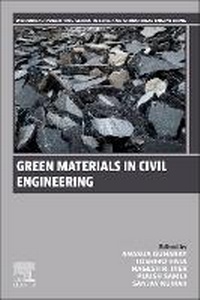
Green Materials in Civil Engineering
Published on 13. February 2024
Book
Paperback/Softback
332 pages
978-0-443-19106-0 (ISBN)
Description
Green Materials in Civil Engineering provides a comprehensive resource for practitioners to learn more about the utilization of these materials in civil engineering, as well as their practical applications. Novel green materials such as fly ash, slag, fiber-reinforced concrete and soil, smart materials, biological materials, and waste materials such as mineral wastes, building and demolition waste, recycled asphalt, coal gangue and industrial by-products are discussed in detail. Emphasis is placed on understanding the qualities, selection criteria, products and applications, durability, life cycle, and recyclability of these materials.
The book will be a valuable reference resource for academic and industrial researchers, materials scientists, and civil engineers who are working in the development of construction materials, utilization of waste, and other fine by-products in the production of concrete and other construction materials.
The book will be a valuable reference resource for academic and industrial researchers, materials scientists, and civil engineers who are working in the development of construction materials, utilization of waste, and other fine by-products in the production of concrete and other construction materials.
More details
Series
Language
English
Place of publication
United States
Publishing group
Elsevier - Health Sciences Division
Target group
Professional and scholarly
Product notice
Paperback (trade)
Dimensions
Height: 229 mm
Width: 152 mm
Thickness: 18 mm
Weight
447 gr
ISBN-13
978-0-443-19106-0 (9780443191060)
Copyright in bibliographic data and cover images is held by Nielsen Book Services Limited or by the publishers or by their respective licensors: all rights reserved.
Schweitzer Classification
Other editions
Additional editions
Anasua GuhaRay | Toshiro Hata | Nagesh R. Iyer
Green Materials in Civil Engineering
E-Book
02/2024
Woodhead Publishing
€195.99
Available for download
Persons
Dr. GuhaRay is an Associate Professor in the Department of Civil Engineering at BITS Pilani, India. She is also cross-appointed faculty at Hiroshima University, Japan. She received her PhD in Geotechnical Engineering from IIT Kharagpur, India, in 2014. Dr. GuhaRay's main areas of expertise are ground improvement with green materials, reliability applications in geotechnical engineering, and stabilization of expansive soil with activated binders. Dr. GuhaRay has previously co-edited Green Materials in Civil Engineering for Elsevier and contributed to several journal papers, book chapters, and peer-reviewed conference proceedings alongside international teams of experts.
Dr. Toshiro Hata is a full professor in the Department of Environmental and Civil Engineering at Hiroshima University, Japan. He attained his PhD in Civil Engineering from Gifu University, Japan in 2005. He commenced his academic career in 2006 taking up an associate professor position at Nagano National College of Technology until 2011. He then moved to Toyama Prefectural University in 2012 and became a full professor in 2016. He has been a visiting scholar at the University of Cambridge, UK; Arizona State University, USA and at Grenoble University in France. Dr. Hata's main area of expertise is on the enhancement of soil strength based on microbial functions. Dr. Nagesh R. Iyer is a Fellow of the Indian National Academy of Engineering and is currently Dean of (Infrastructure, Planning and Support) and Visiting Professor, at the Indian Institute of Technology Dharwad. He was formerly Director of CSIR-Structural Engineering Research Centre and Coordinating Director of CSIR Madras Complex. Concurrently he held the posts of Acting Director and Distinguished Emeritus Professor at the Academy of Scientific and Innovative Research (AcSIR). He has over 44 years of experience in the computer-aided analysis and design of complex and large structures which include infrastructural facilities. Dr. Samui is an Associate Professor in the Department of Civil Engineering at NIT Patna, India. He received his PhD in Geotechnical Engineering from the Indian Institute of Science Bangalore, India, in 2008. His research interests include geohazard, earthquake engineering, concrete technology, pile foundation and slope stability, and application of AI for solving different problems in civil engineering. Dr. Samui is a repeat Elsevier editor but also a prolific contributor to journal papers, book chapters, and peer-reviewed conference proceedings.
Dr. Sanjay Kumar is an Assistant Professor in the Department of Civil Engineering at NIT Patna, India. He received his PhD in Structural Engineering from the same institute in 2019. Dr. Sanjay has more than seventeen years of teaching experience, eight years of research experience, and a lot of practical knowledge from having worked in industry too. His research focuses on innovations in materials and design for civil engineering structures.
Dr. Toshiro Hata is a full professor in the Department of Environmental and Civil Engineering at Hiroshima University, Japan. He attained his PhD in Civil Engineering from Gifu University, Japan in 2005. He commenced his academic career in 2006 taking up an associate professor position at Nagano National College of Technology until 2011. He then moved to Toyama Prefectural University in 2012 and became a full professor in 2016. He has been a visiting scholar at the University of Cambridge, UK; Arizona State University, USA and at Grenoble University in France. Dr. Hata's main area of expertise is on the enhancement of soil strength based on microbial functions. Dr. Nagesh R. Iyer is a Fellow of the Indian National Academy of Engineering and is currently Dean of (Infrastructure, Planning and Support) and Visiting Professor, at the Indian Institute of Technology Dharwad. He was formerly Director of CSIR-Structural Engineering Research Centre and Coordinating Director of CSIR Madras Complex. Concurrently he held the posts of Acting Director and Distinguished Emeritus Professor at the Academy of Scientific and Innovative Research (AcSIR). He has over 44 years of experience in the computer-aided analysis and design of complex and large structures which include infrastructural facilities. Dr. Samui is an Associate Professor in the Department of Civil Engineering at NIT Patna, India. He received his PhD in Geotechnical Engineering from the Indian Institute of Science Bangalore, India, in 2008. His research interests include geohazard, earthquake engineering, concrete technology, pile foundation and slope stability, and application of AI for solving different problems in civil engineering. Dr. Samui is a repeat Elsevier editor but also a prolific contributor to journal papers, book chapters, and peer-reviewed conference proceedings.
Dr. Sanjay Kumar is an Assistant Professor in the Department of Civil Engineering at NIT Patna, India. He received his PhD in Structural Engineering from the same institute in 2019. Dr. Sanjay has more than seventeen years of teaching experience, eight years of research experience, and a lot of practical knowledge from having worked in industry too. His research focuses on innovations in materials and design for civil engineering structures.
Editor
Associate Professor, Dept. of Civil Engineering, Birla Institute of Technology and Science Pilani, Hyderabad, Telangana, India
Professor, Department of Environmental and Civil Engineering, Hiroshima University, Japan
Fellow of the Indian National Academy of Engineering and currently Dean (Infrastructure, Planning & Support) & Visiting Professor, Indian Institute of Technology Dharwad, India
Associate Professor, Dept. of Civil Engineering, National Institute of Technology Patna, Patna, Bihar, India
Assistant Professor, Department of Civil Engineering, National Institute of Technology Patna, Patna, Bihar, India
Content
1 A model to predict water retention characteristic curve of fly ash
2 Experimental study of the parameter for predicting the strength of geopolymer concretes based on ground granulated blast furnace slag and fly ash
3 Mitigating the environmental impacts of conventional concrete-a quantitative sustainable concrete approach
4 Consistency, setting, and strength properties of fly ash and slag based geopolymer mortar activated with water
5 Developing flyash and slagbased high-strength geopolymer concrete
6 Interfacial direct shear behavior of aluminum slag and uniaxial
geogrids
7 Fly ash-granulated blast furnace slag: better replacement
materials for subbase flexible pavement construction
8 High performance concrete using fly ash
9 Engineering green concrete for sustainable infrastructure
10 Behavior assessment of poor subgrade soil using natural coir geotextile under static and repeated load condition
11 Utilization of higher percentage of reclaimed asphalt pavement material in bituminous mixtures
12 Mineral wastes
13 Morphology and strength of concrete incorporating natural rubber latex and plastic fibers
14 Fiber-reinforced polymer nanocomposites for structural retrofitting applications
15 Biological materials for geotechnical engineering
16 A review on microstructural characteristics of bacterial concrete
17 Geoenvironmental evaluation on coal gangue: greener alternative to existing fill materials
18 Utilization of Sustainable Material: Ferrock for Stabilization of Subgrade Soil
2 Experimental study of the parameter for predicting the strength of geopolymer concretes based on ground granulated blast furnace slag and fly ash
3 Mitigating the environmental impacts of conventional concrete-a quantitative sustainable concrete approach
4 Consistency, setting, and strength properties of fly ash and slag based geopolymer mortar activated with water
5 Developing flyash and slagbased high-strength geopolymer concrete
6 Interfacial direct shear behavior of aluminum slag and uniaxial
geogrids
7 Fly ash-granulated blast furnace slag: better replacement
materials for subbase flexible pavement construction
8 High performance concrete using fly ash
9 Engineering green concrete for sustainable infrastructure
10 Behavior assessment of poor subgrade soil using natural coir geotextile under static and repeated load condition
11 Utilization of higher percentage of reclaimed asphalt pavement material in bituminous mixtures
12 Mineral wastes
13 Morphology and strength of concrete incorporating natural rubber latex and plastic fibers
14 Fiber-reinforced polymer nanocomposites for structural retrofitting applications
15 Biological materials for geotechnical engineering
16 A review on microstructural characteristics of bacterial concrete
17 Geoenvironmental evaluation on coal gangue: greener alternative to existing fill materials
18 Utilization of Sustainable Material: Ferrock for Stabilization of Subgrade Soil