

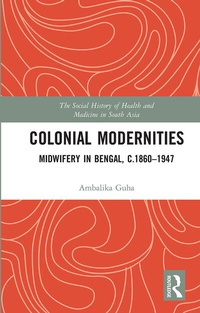
Colonial Modernities
Midwifery in Bengal, c.1860-1947
1st Edition
Published on 18. December 2020
Book
Paperback/Softback
220 pages
978-0-367-73606-4 (ISBN)
Description
The subject of medicalisation of childbirth in colonial India has so far been identified with three major themes: the attempt to reform or 'sanitise' the site of birthing practices, establishing lying-in hospitals and replacing traditional birth attendants with trained midwives and qualified female doctors.
This book, part of the series The Social History of Health and Medicine in South Asia, looks at the interactions between childbirth and midwifery practices and colonial modernities. Taking eastern India as a case study and related research from other areas, with hard empirical data from local government bodies, municipal corporations and district boards, it goes beyond the conventional narrative to show how the late nineteenth-century initiatives to reform birthing practices were essentially a modernist response of the western-educated colonised middle class to the colonial critique of Indian sociocultural codes. It provides a perceptive historical analysis of how institutionalisation of midwifery was shaped by the debates on the women's question, nationalism and colonial public health policies, all intersecting in the interwar years. The study traces the beginning of medicalisation of childbirth, the professionalisation of obstetrics, the agency of male doctors, inclusion of midwifery as an academic subject in medical colleges and consequences of maternal care and infant welfare.
This book will greatly interest scholars and researchers in history, social medicine, public policy, gender studies and South Asian studies.
This book, part of the series The Social History of Health and Medicine in South Asia, looks at the interactions between childbirth and midwifery practices and colonial modernities. Taking eastern India as a case study and related research from other areas, with hard empirical data from local government bodies, municipal corporations and district boards, it goes beyond the conventional narrative to show how the late nineteenth-century initiatives to reform birthing practices were essentially a modernist response of the western-educated colonised middle class to the colonial critique of Indian sociocultural codes. It provides a perceptive historical analysis of how institutionalisation of midwifery was shaped by the debates on the women's question, nationalism and colonial public health policies, all intersecting in the interwar years. The study traces the beginning of medicalisation of childbirth, the professionalisation of obstetrics, the agency of male doctors, inclusion of midwifery as an academic subject in medical colleges and consequences of maternal care and infant welfare.
This book will greatly interest scholars and researchers in history, social medicine, public policy, gender studies and South Asian studies.
More details
Series
Language
English
Place of publication
London
United Kingdom
Publishing group
Taylor & Francis Ltd
Target group
College/higher education
Postgraduate
Dimensions
Height: 216 mm
Width: 138 mm
Weight
453 gr
ISBN-13
978-0-367-73606-4 (9780367736064)
Copyright in bibliographic data and cover images is held by Nielsen Book Services Limited or by the publishers or by their respective licensors: all rights reserved.
Schweitzer Classification
Other editions
Additional editions
E-Book
07/2017
1st Edition
American Book Store
€59.49
Available for download
E-Book
07/2017
1st Edition
American Book Store
€59.49
Available for download
Book
07/2017
1st Edition
Routledge India
€206.00
Shipment within 10-20 days
Person
Ambalika Guha is an independent researcher based in Kolkata, India. She completed her education at Presidency College, University of Calcutta, Kolkata, India, and Victoria University of Wellington, New Zealand. She is also a member of the New Zealand Asia Society.
Content
Preface. Acknowledgements. List of Abbreviations Introduction 1. Scientific Mothers and Healthy Infants: The Birth of a 'Modern-Scientific' Discourse in Bengal, 1860s-1900 2. The Art and Science of Midwifery: Institutionalisation of Midwifery and the Constitution of a Medical Discourse, 1860s-1930s 3. Maternal and Child Welfare: A Nationalist Concern in Late Colonial Bengal, 1900-1940s 4. The 'Care-Givers': Antenatal Care in Bengali Public Discourse and Practice 1860s-1940s 5. Conclusion. Afterword. Glossary. References