

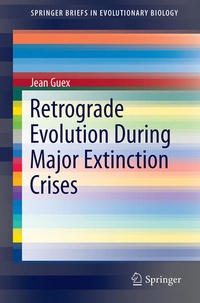
Retrograde Evolution During Major Extinction Crises
Published on 16. February 2016
Book
Paperback/Softback
XV, 77 pages
978-3-319-27916-9 (ISBN)
Description
This book is the first of its kind, providing in-depth analysis of the retrograde evolution occurring during major extinction periods. The text offers a non-strictly adaptative explanation of repetition of phyla after the major extinctions, utilizing a study of seven phylogenetically distinct groups. This opens a new experimental field in evolutionary biology with the possibility of reconstructing ancestral forms in lab by applying artificial stresses.
Reviews / Votes
"This book is about fossils, and, thus, the images of various creatures of the Past dominate the book's pages. The readers will praise the author for his care of them: the informative abstract, the clear conclusion, the lengthy list of references, and the detailed index of fossil names facilitate understanding of GUEX'S ideas and simplify reading of his marvelous book. GUEX'S book is must read to all modern palaeontologists and stratigraphers. Many biologists and geologists will also find it useful" (Dmitry a. ruban, Zentralblatt für Geologie und Paläontologie, iss. 5 - 6, 2016)More details
Series
Edition
1st ed. 2016
Language
English
Place of publication
Cham
Switzerland
Publishing group
Springer International Publishing
Target group
Professional and scholarly
Research
Illustrations
42 s/w Abbildungen, 3 farbige Abbildungen
XV, 77 p. 45 illus., 3 illus. in color.
Dimensions
Height: 235 mm
Width: 155 mm
Thickness: 6 mm
Weight
160 gr
ISBN-13
978-3-319-27916-9 (9783319279169)
DOI
10.1007/978-3-319-27917-6
Schweitzer Classification
Other editions
Additional editions
E-Book
02/2016
1st Edition
Springer
€53.49
Available for download
Person
Jean Guex, Professor Emeritus, University of Lausanne (email: Jean.Guex@unil.ch)
Content
Introduction to retrograde evolutionary changes during major environmental crises.- Evolution of planctonic foraminifera.- Evolution of Radiolarians.- Evolution of ammonoids and Nautiloids.- Evolution of corals.- Evolution of conodonts.- Evolution of silicoflagellates as an example of unique lab experiment.