

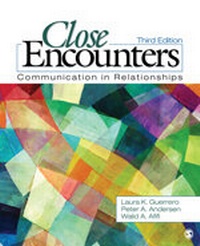
Close Encounters
Communication in Relationships
3rd Edition
Published on 11. January 2011
Book
Paperback/Softback
504 pages
978-1-4129-7737-1 (ISBN)
Description
Close Encounters: Communication in Relationships, Third Edition takes a relational approach to the study of interpersonal communication by focusing on issues that are central to describing and understanding close relationships. Although the primary focus is on communication research, this book emphasizes the interdisciplinary nature of the study of personal relationships by including research from various disciplines such as social psychology and family studies. Organized using a developmental approach, the authors first look at initial interaction and relational escalation, then move on to issues related to maintaining intimate relationships, and finally focus on challenges relational partners face, including relationship endings.
New to the Thrid Edition
- Incorporates the latest research on topics such as date initiation, cohabitation, friends with benefits, affectionate communication, identity in interracial relationships, and the effects of conflict and divorce on children.
- Offers more self-tests so students can better assess themselves and their relationships.
- Provides chapter-opening scenarios that are referred to throughout the chapter to show how communication concepts and theories can be applied to people's lives.
New to the Thrid Edition
- Incorporates the latest research on topics such as date initiation, cohabitation, friends with benefits, affectionate communication, identity in interracial relationships, and the effects of conflict and divorce on children.
- Offers more self-tests so students can better assess themselves and their relationships.
- Provides chapter-opening scenarios that are referred to throughout the chapter to show how communication concepts and theories can be applied to people's lives.
More details
Edition
3rd Revised edition
Language
English
Place of publication
Thousand Oaks
United States
Target group
College/higher education
Edition type
Revised edition
Dimensions
Height: 232 mm
Width: 187 mm
ISBN-13
978-1-4129-7737-1 (9781412977371)
Copyright in bibliographic data and cover images is held by Nielsen Book Services Limited or by the publishers or by their respective licensors: all rights reserved.
Schweitzer Classification
Other editions
New editions

Book
04/2013
4th Edition
SAGE Publications Inc
€133.70
Article exhausted; check for reprint
Previous edition

Book
07/2007
2nd Edition
SAGE Publications Inc
€80.65
Article exhausted; check for reprint
Persons
Laura K. Guerrero (PhD, University of Arizona, 1994) is a professor in the Hugh Downs School of Human Communication at Arizona State University, where she teaches courses in relational communication, nonverbal communication, emotional communication, research methods, and data analysis. She has also taught at the Pennsylvania State University and San Diego State University. Her research focuses on communication in close relationships, such as those between romantic partners, friends, and family members. Her research has examined both the "bright side" of personal relationships, including nonverbal intimacy, forgiveness, relational maintenance, and communication skill, and the "dark side" of personal relationships, including jealousy, hurtful events, conflict, and anger. She recently developed a theoretical framework (hurtful events response theory) to explain patterns of communication following hurtful events in close relationships. Dr. Guerrero has published more than 100 journal articles and chapters related to these topics. In addition to Close Encounters, her book credits include Nonverbal Communication in Close Relationships (coauthored with K. Floyd), Nonverbal Communication (coauthored with J. Burgoon & K. Floyd), The Handbook of Communication and Emotion (coedited with P. Andersen), and The Nonverbal Communication Reader (coedited with M. Hecht). She has received several research awards, including the Early Career Achievement Award from the International Association for Relationship Research, the Dickens Research Award from the Western States Communication Association, and the Outstanding Doctoral Dissertation Award from the Interpersonal Communication Division of The International Communication Association. Dr. Guerrero serves on editorial boards for several top journals in communication and relationships. She lives in Phoenix (during the school year) and San Diego (during the summer) with her husband, Vico, and their daughters, Gabrielle and Kristiana. She enjoys reading, writing fiction (when not writing nonfiction), dancing, and taking long walks in the mountains or on the beach.
Peter Andersen (PhD, Florida State University) is a professor at San Diego State University. The author of five books and more than 150 book chapters, research papers, and journal articles, he has received recognition as one of the 100 most published scholars in the field of communication. Walid A. Afifi (PhD, University of Arizona) is professor in the Department of Communication at the University of California, Santa Barbara, where he teaches interpersonal communication, relational communication, nonverbal communication, and social marketing. His research revolves around people's experience of uncertainty and their decisions to seek or avoid information in relational contexts.
Peter Andersen (PhD, Florida State University) is a professor at San Diego State University. The author of five books and more than 150 book chapters, research papers, and journal articles, he has received recognition as one of the 100 most published scholars in the field of communication. Walid A. Afifi (PhD, University of Arizona) is professor in the Department of Communication at the University of California, Santa Barbara, where he teaches interpersonal communication, relational communication, nonverbal communication, and social marketing. His research revolves around people's experience of uncertainty and their decisions to seek or avoid information in relational contexts.
Content
1. Conceptualizing Relational Communication: Definitions and Principles
The Field of Personal Relationships: A Brief History
Relationships
Principles of Interpersonal Communication
Principles of Relational Communication
Summary and Application
Discussion Questions
2. Communicating Identity: The Social Self
The Development Personal Identity
Principles of Identity Management
Communicating Identity to Others
Summary and Application
Discussion Questions
3. Drawing People Together: Forces of Social Attraction Defining Attraction
A Framework for Understanding Attraction
Personal Variables Related to Attraction
Other People's Qualities
Interpersonal Chemistry Between People
Environmental Features Related to Attraction
Summary and Application
Discussion Questions
4. Making Sense of Our World: Managing Uncertainty
Defining Uncertainty
How do People Manage Uncertainty?
Does Having More Information Always Reduce Uncertainty?
Models of Uncertainty in Relationships
Application and Summary
Discussion Questions
5. Getting Closer: Initiating and Intensifying Relationships
How People Form and Develop New Relationships
Self-Disclosure
Stages of Relationship Development
First Dates and Cohabitation
The Turning Point Approach
Summary and Application
Discussion Questions
6. Communicating Closeness: Affection, Immediacy, and Social Support
Closeness in Relationships
Affectionate Communication
Affectionate Exchange Theory
Immediacy Behaviors
Cognitive Valence Theory
Comfort and Social Support
Sex Differences in the Experience and Expression of Closeness
Summary and Application
Discussion Questions
7. Making a Love Connection Styles of Love and Attachment
What is Love?
Love Styles
Attachment Theory
Summary and Application
Discussion Questions
8. Communicating Sexually: The Closest Physical Encounter
Sexual Attitudes and Behaviors
Communication Patterns
Sexual Coercion and Harassment
Sexual Satisfaction: Misconceptions and Realities
Communication and Safe Sex
Summary and Application
Discussion Questions
9. Staying Close: Maintaining Relationships
Defining Relational Maintenance
Behaviors Used to Maintain Relationships
Maintenance Behavior in Romantic Relationships
Maintenance Behavior in Same-Sex Friendships
Maintenance Behavior in Cross-Sex Friendships
Maintenance Behavior in Friends with Benefits Relationships
Maintenance Behavior in Long-Distance Relationships
The Dialectical Perspective
Summary and Application
Discussion Questions
10. Exchanging Rewards and Costs: Interdependence and Equity in Relationships
Interdependence Theory
The Investment Model
Equity Theory
Summary and Application
Discussion Questions
11. Influencing Each Other: Power Plays and Dominance Moves
Defining Power and Related Terms
Power Principles
Interpersonal Influence Goals
Verbal Power Ploys
Nonverbal Positions of Power
Power and Influence in Families
Summary and Application
Discussion Questions
12. Getting Too Close for Comfort: Privacy and Secrets in Relationships
Communication Privacy Management Theory
Negotiating Privacy Boundaries in Relationships
Obsessive Relational Intrusion
Topic Avoidance and Secret Keeping
Consequences of Topic Avoidance
Summary and Application
Discussion Questions
13. Hurting the Ones We Love: Relational Transgressions
Hurt Feelings in Relationships
Infidelity
Jealousy
Deception
Hurtful Messages
The Aftermath of Hurtful Events
Summary and Application
Discussion Questions
14. Coping with Conflict: When Relational Partners Disagree
Conflict in Relationships
Conflict Styles
Patterns of Conflict Interaction
Explanations for Conflict Patterns
Summary and Application
Discussion Questions
15. Ending Relationships: Disengagement and Termination
Why Relationships End
Communication as a Cause of Relational Breakup
Models of the Disengagement Process
Fifteen Ways to Leave Your Partner
Outcomes: The Results of Relationship Endings
Summary and Application
Discussion Questions
References
The Field of Personal Relationships: A Brief History
Relationships
Principles of Interpersonal Communication
Principles of Relational Communication
Summary and Application
Discussion Questions
2. Communicating Identity: The Social Self
The Development Personal Identity
Principles of Identity Management
Communicating Identity to Others
Summary and Application
Discussion Questions
3. Drawing People Together: Forces of Social Attraction Defining Attraction
A Framework for Understanding Attraction
Personal Variables Related to Attraction
Other People's Qualities
Interpersonal Chemistry Between People
Environmental Features Related to Attraction
Summary and Application
Discussion Questions
4. Making Sense of Our World: Managing Uncertainty
Defining Uncertainty
How do People Manage Uncertainty?
Does Having More Information Always Reduce Uncertainty?
Models of Uncertainty in Relationships
Application and Summary
Discussion Questions
5. Getting Closer: Initiating and Intensifying Relationships
How People Form and Develop New Relationships
Self-Disclosure
Stages of Relationship Development
First Dates and Cohabitation
The Turning Point Approach
Summary and Application
Discussion Questions
6. Communicating Closeness: Affection, Immediacy, and Social Support
Closeness in Relationships
Affectionate Communication
Affectionate Exchange Theory
Immediacy Behaviors
Cognitive Valence Theory
Comfort and Social Support
Sex Differences in the Experience and Expression of Closeness
Summary and Application
Discussion Questions
7. Making a Love Connection Styles of Love and Attachment
What is Love?
Love Styles
Attachment Theory
Summary and Application
Discussion Questions
8. Communicating Sexually: The Closest Physical Encounter
Sexual Attitudes and Behaviors
Communication Patterns
Sexual Coercion and Harassment
Sexual Satisfaction: Misconceptions and Realities
Communication and Safe Sex
Summary and Application
Discussion Questions
9. Staying Close: Maintaining Relationships
Defining Relational Maintenance
Behaviors Used to Maintain Relationships
Maintenance Behavior in Romantic Relationships
Maintenance Behavior in Same-Sex Friendships
Maintenance Behavior in Cross-Sex Friendships
Maintenance Behavior in Friends with Benefits Relationships
Maintenance Behavior in Long-Distance Relationships
The Dialectical Perspective
Summary and Application
Discussion Questions
10. Exchanging Rewards and Costs: Interdependence and Equity in Relationships
Interdependence Theory
The Investment Model
Equity Theory
Summary and Application
Discussion Questions
11. Influencing Each Other: Power Plays and Dominance Moves
Defining Power and Related Terms
Power Principles
Interpersonal Influence Goals
Verbal Power Ploys
Nonverbal Positions of Power
Power and Influence in Families
Summary and Application
Discussion Questions
12. Getting Too Close for Comfort: Privacy and Secrets in Relationships
Communication Privacy Management Theory
Negotiating Privacy Boundaries in Relationships
Obsessive Relational Intrusion
Topic Avoidance and Secret Keeping
Consequences of Topic Avoidance
Summary and Application
Discussion Questions
13. Hurting the Ones We Love: Relational Transgressions
Hurt Feelings in Relationships
Infidelity
Jealousy
Deception
Hurtful Messages
The Aftermath of Hurtful Events
Summary and Application
Discussion Questions
14. Coping with Conflict: When Relational Partners Disagree
Conflict in Relationships
Conflict Styles
Patterns of Conflict Interaction
Explanations for Conflict Patterns
Summary and Application
Discussion Questions
15. Ending Relationships: Disengagement and Termination
Why Relationships End
Communication as a Cause of Relational Breakup
Models of the Disengagement Process
Fifteen Ways to Leave Your Partner
Outcomes: The Results of Relationship Endings
Summary and Application
Discussion Questions
References