

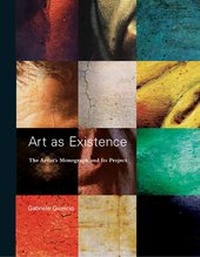
Art as Existence
The Artist's Monograph and Its Project
Published on 26. May 2006
Book
Hardback
392 pages
978-0-262-07268-7 (ISBN)
Description
Is the artist's monograph an endangered species or a timeless genre? This critical history traces the formal and conceptual trajectories of art history's favorite form, from Vasari onward, and reconsiders the validity of the life-and-work model for the twenty-first century.The narrative of the artist's life and work is one of the oldest models in the Western literature of the visual arts. In Art as Existence, Gabriele Guercio investigates the metamorphosis of the artist's monograph, tracing its formal and conceptual trajectories from Vasari's sixteenth-century Lives of the Painters, Sculptors, and Architects (which provided the model and source for the genre) through its apogee in the nineteenth century and decline in the twentieth. He looks at the legacy of the life-and-work model and considers its prospects in an intellectual universe of deconstructionism, psychoanalysis, feminism, and postcolonialism.Since Vasari, the monograph has been notable for its fluidity and variety; it can be scrupulous and exact, probing and revelatory, poetic and imaginative, or any combination of these. In the nineteenth century, the monograph combined art-historical, biographical, and critical methods, and even added elements of fiction. Guercio explores some significant books that illustrate key phases in the model's evolution, including works by Gustav Friedrich Waagen, A. C. Quatremère de Quincy, Johann David Passavant, Bernard Berenson, and others. The hidden project of the artist's monograph, Guercio claims, comes from a utopian impulse; by commuting biography into art and art into biography, the life-and-work model equates art and existence, construing otherwise distinct works of an artist as chapters of a life story. Guercio calls for a contemporary reconsideration of the life-and-work model, arguing that the ultimate legacy of the artist's monograph does not lie in its established modes of writing but in its greater project and in the intimate portrait that we gain of the nature of creativity.
More details
Series
Language
English
Place of publication
Cambridge, Mass.
United States
Publishing group
MIT Press Ltd
Target group
Professional and scholarly
US School Grade: College Graduate Student and over
Product notice
Cloth over boards
Illustrations
52 s/w Abbildungen
52 b&w illus.
Dimensions
Height: 229 mm
Width: 178 mm
Thickness: 22 mm
Weight
953 gr
ISBN-13
978-0-262-07268-7 (9780262072687)
Copyright in bibliographic data and cover images is held by Nielsen Book Services Limited or by the publishers or by their respective licensors: all rights reserved.
Schweitzer Classification
Other editions
Additional editions
Book
10/2009
MIT Press
€7.42
Article exhausted; check different version
Person
Gabriele Guercio is an independent writer living in Milan. He has a doctorate in art history from Yale University and has lectured at the Universities of Rome and Naples. He has been a Fellow at the Center for Advanced Studies in the Visual Arts at the National Gallery and a recepient of a J. P. Getty Postdoctoral Fellowship in the History of Art and the Humanities. Editor of Art after Philosophy and After by Joseph Kosuth (MIT Press, 1991) and De Dominicis, Raccolta di scritti sull'opera e l'artista, he has written on modern and contemporary art as well as the history of art theory.