

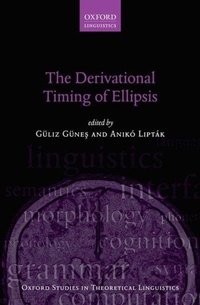
The Derivational Timing of Ellipsis
Published on 31. March 2022
Book
Paperback/Softback
352 pages
978-0-19-884950-6 (ISBN)
Description
This volume explores the nature of ellipsis, the core phenomenon that results in various types of omission in sentences. The chapters adopt the popular 'silent structure' accounts of ellipsis, and investigate the question of when linguistic material becomes silenced during the derivation and realization of syntactic structure.
The book begins with a detailed introduction from the editors that outlines the current generative syntactic approaches to the derivational timing of ellipsis. In the chapters that follow, internationally-recognized experts in the field address key topics including structure building, the architecture of grammar, the interaction of distinct modules with syntax, the order of operations in the post-syntactic component, and constraints on binding relations. The authors also present novel arguments for and against the derivational approaches to ellipsis, the licensing of ellipsis, and phonological constraints on elliptical sentences. The findings, based on data from English and other languages such as Armenian, Italo-Romance, Ossetic, Spanish, Taiwanese, and Turkish, facilitate a deeper understanding of the interaction between syntax and the neighbouring modules in the formation of elliptical utterances.
The book begins with a detailed introduction from the editors that outlines the current generative syntactic approaches to the derivational timing of ellipsis. In the chapters that follow, internationally-recognized experts in the field address key topics including structure building, the architecture of grammar, the interaction of distinct modules with syntax, the order of operations in the post-syntactic component, and constraints on binding relations. The authors also present novel arguments for and against the derivational approaches to ellipsis, the licensing of ellipsis, and phonological constraints on elliptical sentences. The findings, based on data from English and other languages such as Armenian, Italo-Romance, Ossetic, Spanish, Taiwanese, and Turkish, facilitate a deeper understanding of the interaction between syntax and the neighbouring modules in the formation of elliptical utterances.
More details
Series
Language
English
Place of publication
Oxford
United Kingdom
Target group
College/higher education
Product notice
Paperback (trade)
Unsewn / adhesive bound
Dimensions
Height: 233 mm
Width: 155 mm
Thickness: 20 mm
Weight
536 gr
ISBN-13
978-0-19-884950-6 (9780198849506)
Copyright in bibliographic data and cover images is held by Nielsen Book Services Limited or by the publishers or by their respective licensors: all rights reserved.
Schweitzer Classification
Other editions
Additional editions
Gueliz Guenes | Aniko Liptak
The Derivational Timing of Ellipsis
Book
03/2022
Oxford University Press
€115.50
Shipment within 15-20 days
Güliz Günes | Anikó Lipták
The Derivational Timing of Ellipsis
E-Book
03/2022
1st Edition
OUP eBook
€29.49
Available for download
Persons
Gueliz Guenes is a University Lecturer in the Department of English Linguistics at the University of Tuebingen. Her main area of research is prosody and its interfaces with syntax, morphology, and discourse structure. She has focused primarily on the prosody of Turkish, and has also investigated the relationship between prosody and ellipsis in English, Dutch, Icelandic, and Hungarian.
Aniko Liptak is an Associate Professor at the Leiden University Centre for Linguistics (LUCL), where she is a member of the Theoretical and Experimental Linguistics research group. Her main field of research is comparative syntax and the syntax of Hungarian, and she has published extensively on elliptical phenomena. She is currently researching issues concerning the syntactic structure of elliptical utterances and the interaction between ellipsis and morphology.
Aniko Liptak is an Associate Professor at the Leiden University Centre for Linguistics (LUCL), where she is a member of the Theoretical and Experimental Linguistics research group. Her main field of research is comparative syntax and the syntax of Hungarian, and she has published extensively on elliptical phenomena. She is currently researching issues concerning the syntactic structure of elliptical utterances and the interaction between ellipsis and morphology.
Content
General preface
Acknowledgements
List of abbreviations
The contributors
1: Gueliz Guene?and Aniko Liptaks: The derivational timing of ellipsis: An overview of analytical approaches
2: David Erschler: Extra-deletion processes: Implications for the timing of ellipsis
3: James Griffiths and Marcel den Dikken: English VP ellipsis in Unusual Subject configurations: Reviving the Spec-Head Agreement approach
4: Andrew Murphy and Gereon Mueller: Derivational ellipsis and Vehicle Change
5: Andres Saab: Grammatical silences from syntax to morphology: A model for the timing of ellipsis
6: Craig Sailor: The morphophonology of ellipsis: Evidence for Segregated Transfer
7: Andrew Weir: Fragments and left-edge ellipsis: The division of labour between syntax, semantics, and prosody
References
Index
Acknowledgements
List of abbreviations
The contributors
1: Gueliz Guene?and Aniko Liptaks: The derivational timing of ellipsis: An overview of analytical approaches
2: David Erschler: Extra-deletion processes: Implications for the timing of ellipsis
3: James Griffiths and Marcel den Dikken: English VP ellipsis in Unusual Subject configurations: Reviving the Spec-Head Agreement approach
4: Andrew Murphy and Gereon Mueller: Derivational ellipsis and Vehicle Change
5: Andres Saab: Grammatical silences from syntax to morphology: A model for the timing of ellipsis
6: Craig Sailor: The morphophonology of ellipsis: Evidence for Segregated Transfer
7: Andrew Weir: Fragments and left-edge ellipsis: The division of labour between syntax, semantics, and prosody
References
Index