

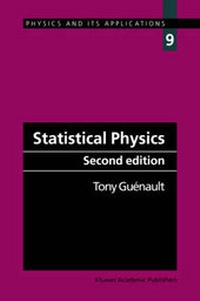
Statistical Physics
Description
In this revised and enlarged second edition, Tony Guénault provides a clear and refreshingly readable introduction to statistical physics. The treatment itself is self-contained and concentrates on an understanding of the physical ideas, without requiring a high level of mathematical sophistication. The book adopts a straightforward quantum approach to statistical averaging from the outset. The initial part of the book is geared towards explaining the equilibrium properties of a simple isolated assembly of particles. The treatment of gases gives full coverage to Maxwell-Boltzmann, Fermi-Dirac and Bose-Einstein statistics.
Reviews / Votes
From the reviews of the second edition:
"This is an introductory level textbook on the basics of statistical physics. . it is an easy-to-read textbook, suited for bachelor students who want to learn the basics of statistical physics by themselves." (Jacques Tempere, Physicalia Magazine, Vol. 30 (4), 2008)
More details
Other editions
Additional editions
Person
Tony Guénault is Emeritus Professor of Low Temperature Physics and a former Head of the School of Physics and Materials at Lancaster University, UK
Content
1: Basic Ideas. 1.1. The Macrostate. 1.2. Microstates. 1.3. The Average Postulate. 1.4. Distributions. 1.5. The Statistical method in Outline. 1.6. A Model Example. 1.7. Statistical Entropy and Microstates. 1.8 Summary.
2: Distinguishable Particles. 2.1. The Thermal Equilibrium Distribution. 2.2. What are a and ß? 2.3. A Statistical Definition of Temperature. 2.4. The Boltzman Distribution and the Partition Function. 2.5. Calculation of Thermodynamic Functions. 2.6. Summary.
3: Two Examples. 3.1. A spin-½ Solid. 3.2. Localized harmonic Oscillators. 3.3. Summary.
4: Gases: The Density of States. 4.1. Fitting waves into boxes. 4.2. Other Information for Statistical Physics. 4.3. An Example - Helium Gas. 4.4. Summary
5: Gases: The Distributions. 5.1. Distribution in groups. 5.2. Identical Particles - Fermions and Bosons. 5.3. Counting Microstates for Gases. 5.4. The Three Distributions. 5.5. Summary.
6: Maxwell-Boltzmann Gases. 6.1. The validity of the Maxwell-Boltzmann Limit. 6.2. The Maxwell-Boltzmann Distribution of Speeds. 6.3. The Connection to Thermodynamics. 6.4. Summary.
7: Diatomic Gases. 7.1. Energy Contributions in Diatomic Gases. 7.2. Heat Capacity of a Diatomic Gas. 7.3. The Heat Capacity of Hydrogen. 7.4. Summary.
8: Fermi-Dirac Gases. 8.1. Properties of an Ideal Fermi-Dirac Gas. 8.2. Application to Metals. 8.3. Application to Helium-3. 8.4. Summary.
9: Bose-Einstein Gases. 9.1. Properties of an Ideal Bose-Einstein Gas. 9.2. Application to Helium-4. 9.3. Phoney Bosons. 9.4. A Note about Cold Atoms. 9.5. Summary.
10: Entropy in Other Situations. 10.1. Entropy and Disorder. 10.2. An Assembly at Fixed Temperature. 10.3. Vacancies in Solids.
11: Phase Transitions. 11.1. Types of Phase Transition. 11.2. Ferromagnetism of a spin-½ Solid. 11.3. Real Ferromagnetic Materials. 11.4. Order-Disorder Transformations in Alloys.
12: Two New Ideas. 12.1. Statistics or Dynamics. 12.2. Ensembles - a LargerView.
13: Chemical Thermodynamics. 13.1. Chemical Potential Revisited. 13.2. The Grand Canonical Ensemble. 13.3. Ideal Gases in the Grand Ensemble. 13.4. Mixed Systems and Chemical Reactions.
14: Dealing with Interactions. 14.1. Electrons in Metals. 14.2. Liquid Helium-3: a Fermi Liquid. 14.3. Liquid Helium-4: a Bose Liquid? 14.4. Real Imperfect Gases.
15: Statistics under Extreme Conditions. 15.1. Superfluid States in Fermi-Dirac Systems. 15.2. Statistics in Astrophysical Systems.
Appendix A - Some Elementary Counting Problems
Appendix B - Some Problems with Large Numbers
Appendix C - Some Useful Integrals
Appendix D - Some Useful Constants
Appendix E - Exercises
Appendix F - Answers to Exercises
Index