

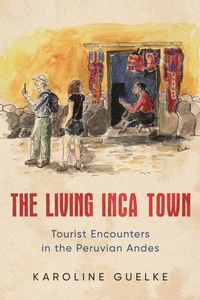
The Living Inca Town
Tourist Encounters in the Peruvian Andes
Published on 9. April 2021
Book
Hardback
204 pages
978-1-4875-0810-4 (ISBN)
Description
The Living Inca Town presents a rich case study of tourism in Ollantaytambo, a rapidly developing destination in the southern Peruvian Andes and the starting point for many popular treks to Machu Picchu. Tourism is generally welcomed in Ollantaytambo, as it provides a steady stream of work for local businesses, particularly those run by women. However, the obvious material inequalities between locals and tourists affect many interactions and have contributed to conflict and aggression throughout the tourist zones. Based on a number of research visits over the course of fifteen years, The Living Inca Town examines the experiences and interactions of locals, visitors, and tourism brokers. The book makes room for unique perspectives and uses innovative visual methods, including photovoice images and pen and ink drawings, to represent different viewpoints of day-to-day tourist encounters. The Living Inca Town vividly illustrates how tourism can perpetuate gendered and global inequalities, while also exploring new avenues to challenge and renegotiate these roles.
More details
Series
Language
English
Place of publication
Toronto
Canada
Target group
College/higher education
Professional and scholarly
Product notice
sewn/stitched
Cloth over boards
Illustrations
31 colour illustrations
Dimensions
Height: 231 mm
Width: 152 mm
Thickness: 18 mm
Weight
440 gr
ISBN-13
978-1-4875-0810-4 (9781487508104)
Copyright in bibliographic data and cover images is held by Nielsen Book Services Limited or by the publishers or by their respective licensors: all rights reserved.
Schweitzer Classification
Person
Karoline Guelke is an assistant teaching professor in the Department of Anthropology at the University of Victoria.
Content
List of Illustrations and Tables
Acknowledgments
1. Introduction
2. Tourist Encounters and Perceptions
3. Negotiating Gender and Ethnicity
4. Negotiating Material Inequalities
5. Conflict, Resistance, and Witchcraft
6. Marketing Spirituality and Romance
7. Conclusion
References
Index
Acknowledgments
1. Introduction
2. Tourist Encounters and Perceptions
3. Negotiating Gender and Ethnicity
4. Negotiating Material Inequalities
5. Conflict, Resistance, and Witchcraft
6. Marketing Spirituality and Romance
7. Conclusion
References
Index